
12 Real Estate Video Ideas That Help Listings Get Noticed
Real estate videos are no longer a nice extra for listings. They are often the fastest way to translate square footage, layout, light, finishes, and neighborhood context into something a buyer can feel before booking a showing.
That matters because the first impression usually happens online. The National Association of Realtors has consistently shown that digital search is central to the home buying journey, which means your listing has to compete in feeds, portals, inboxes, and search results long before someone steps through the door.
The strongest real estate videos do not simply pan across rooms. They answer a specific buyer question: What makes this property worth a closer look? The ideas below are designed to help agents and agencies turn a listing into multiple video assets, each with a clear purpose.
| Marketing goal | Best video idea | Where it works well |
|---|---|---|
| Stop the scroll quickly | Hero listing reel | Instagram Reels, TikTok, YouTube Shorts, Facebook |
| Explain the layout | Guided walkthrough | Listing pages, email follow-ups, YouTube |
| Sell the area | Neighborhood mini-tour | Social media, relocation campaigns, buyer emails |
| Make an empty home feel livable | Virtual staging reveal | Social feeds, listing updates, open house promotion |
| Build trust | Agent or avatar presentation | Social media, agency website, paid ads |
| Reach more buyers | Multilingual listing video | International campaigns, relocation buyers, diverse local markets |
1. The hero listing reel
A hero reel is the main social video for a property. It should feel like the trailer for the listing, not a complete documentary. The goal is to make someone pause, understand the home’s best angle, and want the full listing.
Start with the single most compelling visual. That might be a sunlit kitchen, a dramatic view, a landscaped backyard, a restored historic detail, or a wide exterior shot that establishes curb appeal. Avoid opening with the front door unless the entry is genuinely memorable.
A strong hero reel usually follows this structure: visual hook, three to five standout features, emotional payoff, and clear next step. For example: main living area, kitchen, primary suite, outdoor space, neighborhood note, then a final frame with the address area and contact prompt.
Keep the pacing tight. For social media, 20 to 35 seconds is often enough. If the property has a larger story, create a longer version for YouTube, your website, or buyer follow-up emails.
2. The guided room-by-room walkthrough
A walkthrough video helps buyers understand flow. Photos can make individual rooms look great, but they often fail to show how the entry connects to the living room, where the bedrooms sit, or whether the kitchen opens to the outdoor area.
The best walkthroughs feel calm and intentional. Move in the same direction a buyer would naturally tour the home. Begin outside, enter through the main door, show the primary living spaces, then move toward bedrooms, bathrooms, storage, and outdoor areas.
Use labels sparingly. A simple text overlay such as Primary Bedroom, Lower Level, or South-Facing Patio can reduce confusion without cluttering the video. If you use narration, focus on orientation rather than repeating obvious visuals. Instead of saying, This is the kitchen, say, The kitchen opens directly to the dining area, which makes the main floor feel connected.
3. The five-second hook variation
Most listings have one main video, but the opening is what determines whether people keep watching. A smart tactic is to create several short hook variations using the same core footage.
Try opening the same listing with different angles: the view, the price-positioning, the neighborhood, the renovation, the outdoor space, or the unusual feature. Each version can appeal to a different buyer motivation.
Examples of hook lines include:
- A downtown condo with a private terrace rarely feels this quiet.
- The best part of this kitchen is not the island, it is what it opens to.
- If outdoor space is on your list, start here.
- This home looks compact from the street, but the layout tells a different story.
This idea is especially useful for paid social or retargeting. You can test which hook earns better watch time and clicks, then use that learning to shape future listing videos.
4. The lifestyle story video
A lifestyle video shows what daily life at the property could feel like. Instead of only documenting rooms, it frames the experience of living there: morning light in the breakfast nook, a quiet reading corner, dinner on the patio, or an easy transition from home office to outdoor space.
The key is to keep the story property-focused. Avoid language that implies the home is only for a certain type of person or household. In the United States, real estate marketing should be mindful of fair housing rules, and HUD’s Fair Housing Act overview is a useful reference for understanding protected categories.
Instead of saying, Perfect for young families, say, The flexible second living area can work as a media room, playroom, guest space, or home office. That keeps the video inclusive while still helping buyers imagine use cases.
Lifestyle videos work particularly well for properties with strong atmosphere: waterfront homes, walkable condos, architect-designed spaces, homes with outdoor entertaining areas, and listings where the value is not obvious from a simple room list.
5. The neighborhood mini-tour
Buyers are not only evaluating a home. They are evaluating the life around it. A neighborhood mini-tour adds context that listing photos cannot provide.
Show nearby streetscapes, parks, restaurants, transit stops, trails, shopping areas, or community landmarks. Keep claims factual and verifiable. If you mention commute times, school zones, HOA amenities, or distance to local attractions, verify them and phrase them carefully.
A good neighborhood video does not need to be long. In 30 to 45 seconds, you can establish whether the listing is quiet, urban, scenic, walkable, commuter-friendly, or close to everyday conveniences. Pair the footage with captions so viewers can understand it even with sound off.
This format is also a strong branding asset for agents. Even when a viewer is not interested in the specific home, the video can position you as someone who knows the market street by street.
6. The virtual staging reveal
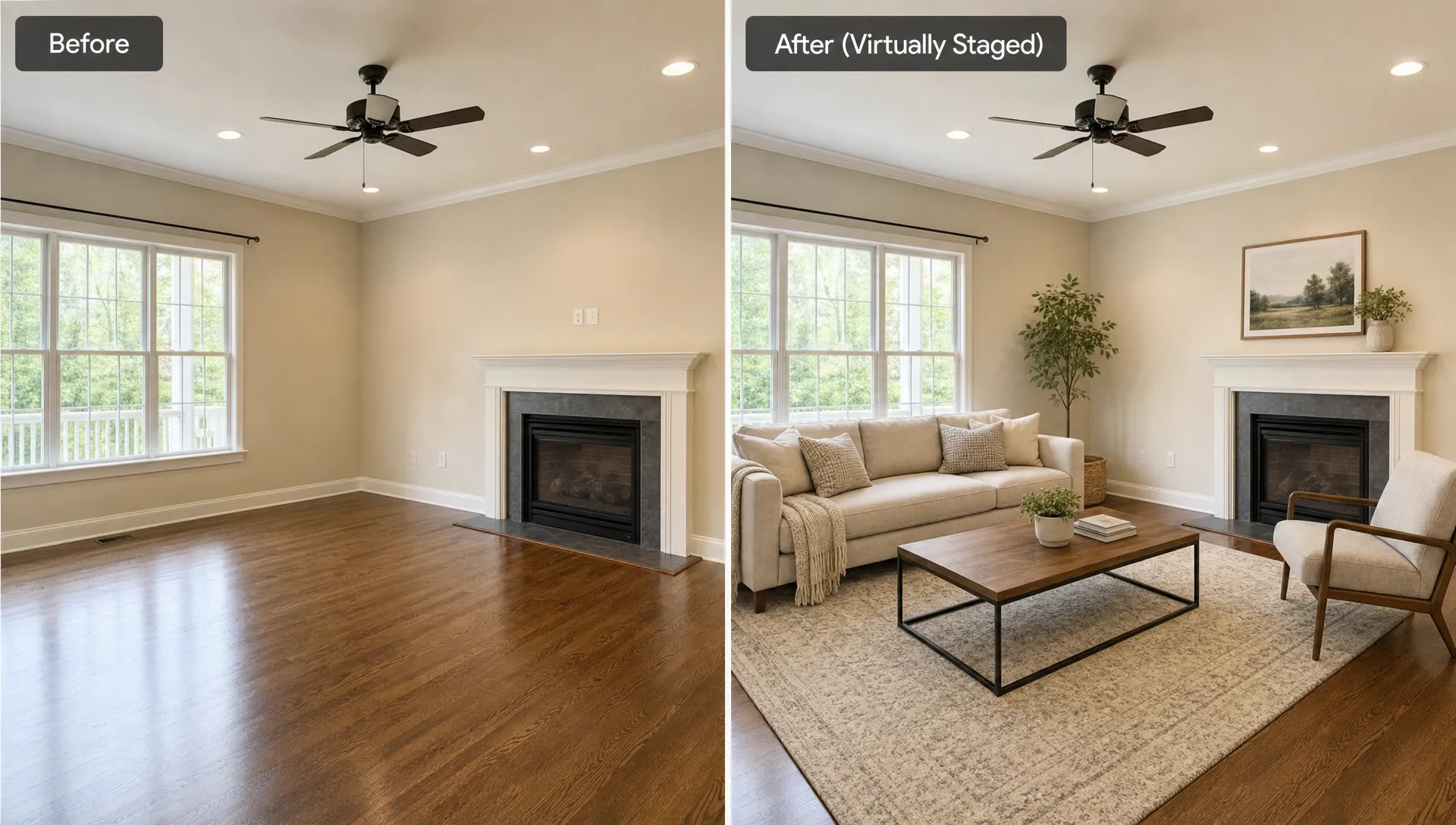
Vacant rooms often underperform online because buyers struggle to understand scale and purpose. A virtual staging reveal can turn an empty room into a more understandable space.
The most effective format is a before-and-after sequence. Start with the empty room, then reveal a staged version that shows a plausible layout. This works well for living rooms, bedrooms, offices, lofts, awkward corners, and bonus rooms.
Be transparent. If an image or video uses virtual staging, disclose it where appropriate and avoid representing staged furniture or finishes as physical features of the home. Virtual staging should clarify potential, not hide defects or mislead buyers.
7. The agent or avatar presentation
Trust still matters in digital marketing. An agent-led video can make a listing feel more personal, especially when the property has a story that benefits from explanation.
This does not have to be a long on-camera tour. A concise introduction can be enough: where the property is, what makes it different, and who should take a closer look based on features and needs rather than demographics.
If you are not comfortable filming yourself for every listing, an AI avatar can help maintain consistency. Platforms such as Diane can create narrated property videos using your voice, your face, or an AI avatar, which helps agents and agencies keep a polished presentation style across multiple listings.
The best agent or avatar videos sound specific. Avoid generic lines like This beautiful home has it all. Instead, explain the strategic value: This corner-unit condo stands out because it combines two exposures, a true dining area, and private outdoor space within three blocks of the station.
8. The narrated listing story
Many listing descriptions already contain the raw material for a compelling video. The problem is that written copy does not always translate to social media. A narrated listing story turns the property description into a short, buyer-friendly script.
The narration should not read like a brochure. It should guide the viewer through the decision points that matter: location, layout, condition, light, storage, outdoor space, parking, updates, and lifestyle flexibility.
A simple script structure works well: Begin with the positioning, highlight the most valuable spaces, add one or two differentiators, then close with a clear next action. For example, Spacious renovated townhome in a quiet pocket of the neighborhood. The main level opens from a bright living area into an updated kitchen with direct access to the patio. Upstairs, the primary suite is separated from two additional bedrooms, creating a practical layout for work, guests, or everyday living.
If you want a deeper look at how listing assets can become polished video content, Diane’s guide to AI for real estate videos explains the broader workflow without requiring agents to start from a blank timeline.
9. The single-feature spotlight clip
A full listing video gives the overview. A feature spotlight gives one reason to care.
This format is ideal for standout details that deserve their own moment: a chef’s kitchen, original hardwood floors, a rooftop deck, a renovated bathroom, a finished basement, mountain views, smart home upgrades, garage storage, or a flexible office nook.
Feature spotlights are useful because they create more content from the same listing. Instead of posting the same full video repeatedly, you can share short clips over several days, each with a different hook. One day highlights the backyard. Another highlights the kitchen. Another focuses on commute access or building amenities.
These clips also work well in buyer follow-up. If someone asks about outdoor space, send the patio spotlight. If they ask about storage, send the garage or closet clip. Video becomes a sales enablement asset, not just a social post.
10. The buyer question video
Every listing raises questions. If you answer them proactively, you reduce friction and make the property easier to evaluate.
Good buyer question videos can address layout, parking, storage, HOA amenities, renovation history, outdoor maintenance, natural light, noise considerations, accessibility features, or what is included in the sale. Keep the answers factual and aligned with the listing documentation.
For example, a 25-second video could answer: How does the lower level work? The video might show the stairs, ceiling height, windows, bathroom access, storage, and possible uses. Another video might answer: What is the outdoor space like? It could show the patio size, privacy, access from the kitchen, and sun exposure at a specific time of day.
This format is especially powerful after the first open house. Collect the questions people ask in person, then turn the most common ones into short videos for the next wave of buyers.
11. The open house invitation and recap
Open house videos are time-sensitive, which makes them naturally attention-grabbing. Before the event, create a short invitation with the property’s strongest visual, date, time, neighborhood, and one reason to attend.
After the event, post a recap. This can be as simple as a few clips from the home, a thank-you message, and a reminder that private showings are available. If the open house generated strong turnout, you can mention interest without exaggerating or creating artificial urgency.
For agencies, this format helps standardize promotion. Every open house can have a pre-event reel, a day-of story, and a post-event recap. Over time, that consistency builds visibility for both the listing and the agent’s local presence.
12. The multilingual listing video
In many markets, buyers speak different languages at home, relocate from abroad, or prefer property information in a language other than English. A multilingual video can make your listing more accessible and more memorable.
Do not treat multilingual video as a simple word-for-word translation. Adapt measurements, phrasing, neighborhood names, and real estate terms so the narration feels natural. Review pronunciation carefully, especially for local streets, schools, buildings, and community names.
Multilingual real estate videos are particularly useful for luxury listings, relocation markets, investment properties, resort areas, and diverse urban neighborhoods. They can also help agencies repurpose the same listing assets for different audiences without recreating the entire campaign from scratch.
How to turn one listing into a full video campaign
The biggest mistake agents make is thinking one listing equals one video. In practice, one listing can support a compact campaign that runs across several channels.
Start with the hero reel as the main asset. Then create a walkthrough for serious buyers, a neighborhood clip for context, two or three feature spotlights for social media, and a buyer question video based on common objections. If the home is vacant, add a staging reveal. If the market is multilingual, create translated versions of the strongest clips.
This is where workflow matters. If your team is managing several active listings, reducing manual setup time is critical. Diane’s Chrome extension can import property details and photos from an existing listing, which helps agents move from published listing assets to video creation faster.
Use this simple production checklist before publishing any listing video:
- Lead with the strongest visual or buyer benefit in the first three seconds.
- Use captions, since many people watch social video with sound off.
- Keep each video focused on one purpose instead of trying to say everything.
- Match the format to the channel, especially vertical video for short-form social platforms.
- Verify factual claims about distances, features, fees, and property details.
- Include a clear next step, such as booking a showing or requesting the full listing.
- Save reusable brand elements so every video feels connected to your agency.
What to measure after you publish
Views are useful, but they are not the whole story. A video that gets fewer views but generates qualified showing requests may be more valuable than a viral clip with no buyer intent.
Track watch time, saves, shares, profile visits, listing clicks, direct messages, email replies, showing requests, and open house attendance. For paid campaigns, compare hook variations and audience segments. For organic content, compare which property features generate the most saves or questions.
Over time, your video analytics can shape your listing strategy. If neighborhood clips consistently drive saves, make them a standard part of your process. If walkthroughs generate the most buyer replies, use them earlier in your follow-up sequence. The goal is not just to make better videos, but to learn what buyers in your market respond to.
Frequently Asked Questions
How long should real estate videos be? For social media, many listing videos work best in the 15 to 45 second range. Walkthroughs, YouTube videos, and buyer follow-up videos can be longer if the content helps viewers understand the property.
Do I need professional video footage for every listing? Not always. Professional videography can be valuable for luxury or complex properties, but many everyday listings can be promoted with high-quality photos, short clips, narration, captions, and AI-assisted editing.
What should every listing video include? Every listing video should include a strong opening visual, the property’s most important benefits, enough context to understand layout or location, and a clear next step for interested buyers.
Can AI create real estate videos from listing photos? Yes, AI tools can help turn listing photos, property details, narration, avatars, and branding into ready-to-publish videos. Agents should still review the final video for accuracy and compliance before publishing.
Should I post the same video on every platform? You can reuse the same core assets, but adjust format, length, caption, and call to action for each channel. A vertical reel may work well on Instagram or TikTok, while a longer walkthrough may fit better on a listing page or YouTube.
Turn these ideas into listing videos faster
Creative video ideas are only useful if your team can execute them consistently. Diane helps agents and agencies turn listings, photos, and property details into ready-to-publish real estate videos with AI narration, avatar presentation, cinematic editing, social formats, multilingual support, custom branding, and direct publishing options.
If you want to create more polished video content without building every reel from scratch, explore Diane’s AI-powered real estate video platform and start turning your next listing into a full video campaign.