
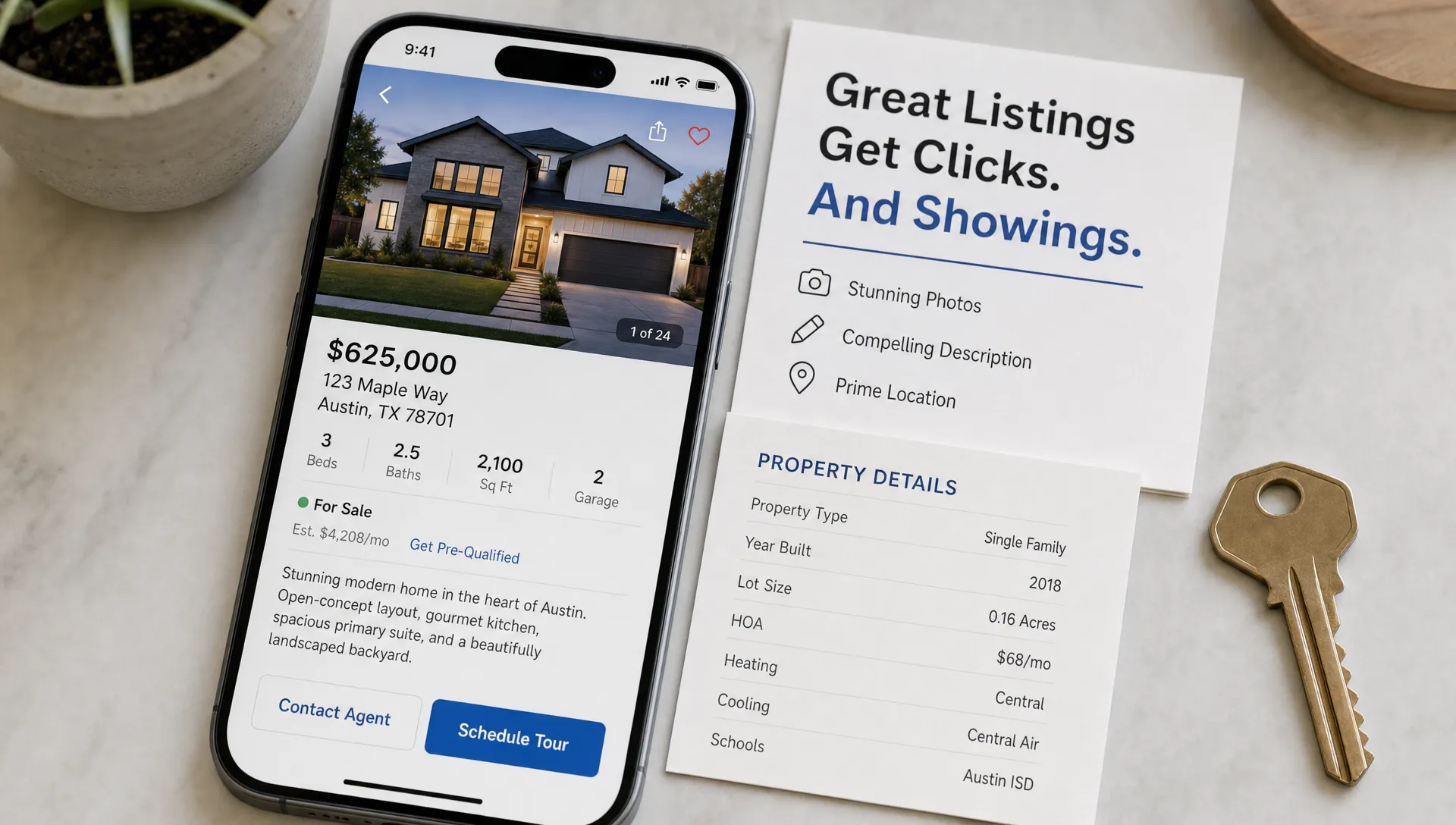
7 Ways to Make Real Estate Listings Stand Out Online
Online buyers make decisions fast. They compare thumbnails, scan opening lines, and move on if a property does not immediately feel relevant. For agents and agency owners, that means real estate listings now need to work as polished digital marketing assets, not just MLS data copied into a portal.
According to the National Association of Realtors Quick Real Estate Statistics, internet search is a central part of the home-buying journey. In 2026, your listing is often discovered first on a phone, in a social feed, in a search result, or in a portal grid surrounded by similar homes. Standing out is not about hype. It is about making the right buyer understand the property faster.
A standout online listing does three things well:
- Shows what is different about the home before the buyer has to dig.
- Reduces uncertainty with clear visuals, details, and next steps.
- Adapts the same property story to portals, social media, email, and your website.
Here are seven practical ways to make your next listing more visible, more memorable, and easier for buyers to act on.
1. Position the property around a specific buyer need
Many listings start with generic phrases like beautiful home, must-see property, or rare opportunity. Those words are common because they are easy to write, but they do not help the buyer quickly understand why this property is worth attention.
Start by identifying the strongest buyer need the home answers. Is it low-maintenance living? A walkable location? Outdoor space? A home office setup? A rental-ready investment? A renovated kitchen in a neighborhood where most inventory needs work?
Once you know the angle, make it visible in the first line, the headline where allowed, and the opening visuals. A buyer should not have to scroll through 30 photos to discover the best reason to care.
| Generic positioning | Stronger positioning |
|---|---|
| Charming 3-bedroom home | Updated 3-bedroom home with fenced yard near commuter routes |
| Luxury condo in great location | Corner condo with skyline views, secure parking, and walkable dining |
| Perfect family home | Flexible 4-bedroom layout with main-level office and large backyard |
| Investor special | Vacant duplex with separate entrances and value-add rental potential |
The goal is not to exclude buyers. It is to create an immediate mental match for the people most likely to inquire. The more specific the promise, the easier it becomes to write better copy, choose better photos, and create stronger social posts.
2. Build a visual story, not just a photo gallery
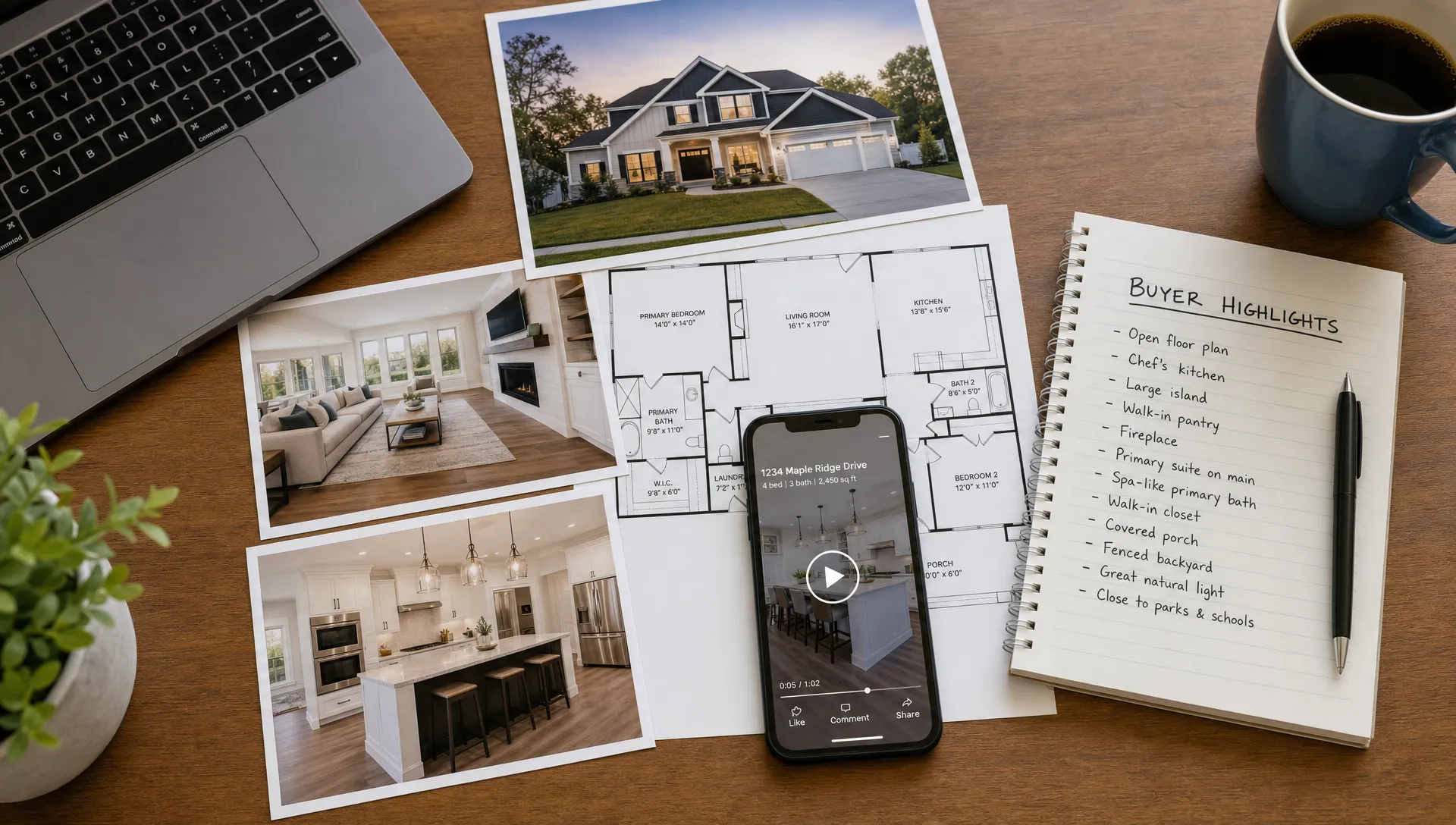
Photos are still the foundation of most online real estate listings, but more photos are not always better. Buyers need a visual sequence that helps them understand the property, not a random upload order that jumps from a bathroom to a garage to a close-up of a light fixture.
Think of your photo gallery as a guided showing. The first image should earn the click, the next few should confirm the value, and the full set should answer practical questions about layout, condition, light, storage, outdoor areas, and neighborhood context.
A strong online photo sequence often follows this order:
- Best exterior, hero interior, or view shot, depending on the property’s strongest asset.
- Main living area, kitchen, and dining flow.
- Primary bedroom and key secondary rooms.
- Outdoor spaces, parking, amenities, and storage.
- Floor plan, location context, or community features.
Professional photography matters, but so does direction. Before the shoot, create a short shot list based on the positioning angle. If the hook is remote-work friendly, capture the office nook, natural light, and quiet separation from living areas. If the hook is entertaining, show the kitchen, dining, patio, and traffic flow together.
For vacant properties, virtual staging can help buyers understand scale and possibility. Just be transparent when images are virtually staged, and avoid creating expectations the physical home cannot support. For occupied homes, prioritize decluttering, consistent lighting, clean lines, and simple styling over heavy editing.
Floor plans also deserve more attention. A buyer can love the photos and still hesitate if they cannot understand how the rooms connect. Adding a simple floor plan can reduce friction, especially for relocation buyers, investors, and anyone comparing several properties remotely.
3. Use video to show flow, light, and atmosphere
A listing photo can show a room. A video can show how the room feels when you move through it. That difference is powerful online, where buyers are trying to evaluate a property before deciding whether to schedule a showing.
Video is especially useful for communicating layout, ceiling height, natural light, transitions between rooms, outdoor access, and neighborhood feel. It also gives agents a more engaging asset for Instagram Reels, TikTok, YouTube Shorts, Facebook, email campaigns, and listing presentations.
The most effective listing videos do not need to be long. For social media, a focused 30 to 60 second reel is often enough to create interest. For serious buyers, a longer walkthrough or narrated tour can answer more practical questions. The key is to structure the video around a story instead of simply panning across each room.
A simple video structure works well for most homes:
- Open with the strongest feature in the first few seconds.
- Introduce the property type, location, and main buyer benefit.
- Move through the layout in a logical order.
- Highlight three to five memorable details.
- End with a clear next step, such as booking a showing or requesting more details.
If you need inspiration beyond the standard walkthrough, these real estate video ideas that help listings get noticed can help you turn one property into multiple pieces of content.
For busy agents, the barrier is usually production time. AI tools can help by turning listing information, photos, and property details into ready-to-publish videos with narration, avatars, cinematic editing, social formats, and branding. That means video no longer has to be reserved for luxury listings or special campaigns.
4. Write copy that is specific, scannable, and compliant
Listing descriptions should make buyers want to know more, but they also need to be factual, clear, and compliant. The best copy connects features to benefits without exaggerating or drifting into vague lifestyle claims.
Start with the most important buyer-facing value in the first sentence. Then use the body of the description to support that value with concrete details. Mention upgrades, layout, natural light, storage, parking, outdoor areas, proximity to amenities, and any relevant property facts that help a buyer decide whether to inquire.
Avoid overused adjectives unless they are backed by specifics. Spacious is stronger when paired with square footage, open sightlines, or room dimensions. Updated is stronger when you name the recent improvements. Convenient location is stronger when you mention actual nearby transportation, schools, employers, parks, or shopping, as long as the information is accurate.
| Weak phrase | Stronger alternative |
|---|---|
| Recently updated | 2024 kitchen updates include quartz counters, cabinet refacing, and stainless appliances |
| Great for entertaining | Open kitchen and dining area connect directly to the covered patio |
| Lots of storage | Two walk-in closets, garage shelving, and a separate laundry room |
| Amazing location | Within blocks of Main Street dining, the public library, and Riverside Park |
Compliance matters too. Avoid language that implies preference for a protected class or makes assumptions about who should live in the home. The HUD Fair Housing Act overview is a useful reference if you want to refresh your team’s understanding of fair housing principles.
For readability, write for skimming. Use short paragraphs, prioritize the first 100 words, and separate critical facts from descriptive copy when the platform allows. Buyers are often comparing properties between appointments, during commutes, or while scrolling in the evening. Clear beats clever.
5. Optimize your listing for search without sounding robotic
Online visibility depends on more than a polished description. Search engines, real estate portals, and social platforms all rely on signals that help them understand what your listing is about. The challenge is to include those signals naturally.
Use the words buyers actually search for, but only when they apply. That might include the property type, neighborhood, city, number of bedrooms, architectural style, outdoor features, views, school district references where appropriate, parking, nearby transit, or special amenities. A listing for a renovated bungalow near downtown should say that clearly. A waterfront condo with deeded parking should not bury those details near the end.
Search-friendly listing content should include:
- A clear title or opening line that includes the property type and location.
- Complete property fields, including beds, baths, square footage, lot size, parking, and HOA details when available.
- Descriptive photo captions where the platform supports them.
- A crawlable listing page on your website, not only image-based flyers or PDFs.
- Consistent address, price, and availability information across channels.
Do not repeat keywords unnaturally. Buyers notice awkward copy, and platforms are increasingly built to reward helpful content. A good rule is simple: if the phrase helps a real person understand the home, include it. If it exists only to manipulate search, remove it.
Your own website can also support listing visibility. A portal listing may get attention quickly, but an agent or agency website gives you more control over branding, calls to action, neighborhood content, lead capture, and retargeting. If you publish listings on your site, make sure pages load quickly, display well on mobile, and include indexable text.
6. Repackage the listing for each online channel
One common mistake is treating the listing description as the whole marketing campaign. The MLS or portal version is only one format. To stand out online, you need to adapt the same property story to each channel where buyers, sellers, and local contacts spend time.
A portal user may be actively comparing homes by price and square footage. An Instagram user may only stop if the first few seconds of a video create curiosity. An email subscriber may respond because the property matches a specific need they mentioned weeks ago. The same listing needs different packaging for each situation.
| Channel | Best role | Strong content angle |
|---|---|---|
| Real estate portals | Capture active buyers | Clear facts, complete fields, strong photo order |
| Instagram Reels and TikTok | Create discovery | Short video hook, lifestyle angle, quick visual payoff |
| Facebook and LinkedIn | Reach local networks | Neighborhood context, open house reminders, shareable highlights |
| Email campaigns | Activate warm leads | Specific buyer match, price point, showing availability |
| Agent or agency website | Build owned visibility | Full listing page, local SEO, lead capture, brand trust |
This is where workflow matters. If creating each asset from scratch takes too long, the listing will usually get posted once and forgotten. Instead, build a repeatable launch kit for every property: portal copy, short reel, story post, square social post, email blurb, open house reminder, and a follow-up post with a different angle.
If the property is already published, importing a real estate listing in one click can reduce the friction of turning existing listing details and photos into new marketing assets. The easier the workflow, the more consistently every property gets promoted beyond the portal.
For listings that may appeal to relocation buyers, investors, or international audiences, multilingual content can also help. Even a short video or caption in another language can make the listing more accessible, as long as the translation is accurate and the core property facts remain consistent.
7. Add trust signals and make the next step obvious
A buyer who is interested but uncertain may not contact you. Your listing should answer enough questions to make the next step feel safe and easy.
Trust signals include accurate property details, transparent disclosures where appropriate, clear showing instructions, professional branding, consistent contact information, and a polished presentation across channels. They also include what you choose not to hide. If there is an HOA, unusual lot shape, renovation history, flood zone consideration, lease restriction, or tenant occupancy detail that buyers need to know, do not bury it until late in the process.
Clarity builds confidence. It also helps reduce low-quality inquiries from buyers who would have ruled out the property if the information had been easier to find.
Your call to action should match the buyer’s stage. A cold social viewer may not be ready to book a showing, but they might save the video, request the full listing, or ask for the floor plan. A portal visitor may be ready to schedule a tour. A warm lead in your CRM may only need a short message explaining why this property matches their criteria.
Instead of ending every post with the same generic contact me, vary the next step:
- Schedule a private showing this week.
- Request the floor plan and full photo gallery.
- Ask for the disclosure package.
- Save this listing if you are looking near this price point.
- Message me for similar homes in this neighborhood.
Speed matters after the click. If you invest in better visuals, copy, and video, make sure your follow-up process is ready. A standout listing can generate attention, but the agent’s response converts that attention into appointments.
Quick audit: is your listing ready to stand out?
Before you publish, run the listing through a simple quality check. This helps keep your marketing consistent even when you are handling multiple properties at once.
| Listing element | Basic version | Standout upgrade |
|---|---|---|
| Positioning | Property facts only | Clear buyer-focused angle |
| Photos | Complete gallery | Strategic sequence that tells a visual story |
| Video | No video or simple slideshow | Narrated short-form video with clear hook and CTA |
| Description | Generic adjectives | Specific benefits supported by facts |
| Search visibility | Minimal fields | Complete data, location terms, and crawlable listing page |
| Distribution | Posted once | Repurposed for portals, social, email, and website |
| Follow-up | Phone number only | Channel-specific CTA and fast response plan |
You do not need every listing to be cinematic, lengthy, or expensive to produce. You do need every listing to be clear, complete, and adapted to how buyers actually browse online.
Frequently Asked Questions
What is the fastest way to make real estate listings stand out online? Improve the first impression. Use a stronger lead photo, a specific opening line, and a clear buyer-focused angle. If the listing looks generic in the portal grid or social feed, buyers may never reach the full description.
Do real estate videos really help listings get noticed? Videos can help buyers understand layout, flow, light, and atmosphere faster than photos alone. They are also easier to repurpose across social media, email, and listing pages. The video still needs strong visuals, accurate information, and a clear call to action.
How long should a real estate listing video be? For social media, 30 to 60 seconds is often enough to create interest. For serious buyers, a longer narrated walkthrough can be useful. The right length depends on the property, the channel, and the buyer’s stage.
What should the first listing photo show? Choose the image most likely to make the right buyer stop. That may be the exterior, kitchen, living area, view, outdoor space, or a unique feature. The best first photo is not always the front of the house.
Can AI help create better listing marketing? Yes. AI can help turn listing details, photos, and descriptions into videos, captions, translations, and social formats faster. Agents should still review every asset for accuracy, compliance, tone, and local market context.
Make your next listing easier to notice
Standing out online is no longer just about uploading a property and waiting for inquiries. The agents who win attention are the ones who turn each listing into a complete marketing package with strong visuals, clear copy, video, search visibility, and channel-specific promotion.
Diane helps real estate agents and agencies turn property listings into ready-to-publish videos using listing details, photos, AI narration, avatars, voice cloning, multilingual support, cinematic editing, branding, and social formats. If you want polished listing videos without slowing down your launch workflow, Diane can help you market each property faster and more consistently.