
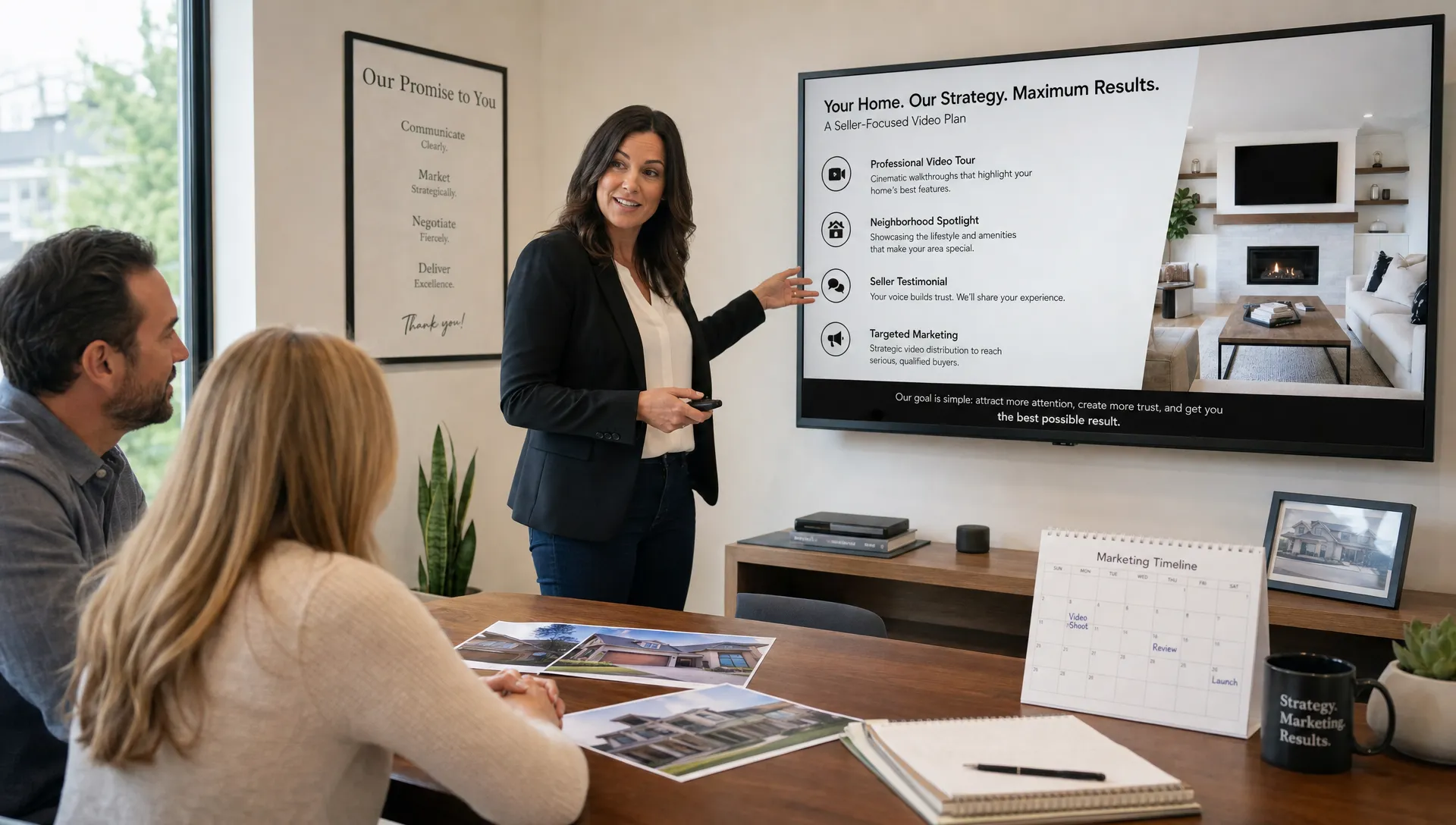
A Listing Agent's Video Plan for Winning More Seller Leads
Seller leads rarely choose a listing agent because of one postcard, one market report, or one impressive sales claim. They choose the agent who makes the next step feel safer. For most homeowners, that means seeing clear proof that you can position their property well, attract attention, explain value, and create confidence before a buyer ever walks through the door.
That is where video changes the conversation.
A strong listing agent video plan is not just about making prettier listing reels. It is a repeatable system for turning your everyday marketing activity into seller trust. Each video should answer a quiet question in the homeowner's mind: Will this agent make my property stand out, communicate professionally, and protect the value of my sale?
The goal is not to become a full-time content creator. The goal is to build a practical video workflow that helps you win more seller leads without adding hours to every listing launch.
Why sellers respond to video before they contact you
Most seller lead strategies focus on visibility: rank locally, run ads, send emails, post on social media, call past clients. Visibility matters, but sellers also need evidence. They want to know how you will represent their biggest asset.
Video gives them that evidence faster than text alone. A homeowner can watch a 45-second listing reel and instantly judge your eye for presentation, your tone, your confidence, and your ability to make a home feel desirable. That emotional judgment often happens before they compare commission structures or read a full bio.
For a listing agent, this creates an opportunity. Every property video can do two jobs at once. It can attract buyers for the current listing, and it can signal to future sellers that you know how to market homes in a modern way.
The best seller-focused video plans are built around four types of trust:
- Marketing trust: Sellers see that you can make a property look polished, clear, and worth attention.
- Local trust: Sellers believe you understand the area, buyer behavior, and neighborhood context.
- Process trust: Sellers understand what happens after they sign the listing agreement.
- Personal trust: Sellers feel comfortable hearing your voice, seeing your face, or experiencing your communication style.
When your content covers all four, you stop posting random videos and start building a seller lead engine.
The seller lead video funnel
A homeowner may not be ready to book a valuation the first time they see your video. Your plan should meet them at different levels of intent, from casual awareness to active listing conversations.
| Funnel stage | Seller's question | Best video type | Primary goal |
|---|---|---|---|
| Awareness | Who is active and visible in my local market? | Neighborhood updates, property highlights, short market observations | Become familiar before the seller needs you |
| Consideration | Would this agent market my home well? | Listing reels, launch process videos, before-and-after presentation examples | Prove your marketing quality |
| Intent | What would my home be worth and how would it sell? | Valuation explainers, comparable sale breakdowns, seller preparation tips | Start a direct conversation |
| Appointment | Why should I list with this agent? | Personalized pre-appointment videos, proof reels, listing strategy previews | Increase appointment conversion |
| Nurture | Is now the right time to sell? | Monthly homeowner updates, timing advice, local demand recaps | Stay top of mind until they are ready |
This funnel matters because seller leads are often long-cycle leads. Some homeowners will contact you this week. Others may watch quietly for six months. A consistent video presence gives both groups reasons to remember you.
Build a local proof library, not just a content calendar
A content calendar tells you what to post. A proof library gives you assets that strengthen every seller conversation.
Think of your video library as a collection of trust-building clips you can reuse across Instagram, Facebook, LinkedIn, email, your website, and listing presentations. Some videos should be attached to active listings, while others should demonstrate your local expertise even when you do not have a new property to promote.
Useful local proof videos include short clips about buyer demand in specific neighborhoods, quick explanations of why certain homes sell faster, local amenities that influence value, and seasonal selling advice. You can also create seller education videos such as how to prepare for photography, which repairs matter before listing, and what happens during the first week on market.
The key is specificity. A generic video called "3 tips to sell your home" is easy to ignore. A video called "Why renovated family homes near the park are getting stronger buyer interest this month" feels much more relevant to a real homeowner in your market.
Do not worry if each video feels narrow. Narrow content often works better for seller leads because it makes the right person feel recognized.
Make every listing video work twice
Most agents treat a listing video as a buyer-facing asset. It goes on social media, gets added to a listing page, and disappears once the property sells. A stronger strategy is to create two versions of each listing video.
The buyer version should focus on the property experience: layout, light, finishes, outdoor space, location, and lifestyle. The seller version should subtly highlight your marketing process: professional presentation, storytelling, distribution, and the way you frame value.
For example, a buyer-facing caption might say, "A bright three-bedroom home with a renovated kitchen and south-facing garden." A seller-facing caption might say, "When launching a family home like this, the goal is to show flow, natural light, and outdoor living in the first few seconds so buyers immediately understand the lifestyle."
The video itself can be similar, but the framing changes the audience. Sellers are not just admiring the home. They are imagining their own property receiving the same level of care.
If the raw material already exists in a published listing, tools like Diane's one-click listing import can help reduce the friction of turning property details and photos into video assets. That matters because consistency is easier when the workflow starts from information you already have.
Use a weekly publishing rhythm sellers can recognize
You do not need to post daily to win seller leads. You need to be predictable enough that homeowners repeatedly see evidence of your activity.
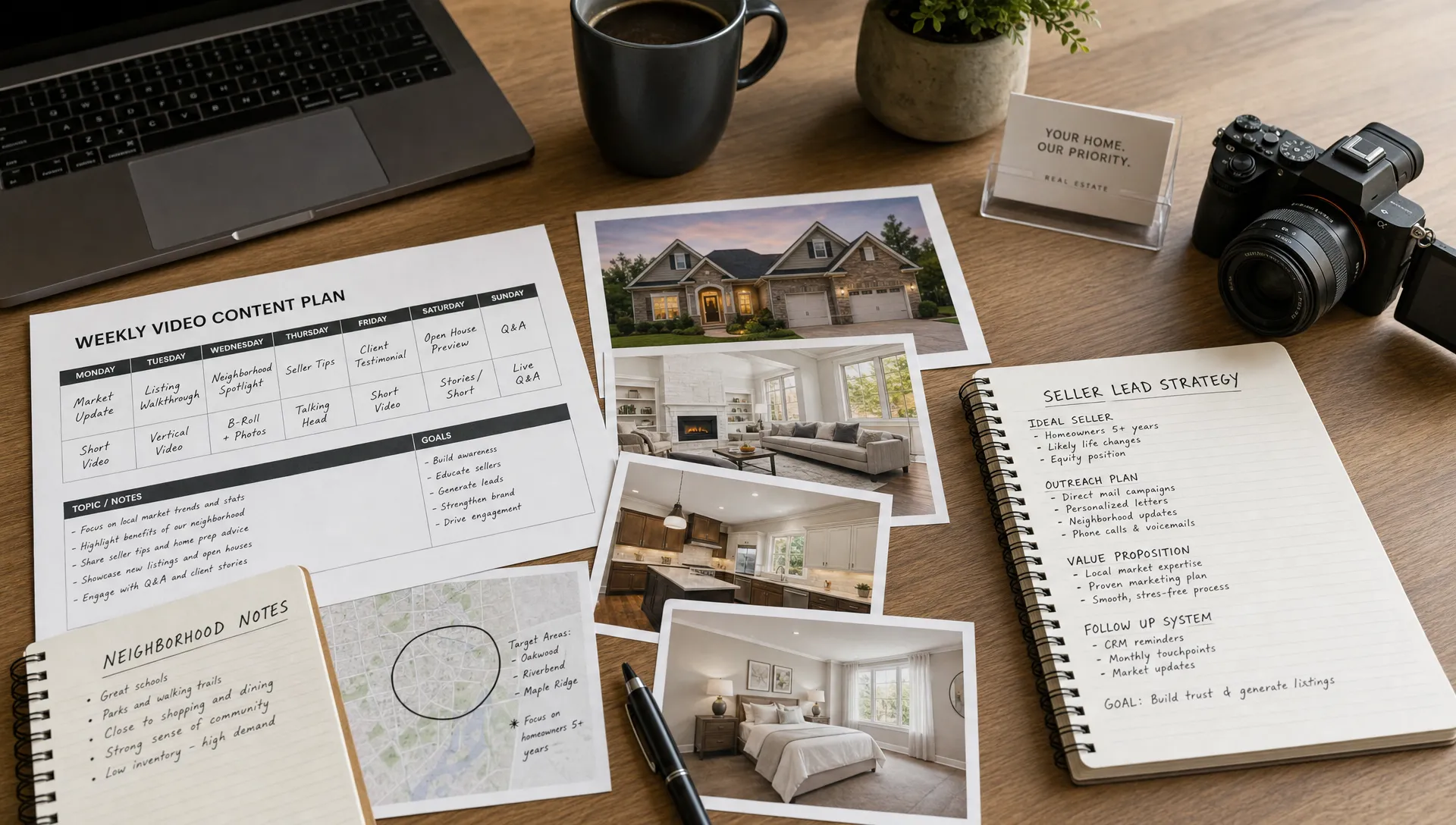
A simple weekly rhythm can work well for a solo listing agent or a small agency team:
| Day | Video focus | Seller lead purpose |
|---|---|---|
| Monday | Local market or neighborhood insight | Show expertise and create relevance |
| Wednesday | Listing, sold, or property presentation clip | Demonstrate marketing quality |
| Friday | Seller education or preparation tip | Reduce uncertainty and invite questions |
| Monthly | Proof reel or client journey recap | Summarize your process and results without overposting |
This structure keeps your content balanced. You are not only saying "look at this listing." You are showing that you understand the market, know how to present property, and can guide sellers through decisions.
Consistency also helps with production. Once you know the weekly categories, you can batch ideas, record short voiceovers, and repurpose listing media instead of starting from a blank page each time. If you need more concepts to fill the calendar, this list of real estate video ideas that help listings get noticed can be adapted for both buyer and seller audiences.
Turn views into seller conversations
Video attention is valuable, but it does not automatically become a lead. You need clear conversion paths.
Every seller-focused video should lead to one logical next step. That does not always mean "book a valuation now." For lower-intent videos, a softer call to action often performs better. Invite homeowners to ask for a neighborhood update, request a preparation checklist, or send a message if they are curious about local buyer demand.
Stronger calls to action can be saved for higher-intent content, such as sold recaps, pricing explainers, or seller preparation videos. In those cases, you can invite the viewer to request a home value conversation or a custom launch plan.
The most effective conversion paths are specific:
- "Want to know how buyers would compare your home to this one? Send me your street name."
- "If you are thinking about selling this spring, I can send you a short preparation checklist."
- "I am putting together a local pricing update for homeowners in this area. Message me if you want a copy."
- "If you want to see how I would present your property on video, I can record a quick sample strategy."
These prompts feel more natural than a generic "contact me today" because they connect directly to the content the seller just watched.
If your agency wants a more formal testing mindset, it can help to study how growth teams structure experiments around audience, message, channel, and conversion. A resource like User Story's growth marketing and innovation work is a useful reminder that lead generation improves when you treat each campaign as a testable system rather than a one-off post.
Bring video into the listing appointment
A seller lead video plan should not stop when someone books an appointment. In fact, video can make the appointment easier before you arrive.
Send a short pre-appointment video that introduces your approach and previews what you will cover. Keep it simple: thank the homeowner, mention that you will review positioning, preparation, pricing context, and launch strategy, then explain that your goal is to help them make a confident decision.
This small touch does three things. It reduces uncertainty, makes you feel more familiar, and positions you as organized before the meeting begins.
During the listing presentation, use a proof reel. This can be a short compilation of recent listing videos, neighborhood clips, social formats, and examples of how you turn property features into buyer-facing stories. The proof reel should not be a bragging montage. It should answer the seller's practical question: What will my home look like when you market it?
After the appointment, send a recap video. A 60-second summary can reinforce the recommended next steps, remind the seller of your strategy, and create a more personal follow-up than a plain email.
What to say in seller-focused videos
Many agents delay video because they do not know what to say. The easiest fix is to use repeatable angles instead of writing from scratch.
The property positioning angle
Use this when you want sellers to see your marketing judgment. Talk about why a feature matters, not only what the feature is.
Example: "The strongest part of this home is not just the renovated kitchen. It is the way the kitchen connects to the garden, which is exactly the kind of everyday living space many buyers in this area are looking for."
The seller education angle
Use this to attract homeowners who are thinking ahead. Give practical advice without pressuring them.
Example: "Before you spend money preparing a home for sale, look at three things first: light, first impressions, and obvious maintenance concerns. Those are often the details buyers notice before they study the floor plan."
The launch process angle
Use this to show professionalism. Explain what happens behind the scenes.
Example: "When we launch a listing, the first few seconds of video matter. Buyers are scrolling quickly, so we lead with the strongest visual hook, then give enough context to make them want the full viewing."
These angles help you speak with purpose. You are not performing for the camera. You are demonstrating the thinking a seller would hire you for.
Metrics a listing agent should track
Views are useful, but they are not the whole story. A seller lead video plan should be measured by whether it creates conversations, appointments, and listing opportunities.
Track a small set of metrics that connect content to pipeline:
| Metric | Why it matters | What to look for |
|---|---|---|
| Saves and shares | Indicates usefulness and relevance | Education videos that homeowners keep or send to a partner |
| Direct messages | Shows movement from passive viewing to conversation | Questions about timing, pricing, or preparation |
| Profile visits | Suggests viewers want to evaluate you further | Spikes after listing reels or market updates |
| Valuation requests | Connects content to seller intent | Requests after sold recaps or pricing explainers |
| Listing appointments | Measures business impact | Appointments influenced by video touchpoints |
| Source notes in CRM | Helps you identify which content drives leads | Tags such as Instagram reel, email video, market update, referral video |
Keep the tracking lightweight. You do not need a complex dashboard to learn what works. Add a simple note in your CRM or spreadsheet whenever a seller mentions a video, replies to a clip, or books after watching your content.
Over time, patterns will appear. You may find that neighborhood updates create awareness, but sold recaps produce more valuation conversations. Or you may discover that short preparation tips perform best in email to past clients. The point is to improve the plan based on behavior, not guesswork.
Avoid the mistakes that weaken seller trust
Video can build trust quickly, but it can also dilute your positioning if it feels rushed or unfocused.
The most common mistake is making every video about the agent. Sellers do need to know who you are, but they care more about what you will do for them. Keep the spotlight on property strategy, buyer behavior, and the seller's decision-making process.
Another mistake is posting beautiful listing videos with no seller context. A cinematic home tour may impress buyers, but future sellers need to understand the strategy behind it. Add captions or voiceover that explain why certain features are being highlighted.
A third mistake is inconsistency. If you post three strong videos in one week and then disappear for two months, sellers may not see you as active. A realistic weekly rhythm is better than an ambitious plan you cannot maintain.
Finally, avoid unsupported claims. Be careful with statements about guaranteed outcomes, buyer numbers, or sale prices. Your content should inspire confidence without overpromising.
How AI makes the plan easier to sustain
The hard part of real estate video is rarely the idea. It is the production workload: selecting photos, writing scripts, recording narration, editing for social formats, and adapting videos for different channels.
AI can remove much of that friction. Diane is built for agents and agencies that want to turn property listings, photos, and details into ready-to-publish marketing reels in minutes. It supports AI narration, animated avatars, cinematic editing, social media formats, custom real estate branding, multilingual video support, virtual home staging, and direct social publishing.
For a listing agent, the practical advantage is consistency. If every new listing can become a set of polished videos quickly, you have more than a buyer marketing asset. You have ongoing proof for future seller leads.
This is especially useful for solo agents and small agencies. You may not have an in-house video editor, a social media manager, or time to record every script manually. A repeatable AI-assisted workflow helps you show up with professional video even when your schedule is full.
Frequently Asked Questions
How often should a listing agent post videos to attract seller leads? A realistic starting point is two to three videos per week. Focus on one local insight, one listing or property presentation clip, and one seller education video. Consistency matters more than posting every day.
Should listing videos be aimed at buyers or sellers? They should serve both. Create buyer-facing versions that highlight the property experience, then reframe the same asset for sellers by explaining the marketing strategy behind the presentation.
Do I need to appear on camera to win seller leads with video? Not always. Seeing your face can build trust, but voiceover, AI narration, branded listing reels, and avatar-led videos can also work. The most important thing is clarity, professionalism, and consistency.
What is the best call to action for seller-focused real estate videos? Match the call to action to the viewer's intent. For early-stage sellers, offer a checklist or neighborhood update. For high-intent videos, invite them to request a valuation or a custom property launch plan.
Can AI-generated videos still feel personal? Yes, if the message is specific to the property, neighborhood, and seller concern. AI should speed up production, but the strategy should still reflect your local knowledge and professional judgment.
Put your seller lead video plan into action
Winning seller leads is not about making one perfect video. It is about showing, week after week, that you know how to position property, communicate value, and guide homeowners through a high-stakes decision.
Start with a simple rhythm. Turn each listing into buyer and seller-focused assets. Add local proof videos. Track which clips create conversations. Use video before, during, and after the listing appointment.
If you want to make that workflow easier, Diane helps real estate agents create polished listing videos from property details, photos, narration, avatars, and branded formats, so your marketing plan can stay consistent even when your week is busy.