

Fair Housing Rules for Real Estate Videos and AI Narration
A real estate video can violate fair housing rules without saying anything openly hostile. A narrator describing the “ideal resident,” an AI-generated scene suggesting who belongs in the neighborhood or a paid campaign excluding certain audiences can all create risk. Reviewing the listing description alone is not enough.
For agents and agency owners, the practical approach is to review the entire advertisement: spoken words, captions, imagery, translations and distribution settings. AI can help produce those elements, but it does not replace your brokerage’s compliance review.
This guide focuses on U.S. federal fair housing requirements and practical publishing safeguards. State and local protections, MLS rules and platform policies may add obligations. It is general information, not legal advice for a particular advertisement or transaction.
Fair housing rules for real estate video advertising
The Fair Housing Act prohibits housing advertisements that indicate a preference, limitation or discrimination based on race, color, religion, sex, disability, familial status or national origin. Familial status generally includes households with children under 18, pregnant people and people securing custody of children.
The relevant language appears in 42 U.S.C. § 3604(c). It covers notices, statements and advertisements concerning the sale or rental of a dwelling. A short social video is not outside that framework because it feels informal or disappears after a day.
The federal advertising regulation at 24 C.F.R. § 100.75 addresses words, photographs, illustrations, symbols and other advertising choices. It also addresses selecting advertising media or locations in ways that deny particular segments of the housing market information about housing opportunities because of protected characteristics.
Check state and local protections too, including rules addressing source of income, age, marital status, sexual orientation and gender identity. Do not assume a platform’s approval or an Equal Housing Opportunity logo establishes compliance. Neither fixes discriminatory content or distribution.
Describe the property, not the preferred occupant
The most useful script-writing rule is simple: describe what the home offers rather than who should live there. Bedrooms, storage, outdoor space and verified accessibility features give viewers information without sorting them into acceptable and unacceptable residents.
In real estate narration, seemingly friendly audience descriptions can introduce a preference that the original listing never contained. Ask an AI tool to emphasize property features, not to invent a buyer persona.
The examples below assume ordinary housing, not a legally established exemption. Context still matters.
| Wording to flag | Why it needs review | Property-focused alternative |
|---|---|---|
| “Adults only. No children.” | Indicates a familial-status restriction | “Two bedrooms, a private balcony and shared outdoor space.” |
| “Christian buyers preferred.” | States a religious preference | Describe the home and its verified amenities without specifying a buyer’s religion. |
| “Not suitable for disabled tenants.” | Expresses a disability-based limitation | “The entrance has two steps and the building has no elevator,” if verified. |
| “Female tenants preferred.” | States a sex-based preference | Describe the available dwelling and route any special shared-living circumstances for legal review. |
| “Applicants must speak perfect English.” | Can signal a national-origin preference or exclusion | “Contact the agent by phone or email for listing details.” |
A factual description of physical conditions is different from deciding who can live with those conditions. “Three flights of stairs” tells viewers something relevant. “Not for people with disabilities” makes an exclusionary judgment.
Keep neighborhood descriptions factual
Avoid describing a neighborhood through the race, religion, nationality or family makeup of its residents. Phrases such as “people like you live here” can turn a property presentation into a message about belonging.
Use verifiable information instead: nearby transit stops, distances to parks, municipal services and named amenities. If you discuss school attendance boundaries, verify them with the relevant district and explain that buyers should confirm current assignments. Do not substitute demographic assumptions for school information.
Neighborhood language in real estate videos should help viewers evaluate the location themselves, not steer them toward or away from it based on identity. If a seller asks for a demographic description, escalate the request rather than placing it in the narration.
There is no universal forbidden-word list that replaces judgment. “Walk-in closet,” for example, describes a feature; it does not automatically indicate a disability preference. Meaning and context matter more than mechanically deleting individual words.
Review what AI adds to the listing
AI may expand a short description into a more persuasive script. That expansion is where unsupported claims and occupant assumptions often enter: “perfect for young couples,” “an exclusive community of professionals” or “a peaceful retreat without children.”
A useful drafting instruction is: “Describe verified property features and location facts. Do not infer the preferred occupant, neighborhood demographics, eligibility restrictions or accessibility features.” Treat that instruction as a starting point, not a compliance guarantee.
For real estate marketing, approval should cover the generated script and the finished video. The published version may contain captions, visual scenes or improvised narration that were not obvious in the original draft.
Check avatars, people and staged scenes
An avatar’s appearance does not automatically make an advertisement discriminatory. Context matters, including how people are presented and whether the advertisement communicates that certain groups are preferred or excluded.
Review generated lifestyle scenes carefully. A sequence portraying only one type of household, combined with narration about “the right community,” can communicate more than either element alone. Showing diverse people also does not cure an explicitly discriminatory script.
Virtual staging needs a separate factual check. Added furniture should not become an invented ramp, widened doorway or accessible bathroom. Do not narrate a generated feature as an existing condition. Follow applicable MLS and platform disclosure requirements for altered images.
For a separate accuracy pass, use checks for imported listing details before approving the final cut.
Review every language and synthetic voice
Translations can change meaning, especially around words such as “family,” “exclusive” and “community.” Have someone competent in the language review the actual spoken version and captions, rather than relying only on the English source script.
Choose narration for clarity and audience understanding, not as a signal that only people with a certain accent or background belong. Offering another language can expand access; using language-specific campaigns to exclude protected groups raises a different issue.
When real estate videos use a cloned voice or an avatar, obtain the appropriate permission and avoid fabricated testimonials. Review applicable disclosure requirements and make the presenter’s role clear when viewers could otherwise mistake a synthetic presentation for a genuine resident endorsement. Consent and disclosure are separate from fair housing compliance.
Review targeting as carefully as the script
A compliant-looking video can still be distributed through problematic audience settings. Review paid promotion, boosted posts, retargeting and agency-managed campaigns, not just the organic upload.
Use a platform’s housing advertising category when required. Do not work around restrictions by placing a housing advertisement in another category or asking a vendor to recreate prohibited demographic filters through proxy audiences.
Geographic targeting can be appropriate for property marketing. However, exclusions designed to avoid protected groups create risk even when no protected characteristic appears in the settings. Language, interests and audience segments also deserve review for how they are being used.
For a real estate campaign, document the business reason for material audience restrictions and have questionable settings reviewed before launch. A narrow audience should serve a legitimate marketing purpose, not an assumed picture of the “right” buyer or renter.
Ask advertising vendors how they classify housing campaigns, what exclusions they apply and what delivery information they provide. Platform automation does not remove the need for oversight. Delivery reports can identify questions worth investigating, but they do not by themselves prove fair distribution.
Keep a record of the approved creative and campaign settings according to your brokerage’s retention policy. Screenshots are especially useful when settings may change after publication.
Make information accessible without labeling the audience
Captions, readable on-screen text and a clear spoken description help more people access listing information. Include essential facts and a contact route in accompanying text so that the audio track is not the only way to understand the offer.
These are practical accessibility measures, not a claim that captions alone satisfy every applicable legal obligation. Separate disability-access requirements, reasonable accommodation duties and platform rules may also apply to your business.
Accessible real estate communication continues after someone responds. Do not assume a viewer’s accent, speech fluency or use of assistive communication tells you whether they are a suitable buyer or renter.
Speech and language services, such as those offered to children and adults by Bridges Speech Center in Dubai, address varied communication needs. For listing inquiries, provide a written contact option alongside a phone number and allow prospects to communicate without unnecessary pressure to speak in a particular way.
Describe accessibility features precisely. “Step-free entrance” should be verified, not inferred from a photograph. Broader claims such as “fully accessible” require careful support. Route accommodation requests through your brokerage’s established process rather than improvising eligibility judgments in messages or comments.
Build a repeatable pre-publication review
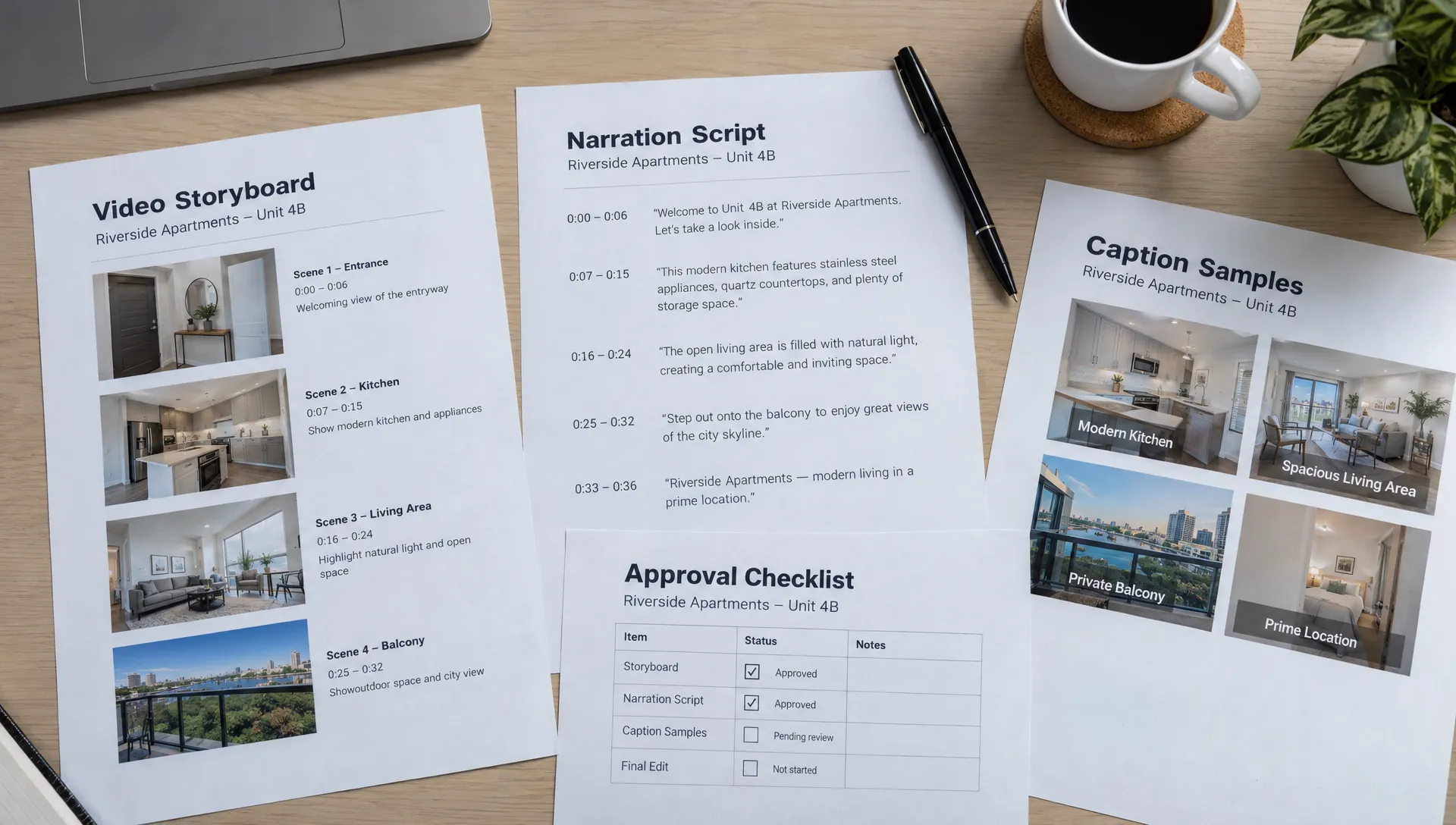
Small teams do not need a complicated approval system, but they do need a consistent one. Assign a reviewer who can stop publication when a script, image or targeting choice raises a concern. Solo agents can use the same checklist and escalate uncertain cases to their broker or counsel.
Use these checkpoints for each completed video:
- Source facts: Confirm the price, availability, property features, location claims and any stated restrictions against reliable listing information.
- Narration and text: Review the audio, captions, thumbnail, title and post description for preferences, exclusions and unsupported claims.
- Visual meaning: Check avatars, depicted households, lifestyle scenes and staged features for misleading or exclusionary messages.
- Language and access: Verify translations, caption accuracy, text readability and available contact methods.
- Distribution: Review the housing category, audience exclusions, geography and vendor instructions before paid promotion begins.
- Approval record: Save the approved version, reviewer’s decision and campaign settings under your brokerage’s retention policy.
An AI-assisted listing video workflow should place this review after generation and before publishing. Reviewing the input alone misses changes introduced during production.
Keep compliance approval distinct from factual approval. A real estate video can accurately describe a property and still communicate an unlawful preference, or use inclusive language while misrepresenting the home.
If you find a problem after posting, pause affected paid promotion and follow your brokerage’s correction process across every published version. Replacing the original file may not update reposts, translated versions or active advertisements.
Frequently asked questions
Does the Fair Housing Act apply to social media reels? Yes. A reel advertising the sale or rental of a dwelling can fall within the Act’s advertising provisions. Informal language, short duration and organic distribution do not automatically create an exemption.
Is AI narration prohibited in housing advertisements? No federal fair housing rule generally bans AI narration as a format. The relevant questions include what the advertisement communicates and how it is distributed. Synthetic narration is not a defense for discriminatory wording.
Can I advertise a property as “55+” or “adults only”? Certain housing for older persons can qualify for a familial-status exemption, but an agent should not invent that status from the seller’s preference. Confirm the community’s documented qualification and approved wording with the broker or counsel before advertising an age restriction.
Does an Equal Housing Opportunity logo make a video compliant? No. A logo or statement can communicate a commitment, but it does not neutralize discriminatory narration, imagery or distribution choices.
Should every real estate video include captions? Captions are a useful default for comprehension and access. Check any legal, brokerage and platform requirements that apply to your business. Also verify caption accuracy and provide important listing details in text.
Put a human approval step before publishing
Diane turns listing information and photos into narrated property videos, with options including AI avatars, voice cloning and multilingual presentation. Those production options make review more important, not less.
When creating real estate videos with Diane, approve the finished narration, visuals, captions and publishing plan before release. Keep the message focused on verified property information and give uncertain language or targeting choices to your broker or counsel before they reach prospective buyers or renters.