
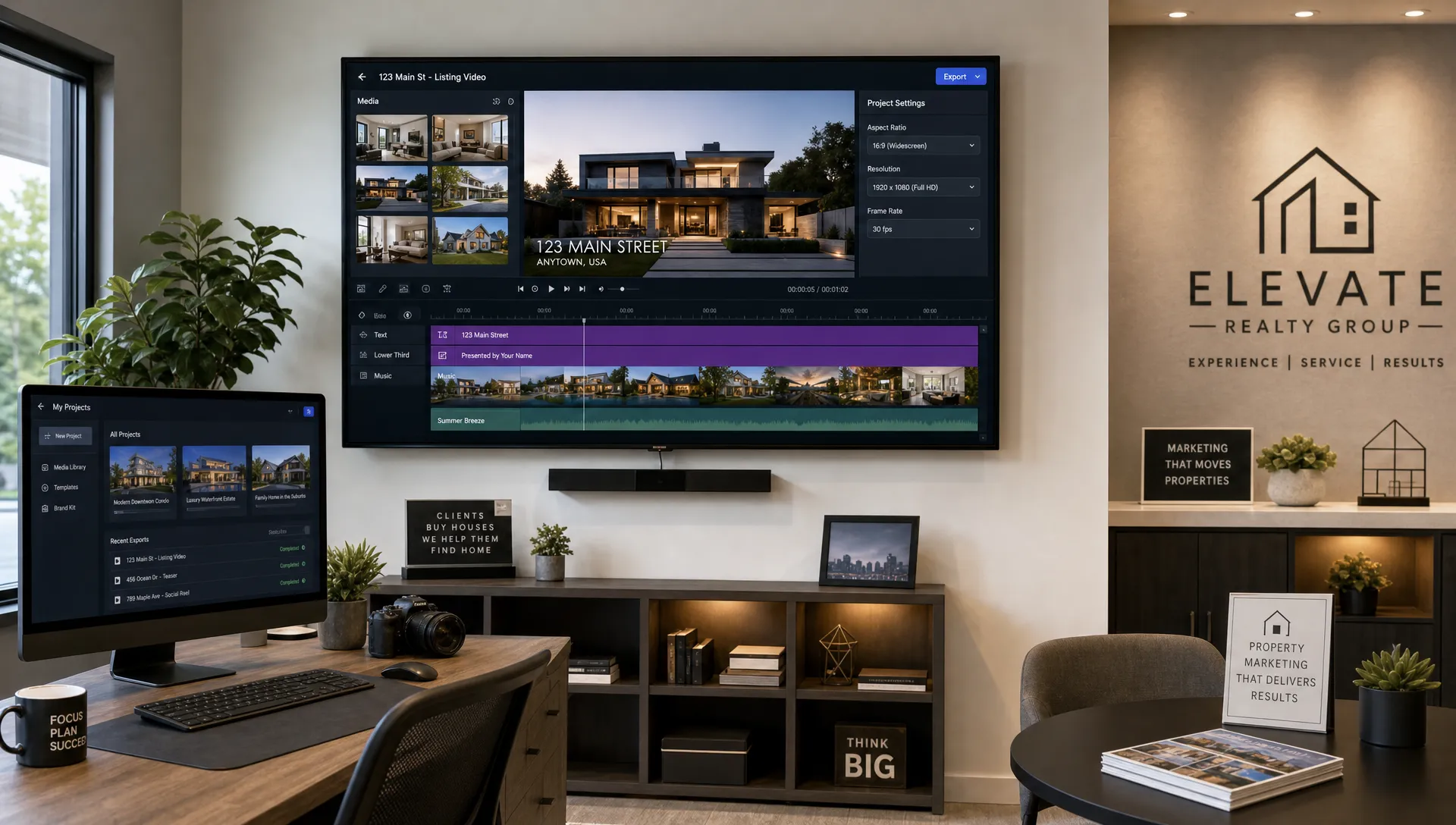
How to Choose a Real Estate Platform for Listing Video
A listing video platform can either remove hours from your marketing workflow or become one more tool your team avoids. The difference usually comes down to fit: how quickly it turns listing materials into a polished video, how well it protects your brand, and whether it matches the way buyers discover homes today.
For independent agents and agency owners, this decision is not just about choosing creative software. It is about choosing a real estate platform that supports the full listing lifecycle, from importing property details to publishing a ready-to-share video while the listing is still fresh.
The right choice should help you move faster without making your marketing feel generic. It should make each home easier to understand, easier to remember, and easier to promote across portals, social media, email, and client updates.
What a real estate listing video platform should actually do
A general video editor can cut clips, add music, and export files. A real estate platform for listing video should do more. It should understand the practical constraints of property marketing: listing descriptions, photo order, square footage, room labels, neighborhood context, agent branding, compliance, and fast turnaround.
That matters because buyer behavior is heavily digital. The National Association of Realtors Profile of Home Buyers and Sellers consistently shows that online search plays a central role in the home search journey. Buyers are not waiting for a brochure. They are comparing listings, watching short-form content, saving favorites, and forwarding links before they ever speak to an agent.
A good platform helps you transform static listing assets into a video story quickly enough to meet that moment. Instead of asking whether a tool can make a beautiful video in theory, ask whether it can help you publish useful listing video content every week, on every active listing, without disrupting your sales work.
Start by mapping your real listing workflow
Before you compare software, map the process you already use. This prevents you from being distracted by features that look impressive in a demo but do not solve your daily bottlenecks.
For most agents, the workflow looks something like this: the photographer delivers images, the listing copy is finalized, the property goes live, the agent posts on social, and buyer questions begin. The video platform you choose should compress the time between those steps.
Ask yourself these workflow questions before building a shortlist:
- Where do your listing photos and property details usually live first?
- Who writes or approves the listing description?
- How soon after publishing do you need a video live?
- Which channels matter most for you: Instagram, TikTok, Facebook, YouTube Shorts, portals, email, or paid ads?
- Do you need your own voice, an AI voice, an avatar, or no presenter at all?
- Will one agent use the platform, or does an agency team need consistent branding across multiple negotiators?
If a platform fits this map, adoption becomes much easier. If it requires you to rebuild your process around the tool, it may slow you down even if the creative output looks strong.
The core criteria for choosing a real estate platform
The best way to evaluate listing video software is to compare outcomes, not isolated features. A feature only matters if it improves speed, consistency, quality, compliance, or distribution.
| Evaluation area | What to look for | Why it matters for listing video |
|---|---|---|
| Listing import | Ability to pull or reuse listing details and photos efficiently | Reduces manual copy-paste work and lowers the risk of errors |
| AI video generation | Automated creation from property assets and descriptions | Helps you produce videos while the listing is still timely |
| Narration options | AI narration, voice cloning, avatar presentation, or script control | Lets you match the tone of your brand and market |
| Branding controls | Logo, colors, typography, agent identity, and brokerage style | Keeps every listing recognizable and professional |
| Social formats | Vertical, square, and landscape exports where relevant | Makes one listing easier to repurpose across channels |
| Editing quality | Smooth pacing, cinematic transitions, room sequencing, captions, and music | Helps the property feel premium without overproducing it |
| Multilingual support | Ability to present listings in more than one language | Useful in international, relocation, luxury, or tourist-heavy markets |
| Publishing workflow | Export or direct social publishing options | Reduces friction between video creation and distribution |
Use this table during demos. If a vendor cannot show how each area works with a real listing, not a sample property, keep asking questions.
1. Prioritize listing import and asset preparation
Manual setup is one of the hidden costs of video marketing. If you have to download photos, rename files, paste descriptions, retype property facts, and manually organize every room, you will produce fewer videos than planned.
A strong listing video platform should make asset preparation feel almost invisible. It should help you bring in property details, photos, and descriptions from the places where your listings already exist. For example, Diane offers one-click listing import through a Chrome extension designed to pull property details and photos from an existing listing into the platform.
When evaluating this part of the workflow, look closely at accuracy. Does the platform preserve the correct price, address area, bedroom count, surface area, and image order? Can you review and edit the details before generating the video? Does it make it obvious which assets are being used?
Speed matters, but control matters too. The goal is not to let software publish unchecked property claims. The goal is to remove repetitive admin work so you can spend more time improving the message.
2. Judge video quality by clarity, not only effects
Cinematic effects can make a listing feel polished, but they should not distract from the property. Buyers need to understand the home: the layout, the light, the finishes, the outdoor space, and the lifestyle the property supports.
A good listing video usually has a simple structure. It opens with the strongest hook, shows the most important spaces early, explains what makes the property distinctive, and ends with a clear next step. For some homes, the hook is a renovated kitchen. For others, it is a terrace, view, location, investment potential, or rare floor plan.
During your platform evaluation, create a test video from one ordinary listing, not only your most beautiful property. Premium tools can make a luxury home look good. The real test is whether they can make a normal apartment, family house, or rental opportunity feel clear and appealing.
Pay attention to pacing. If the video moves too slowly, social viewers leave. If it moves too quickly, buyers cannot understand the rooms. The platform should help you find the middle ground: polished enough to hold attention, accurate enough to support a real decision.
3. Evaluate narration, avatars, and voice options carefully
Narration can turn a simple slideshow into a guided viewing experience. It gives structure to the video and helps highlight selling points that might not be obvious from photos alone. But narration also affects trust, so the platform should give you control over tone, wording, and presenter style.
AI narration is useful when you need speed and consistency. Voice cloning can be valuable if you want the listing video to sound like you, especially when your personal brand is part of your sales process. AI avatars can help create a presenter-led feel without filming yourself for every property.
The key is flexibility. Some listings need a warm agent-style introduction. Others need a clean, minimal voiceover. Some luxury or international properties may benefit from multilingual versions. If you serve relocation buyers, second-home buyers, or cross-border clients, multilingual video support can turn one listing into several targeted assets.
Also check governance. Voice cloning should only be used with consent, and any AI-generated presenter should support your professional reputation rather than create confusion. If your market or brokerage has rules around AI disclosure, make sure the platform can fit those expectations.

4. Make sure distribution is built into the platform mindset
A listing video is only valuable if it reaches the right people. That is why your platform should support the formats and publishing habits that match your channels.
For social media, vertical video is often essential. Instagram Reels, TikTok, Facebook Reels, and YouTube Shorts are built around mobile viewing. For websites, email campaigns, and listing presentations, landscape or square versions may still be useful. The platform does not need to make every format equally important, but it should not lock you into one output that is awkward everywhere else.
Look for practical publishing details: captions, safe text placement, thumbnail options, file export quality, aspect ratios, and the ability to adapt the same listing into different cuts. A 20-second teaser can generate attention, while a longer video may be better for warm leads who already requested details.
If you are not sure what to publish beyond a standard property tour, explore different real estate video ideas that help listings get noticed. The platform you choose should make those variations easier, not require a full production process every time.
5. Protect your brand and stay compliant
Real estate video is marketing, but it is also representation. Your platform should help you present properties accurately and consistently.
Branding controls are especially important for agents who rely on repeat recognition. A buyer or seller should be able to see your video and know it belongs to you or your agency. Look for the ability to apply your logo, color palette, agent identity, and preferred visual style without rebuilding each video from scratch.
Compliance is just as important. In the United States, real estate advertising must be handled with care around protected classes, availability, property claims, brokerage requirements, and local rules. The HUD Fair Housing Act overview is a useful reference point for understanding federal fair housing principles, but agents should also follow state, MLS, and brokerage guidelines.
Here are common areas to review before committing to a platform:
| Compliance area | Platform question to ask |
|---|---|
| Property facts | Can you review and edit all AI-generated text before export? |
| Fair housing language | Can scripts be adjusted to avoid risky or exclusionary phrasing? |
| Brokerage identity | Can required logos, names, or disclaimers be included? |
| Virtual staging | Can you clearly manage and disclose staged or altered visuals when needed? |
| Music and media rights | Does the platform provide usable assets for commercial marketing? |
| AI voice or avatar use | Are consent, disclosure, and usage controls clear? |
This does not mean your video platform must replace legal or broker review. It means it should make responsible review easy before content goes public.
6. Choose for a busy listing month, not a quiet week
Many tools feel manageable when you have one listing to promote. The real test is what happens when you have six new listings, two price changes, three seller updates, and a full calendar of visits.
A scalable platform should help you maintain quality when volume increases. For a solo agent, that may mean fast templates and minimal editing steps. For an agency owner, it may mean brand consistency across several agents, repeatable formats, and an easy way to standardize how listings are presented.
Think about adoption. If the platform requires advanced editing knowledge, your team may depend on one person to produce every video. If it is too automated and rigid, agents may feel the output does not represent them. The right balance is guided automation: enough AI to save time, enough control to preserve expertise.
Support and onboarding also matter. Even intuitive software has a learning curve. During a trial, pay attention to how quickly you can create your first usable video, how easily mistakes can be corrected, and whether the platform feels built for real estate rather than generic content creation.
7. Compare price against total production cost
Subscription price is only one part of the decision. The better question is: what does it cost you to produce listing videos consistently today?
If you hire freelancers, calculate the cost per video, revision time, and turnaround delays. If you edit yourself, calculate the hours spent writing scripts, importing media, selecting music, rendering, and resizing. If you skip video entirely on some listings, consider the opportunity cost of less engaging marketing.
A real estate platform is worth considering when it reduces production friction enough that you actually publish more. The return may come from saved time, better seller presentations, stronger social presence, or faster marketing execution. It is rarely just about making one video cheaper.
Use a simple scorecard during your trial:
| Metric | What to measure during the trial |
|---|---|
| Time to first draft | Minutes from listing import to reviewable video |
| Time to final version | Minutes or hours after edits and approvals |
| Number of manual steps | Downloads, uploads, copy-paste tasks, resizing, and exports |
| Brand consistency | How closely the output matches your agency or personal brand |
| Channel readiness | Whether the video is ready for the places you actually publish |
| Agent confidence | Whether you would proudly send it to a seller or buyer lead |
If a platform performs well on these measures, price becomes easier to evaluate because you are comparing it to real operating value.
Questions to ask before booking a demo
A demo is more useful when you bring specific scenarios. Instead of asking the vendor to show the nicest possible result, ask them to walk through your daily reality.
- Can we generate a video from one of our existing listings during the demo?
- How does the platform import listing details, photos, and descriptions?
- Can we edit AI-generated scripts before the video is finalized?
- What narration options are available, including AI voice, voice cloning, or avatars?
- Which aspect ratios and social media formats can we export?
- Can we apply our brokerage branding consistently?
- How are multilingual videos created and reviewed?
- What controls exist for virtual staging, image changes, and disclosures?
- Can the platform support both solo agents and agency workflows?
- What happens if we need to revise a video after a price change or seller request?
The answers will reveal whether the platform is a creative novelty or a serious part of your listing marketing system.
Frequently Asked Questions
What is a real estate platform for listing video? It is software designed to turn listing assets, such as photos, property details, descriptions, branding, and narration, into marketing videos for real estate promotion. Unlike a generic editor, it should support property-specific workflows and channel-ready outputs.
Can AI listing videos replace professional property videography? Not always. Professional videography is still valuable for luxury listings, complex properties, and campaigns where original footage is essential. AI listing video is best for producing polished marketing content quickly from existing listing materials, especially when speed and scale matter.
How long should a real estate listing video be? Short social videos often work well in the 15 to 45 second range, while website or buyer-nurture videos can be longer if the viewer has stronger intent. The right length depends on the channel, property type, and how much context buyers need.
Should agents use their own voice or an AI voice? Both can work. Your own voice can build personal trust, especially in relationship-driven markets. AI narration can be faster and more consistent. The best platform gives you options so you can choose the right voice for each listing.
Is virtual staging acceptable in listing videos? Virtual staging can be useful, but it should be handled transparently and in line with MLS, brokerage, and local advertising rules. Buyers should not be misled about the actual condition or contents of the property.
Turn listing videos into a repeatable marketing advantage
Choosing a real estate platform for listing video is really a decision about consistency. Can you create polished videos for every important listing, not just when you have extra time? Can you keep your brand visible while reducing repetitive production work? Can you publish while buyer attention is still fresh?
Diane is built for that workflow. It helps real estate agents and agencies turn listings, photos, and property details into ready-to-publish marketing reels with AI narration, avatar presentation, cinematic editing, multilingual support, branding options, and social-ready formats.
If listing video is becoming part of your marketing standard, choose a platform that makes it practical to deliver every week, not just possible once in a while.