
How to Compare Real Estate Advertising Platforms for Video
Real estate advertising platforms are no longer just places to upload photos and wait for buyer inquiries. For agents and agency owners, they now sit at the center of a bigger question: how do you turn a listing into video content that attracts attention, protects your brand and can be published fast enough to matter?
That makes comparison harder. One platform may give you reach but weak creative tools. Another may produce polished video but leave distribution to you. A third may be built for social ads, not property marketing. The right choice depends less on the longest feature list and more on how well the platform supports your listing workflow from intake to publication.
This guide gives you a practical way to compare real estate advertising platforms for video, with criteria you can use before booking a demo, running a trial or rolling a tool out across your agency.
Start by separating the platform types
Many agents compare tools that do completely different jobs. A listing portal, a video creation tool and a paid social platform can all be part of your advertising stack, but they should not be judged by the same criteria.
A helpful first step is to place each option into one of these categories.
| Platform type | Best for | Common limitation |
|---|---|---|
| Listing portals | Capturing active buyer intent and supporting property discovery | Limited creative control and video storytelling |
| Social ad platforms | Targeted reach, retargeting and fast campaign testing | Requires strong creative assets to perform well |
| AI video platforms | Turning listing materials into publishable video quickly | Distribution may depend on integrations or manual publishing |
| Brokerage marketing suites | Brand consistency, approvals and multi-agent coordination | Can be slower or less flexible for individual agents |
| Creative production services | Premium campaigns for luxury or hero listings | Higher cost and longer turnaround |
If your main problem is visibility, a distribution-first platform may be the priority. If your main problem is producing enough quality content for every listing, a video creation platform may solve more of the bottleneck. If your team struggles with inconsistent branding across agents, an agency-level workflow matters more than raw ad reach.
Compare based on the buyer journey, not the software category
Video does not serve the same purpose at every stage of the buyer journey. A short vertical reel might stop someone scrolling on Instagram. A narrated walkthrough might help a serious buyer understand the flow of the property. A neighborhood-focused clip may support relocation buyers who are still comparing areas.
Before comparing platforms, decide which video use cases matter most to your business:
- Listing launch videos for new properties
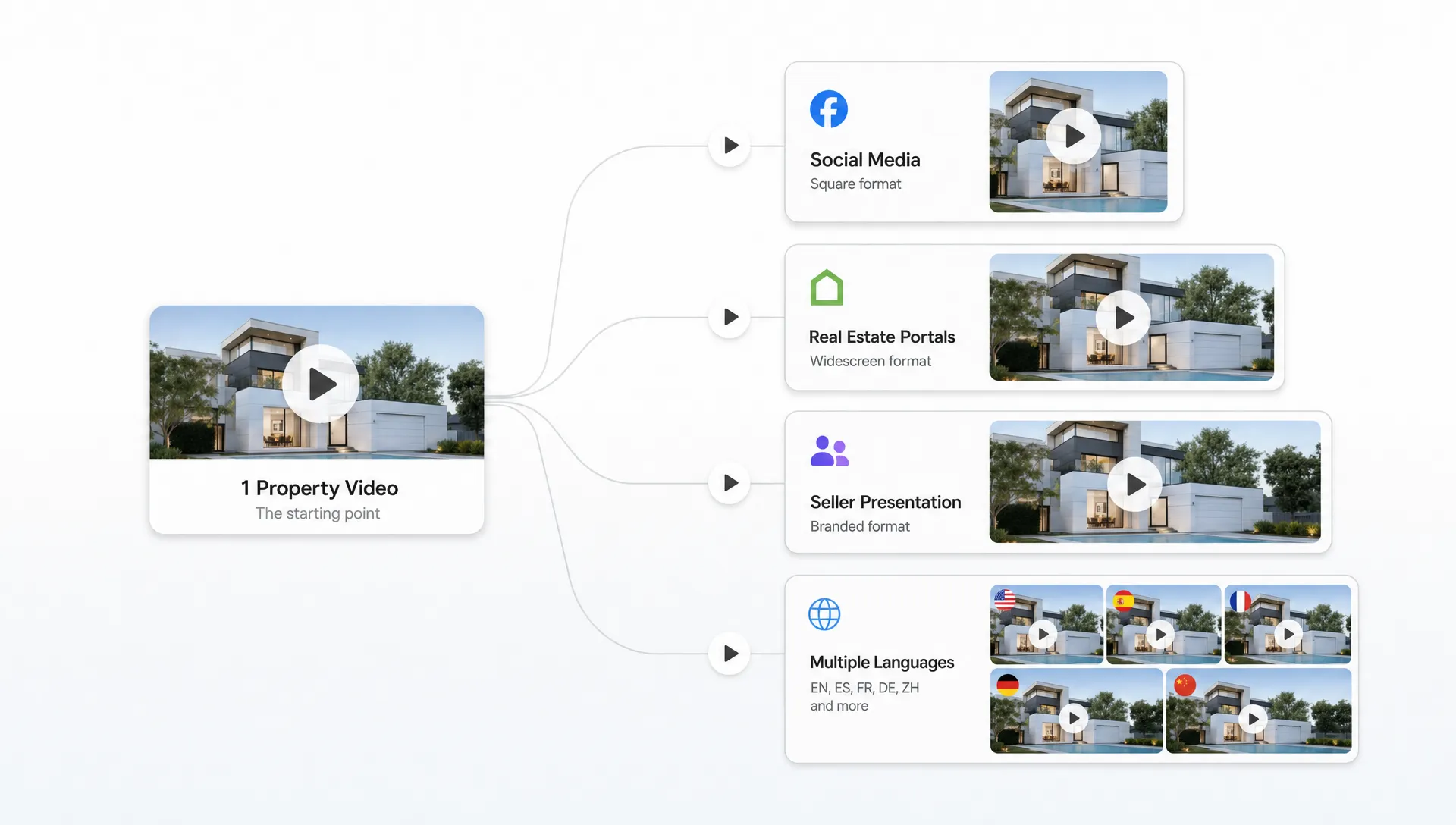
- Short-form reels for Instagram, TikTok, Facebook and YouTube Shorts
- Portal-friendly video assets for listing pages
- Agent-branded videos for seller presentations
- Multilingual videos for international or relocation buyers
- Retargeting clips for people who viewed a listing but did not inquire
This prevents a common mistake: choosing a platform because its demo looks impressive, then realizing it does not create the type of video you actually publish every week.
For example, if your goal is to make listing pages stronger while also driving traffic from social media, your comparison should account for how video complements portals rather than replacing them. Diane has a separate guide on using video alongside real estate listing sites if you want a deeper look at that workflow.
Evaluate creative quality in real estate terms
A generic video tool can make a clip look polished, but real estate video has its own requirements. The video must make the property clear, credible and appealing without overpromising or distracting from the listing.
When reviewing creative quality, look beyond surface-level effects. Ask whether the platform helps buyers understand the home. Does the video communicate the property type, layout, standout rooms, outdoor space and lifestyle context? Does the narration sound natural? Do transitions support the viewing experience or simply add motion?
For real estate advertising, strong video usually has four traits.
First, it gives structure to the listing. A good property video should not feel like random photos placed on a timeline. It should open with a strong hook, move through the home logically and close with a clear next step.
Second, it preserves trust. Heavy filters, exaggerated claims and misleading edits may attract clicks, but they can create poor showings and disappointed buyers. The platform should help you present the property attractively while staying accurate.
Third, it adapts to channel behavior. A reel, a listing page video and a paid ad should not always be identical. Compare whether the platform supports different aspect ratios, lengths and pacing styles.
Fourth, it reflects your brand. Fonts, colors, logo placement, voice style and agent presence all influence whether the video feels like part of your business or like a generic template.
If you need inspiration before judging creative output, review these real estate advertising samples that make video work. They can help you evaluate whether a platform is producing attention for the right reasons.
Check how fast the platform moves from listing to video
Speed matters because listing marketing has a short window. The first days after a listing goes live often shape seller perception and buyer interest. If your video workflow takes too long, agents may skip it on normal listings and reserve it only for premium properties.
Compare how each platform handles the basic production flow. Can it import listing details from portals or listing sources? Can it use existing property photos? Can the script be generated and edited quickly? Can narration be created without booking a recording session? Can the final video be exported or published in the formats your channels require?
This is where AI-powered video platforms can be especially useful. Diane, for instance, is built to turn property listings, photos and details into ready-to-publish marketing reels with AI narration, animated avatars, cinematic editing, social formats and custom real estate branding. For agents who need a repeatable process rather than a one-off production project, that difference can be significant.
A useful test is simple: take one real listing and time the process from raw materials to publishable video. Do not judge only the final asset. Judge the number of handoffs, edits, approvals and manual steps required to get there.

Compare branding and compliance controls
Real estate advertising is not just creative. It also needs to respect brand guidelines, local rules, brokerage policies and fair housing standards. The more people on your team who create videos, the more important controls become.
For independent agents, branding controls help every video feel recognizable. For agency owners, they reduce the risk of each agent inventing their own style. When comparing platforms, look for practical controls such as reusable brand settings, logo placement, approved templates, editable scripts and review steps before publishing.
You should also evaluate how easy it is to correct language. AI-generated narration or scripts can save time, but you still need the ability to adjust claims, remove sensitive wording and match the way you speak to clients. A platform that creates fast videos but makes edits difficult can become risky in a professional environment.
A good comparison question is: would you be comfortable letting a new agent use this platform during a busy listing week? If the answer is no, the tool may need stronger guardrails before it becomes part of your agency workflow.
Look at distribution, not just creation
Some real estate advertising platforms are strong at creation but weak at publishing. Others are strong at media buying but assume you already have the creative assets. Your comparison should account for both.
For video, distribution usually means more than pressing publish once. You may need vertical versions for social, horizontal versions for YouTube or websites, short cuts for ads and listing-friendly versions for portals. A platform that creates only one format can still help, but it may leave extra work for your team.
Ask these questions during comparison:
- Which channels can the platform publish to directly?
- Which video formats and aspect ratios does it support?
- Can you export files without quality loss or awkward watermarks?
- Can you create multiple versions for different audiences?
- Does it support multilingual video if your market needs it?
- Can your team keep files organized by listing, agent or office?
If the platform is mainly for paid advertising, also check how it handles campaign setup, retargeting, budget control and reporting. If it is mainly for content creation, check how easily the final videos can move into your existing advertising channels.
Measure performance with the right metrics
Video performance can be misleading if you look only at views. A video with high reach but no inquiries may be useful for brand awareness, but it should not be judged the same way as a lead-generation campaign. A listing walkthrough may have fewer views yet produce better qualified showings.
Use metrics that match the job of the video.
| Video goal | Metrics to compare | What to watch for |
|---|---|---|
| Awareness | Reach, impressions, completion rate | High views with low watch time may signal weak creative fit |
| Engagement | Saves, shares, comments, click-through rate | Engagement quality matters more than comment volume |
| Listing interest | Listing page visits, inquiries, showing requests | Track whether the video attracts qualified buyers |
| Seller marketing | Seller feedback, listing presentation impact, brand consistency | Harder to quantify but important for winning instructions |
| Retargeting | Cost per click, cost per lead, conversion rate | Compare against other retargeting creatives, not broad awareness posts |
The key is to compare like with like. Do not compare an organic neighborhood reel against a paid listing ad and call one platform better. Use the same listing, similar timing, similar audience and similar budget where possible.
This mindset is common in other data-driven fields. Investors use tools like anonymous portfolio benchmarking to compare performance against verified peers instead of relying on isolated numbers. Real estate teams can take the same principle into advertising: benchmarks only become useful when the comparison set is fair.
Build a scoring matrix before demos
Sales demos can make every platform look capable. A scoring matrix keeps your decision grounded in your actual workflow. Before you speak to vendors or start trials, assign weights to the criteria that matter most.
Here is a practical example for an independent agent or small agency that wants to scale listing video.
| Criteria | Suggested weight | Why it matters |
|---|---|---|
| Video quality for listings | 20% | The asset must make the property look credible and appealing |
| Speed from listing to publish | 20% | Slow workflows reduce adoption |
| Brand control | 15% | Consistency matters for seller trust and agency reputation |
| Channel formats | 15% | Videos need to work across social, portals and websites |
| Ease of editing | 10% | Agents need to correct scripts, visuals and calls to action |
| Reporting | 10% | Performance data helps improve future campaigns |
| Cost and scalability | 10% | The platform should make sense across your listing volume |
Your weights may differ. A luxury agency may place more emphasis on cinematic quality. A high-volume listing team may care more about speed, automation and approval workflows. A solo agent may value ease of use over advanced reporting.
The point is not to find a universal winner. It is to find the platform that fits the way you win listings, market properties and follow up with leads.
Understand the full cost, including time
Subscription price is only one part of cost. A platform that looks inexpensive can become expensive if it requires hours of editing, manual resizing or outside help. A higher-priced tool can be economical if it replaces repeated production work and helps you publish more consistently.
When comparing cost, include:
- Platform subscription or usage fees
- Production time per listing
- Editing or revision time
- Team training and adoption
- Paid ad spend, if the platform includes media buying
- Outsourced creative costs still required alongside the platform
- Opportunity cost when listings go live without video
For a more detailed breakdown of production methods and budget tradeoffs, Diane’s guide to real estate video cost in 2026 compares common options such as traditional production, DIY workflows and AI-assisted creation.
The most useful cost metric is often cost per usable video, not cost per month. If one platform helps you create 20 listing videos a month and another only gets used twice because the workflow is painful, the cheaper option may not actually be cheaper.
Run a fair trial with real listing materials
A platform trial should use your actual marketing conditions. Demo assets are usually cleaner than real listing materials. Your own listings may have uneven photo quality, missing details, tight deadlines and agent-specific preferences.
Choose two or three representative listings for testing. Include one standard listing, one premium listing and one more difficult listing, such as a property with limited photos or a less obvious selling angle. Give each platform the same materials and evaluate both the process and the output.
During the trial, document:
- Time required to create the first draft
- Number of edits needed before approval
- Quality of the script and narration
- Accuracy of property details
- Ease of creating channel-specific versions
- Agent or team willingness to use it again
- Performance after publication, when possible
This last point matters. A platform can feel impressive during setup but fail in adoption. If agents avoid using it without marketing support, the tool will not scale.
Watch for red flags
Some weaknesses only appear once you look closely. Be cautious if a platform makes editing difficult, locks your assets into one channel or relies on templates that make every listing look the same. Also be careful with tools that create flashy videos but do not give you enough control over property claims, branding or calls to action.
Another red flag is poor fit with your listing intake process. If your team already stores listing details in portals, CRMs or shared folders, the platform should reduce copying and pasting rather than add more of it.
Finally, do not overvalue novelty. AI avatars, voice cloning, virtual staging and cinematic effects can be powerful when they support the marketing message. They should not become the message themselves. The property, the agent and the buyer’s next step still need to remain clear.
A simple comparison checklist
Use this short checklist when narrowing your options:
- Can the platform create real estate-specific videos from listing materials quickly?
- Does the output match your brand and quality standards?
- Can you edit scripts, narration, visuals and calls to action?
- Does it support the formats you need for social media, listing sites and ads?
- Can it scale across your listing volume without slowing the team down?
- Does reporting connect video activity to meaningful outcomes?
- Is the total cost reasonable once time and adoption are included?
If a platform scores well on these questions, it is worth a deeper trial. If it fails several of them, a polished demo probably will not fix the mismatch.
Frequently Asked Questions
What are real estate advertising platforms for video? They are tools or channels that help agents create, publish, promote or measure property videos. Some focus on distribution, such as social ad platforms or listing portals. Others focus on creation, such as AI real estate video tools that turn listings and photos into video assets.
Should agents choose one platform or use several? Most agents benefit from a small stack rather than one all-purpose tool. For example, you might use an AI video platform to create listing videos, social platforms to distribute short clips and listing portals to capture active buyer demand.
What is the most important feature to compare? Workflow fit is often the deciding factor. A platform must help you move from listing materials to publishable video quickly, with enough control over branding, accuracy and formats. If the workflow is too slow, agents usually stop using it.
How do you compare video platform ROI? Compare total cost against usable output and outcomes. Look at cost per publishable video, time saved, listing inquiries, showing requests, seller feedback and performance across channels. Avoid judging ROI by views alone.
Can AI video replace professional real estate videography? AI video can cover many everyday listing marketing needs quickly, especially when you already have strong listing photos and details. Professional videography may still make sense for luxury homes, major brand campaigns or properties where original footage is essential.
Make your comparison practical
The best real estate advertising platforms for video are the ones your team will actually use. They help you produce strong listing content quickly, keep branding consistent and publish in the formats where buyers and sellers already spend time.
If your current process depends on manual editing, delayed production or inconsistent agent-made videos, Diane can help you turn listings into polished AI-powered real estate videos in minutes. Explore Diane to see how AI narration, avatar presentation, multilingual support, virtual staging, cinematic editing and social media formats can fit into your listing marketing workflow.