

How a Real Estate Agent Can Compare Homes for Buyers With Video
A real estate agent for buyers can use video to make competing homes easier to evaluate, but only if each property is presented on the same terms. Three polished listing reels may create three different impressions without helping a client decide which home actually fits their needs.
A useful comparison video does something more specific: it shows the same spaces, answers the same questions and makes trade-offs visible. The goal is not to declare a winner before the buyer has visited. It is to build a defensible shortlist and identify what needs checking in person.
Choose a format that supports a decision
Start by separating public listing marketing from private buyer guidance. A public reel introduces a property to a broad audience. A private comparison should reflect one buyer’s stated priorities and can include questions, limitations and unresolved details.
For a small shortlist, create one short video per property using an identical sequence. Send those videos together with a comparison sheet. Alternatively, assemble a single video that moves through the same criteria across two or three homes.
Neither format requires a dramatic production. Consistent narration and comparable views matter more than elaborate transitions. Keep listing pages available alongside the videos so buyers can review full descriptions, disclosures and current availability. A workflow that uses video alongside real estate listing sites preserves that distinction between a visual summary and the underlying property information.
Set priorities as a real estate agent for buyers
Before selecting footage, ask the buyer which differences would change their decision. Translate broad preferences into observable criteria rather than guessing what “comfortable,” “spacious” or “convenient” means.
A practical brief might include:
- Non-negotiables: A step-free entrance, an enclosed office or a particular bedroom arrangement.
- Preferences: More outdoor space, extra storage or a kitchen connected to the living area.
- Financial boundaries: Purchase budget and acceptable recurring ownership costs.
- Questions to resolve: Street noise, parking restrictions or the condition of major systems.
Let the buyer distinguish requirements from preferences. Otherwise, a visually impressive feature can distract from a missing essential.
Keep the brief in the buyer’s own words and confirm it before production. Compare homes against those instructions, not assumptions about their age, family status or health. Apply the same approach to neighborhood information: provide objective facts and avoid steering based on protected characteristics.
Gather comparable evidence for every home
Collect current listing details, authorized photos or footage, floor plans when available and relevant disclosures. Record where each material came from and when you checked it. Follow applicable usage rights, brokerage requirements and local MLS rules before reusing another agent’s assets.
For a real estate agent for buyers, separating verified facts from unresolved questions is more useful than filling every gap with confident narration. “The listing reports a two-car garage” is different from “Your truck will fit.” The second statement requires dimensions and clearance checks.
Use a simple evidence standard:
| Information | How to present it |
|---|---|
| Supported by a current document or measurement | State the fact and retain its source |
| Supplied by the listing agent but not independently checked | Attribute it clearly |
| Visible in a photo but not measured | Describe what is visible without asserting dimensions |
| Missing or uncertain | Flag it as a question for the showing |
If one property has detailed footage and another has only photos, acknowledge that imbalance. Better source material does not necessarily mean a better home.
Compare comfort without making health claims
Comfort deserves its own questions because attractive interiors reveal little about temperature control, noise or bedroom light. Ask buyers which conditions matter to them, then document relevant features such as operable windows, shading, thermostat locations and bedroom placement.
If a buyer volunteers that menopause-related night sweats affect sleep, The Menopause Kit’s symptom guides can help them articulate sleep and cooling preferences. Keep your property assessment focused on observable features, not treatment advice or promises that a particular home will relieve symptoms.
A real estate agent for buyers should record the requested housing features rather than putting private medical details into a video. Even a private comparison may be forwarded. “Buyer prefers independently controlled bedroom cooling” gives you a useful criterion without disclosing why it matters.
Build a comparison matrix before editing
Write the comparison first, then choose images that support it. This prevents the available footage from dictating the recommendation.
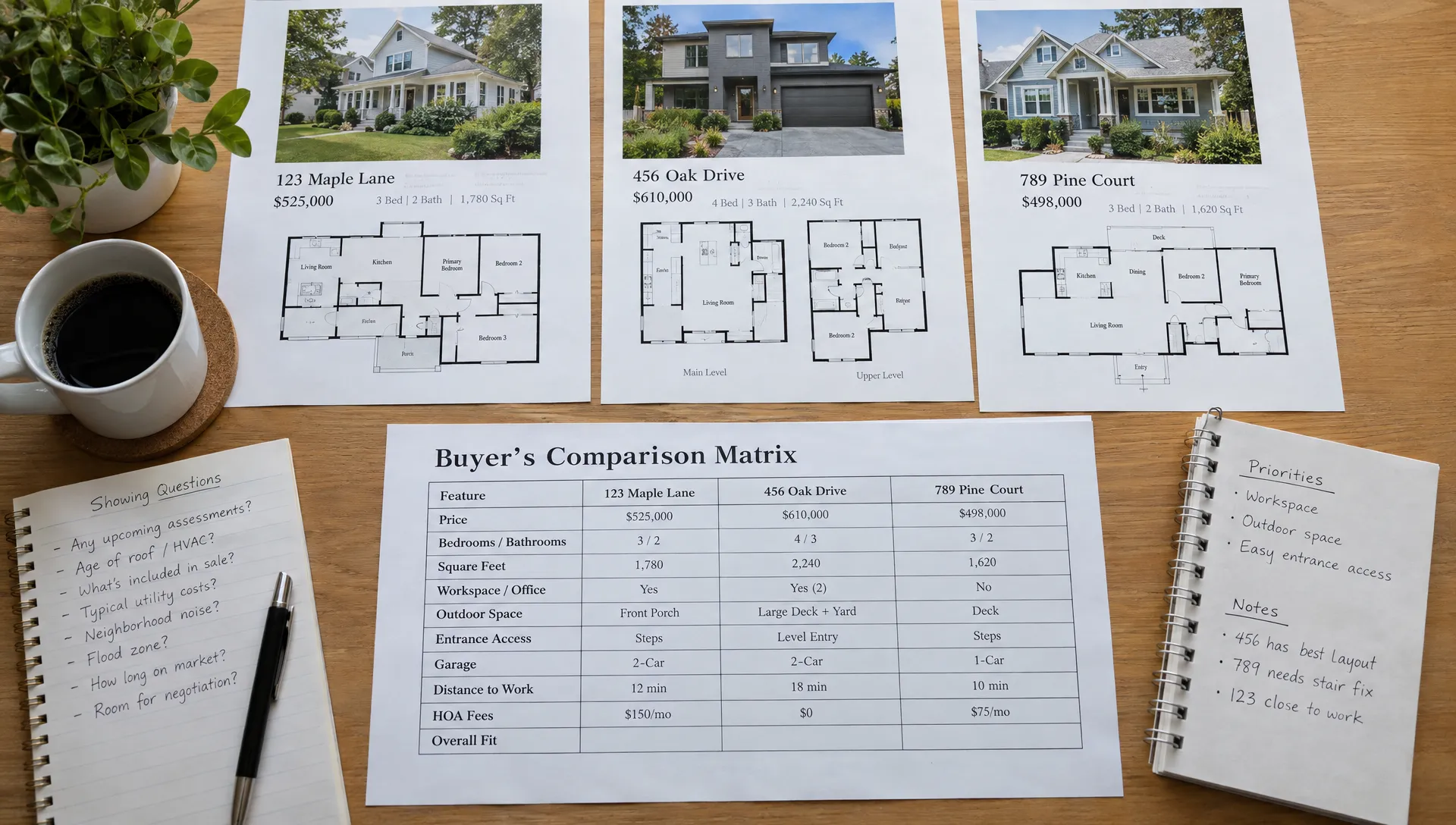
The hypothetical example below shows how three properties might be assessed against the same buyer brief. It is an illustration, not a set of actual listings.
| Buyer criterion | Home A | Home B | Home C |
|---|---|---|---|
| Enclosed workspace | Separate room | Living-room nook | Separate room |
| Outdoor space | Small fenced yard | Balcony | Larger yard |
| Entrance access | Steps visible | Shared elevator access | Entrance not documented |
| Cooling information | Central system listed | Individual units listed | System details missing |
| Priority showing question | Street noise | Building fees and rules | Access and system condition |
Keep facts and interpretations separate. A larger yard is observable; whether it is worth the upkeep depends on the buyer. Avoid an overall score unless the client has agreed on the criteria and their relative importance.
Use the same video sequence for each property
A repeatable structure helps buyers compare rather than remember only the most striking kitchen. As a starting point, aim for roughly 60 to 90 seconds per home, extending the video only when a meaningful difference needs explanation.
A real estate agent for buyers should give important criteria comparable attention across the shortlist. Do not spend half of one video on outdoor space and barely show it in the others.
Opening context: Identify the property and its current asking price, with the date checked. State which buyer priorities the video will examine.
Layout and circulation: Show the entrance, main living space and relevant room relationships. Use a verified floor plan if available; disconnected photos alone cannot establish how rooms connect.
Priority spaces: Cover the same essentials in each home, such as the office, primary bedroom and outdoor area. Explain fit using documented details rather than adjectives.
Costs and constraints: Mention known recurring fees and relevant restrictions. Label estimates and identify their sources. Video is not a substitute for a lender’s payment estimate or a full ownership-cost review.
Trade-off and next check: Finish with one clear compromise and one question to resolve during the showing. This gives buyers a reason to visit beyond confirming that the home looks appealing.
Example narration for a shortlist
Using the hypothetical matrix above, a real estate agent for buyers could narrate the comparison like this:
“Home A has an enclosed workspace and a smaller fenced yard. The entrance has visible steps, so we should check whether access meets your requirements. Street noise remains a showing question.”
“Home B offers a balcony rather than a yard, and the workspace is part of the living room. We need to review the building fees, elevator access and applicable rules before comparing its total fit.”
“Home C combines an enclosed workspace with a larger yard. Entrance access and cooling-system details are not documented yet, so those questions remain open.”
Each summary follows the same logic without forcing a winner.
Use AI production without confusing illustration with evidence
AI can reduce the work involved in producing consistent property videos. Diane can turn listings, photos and details into narrated videos, with options including AI avatars, voice cloning, cinematic editing and custom real estate branding.
Use those capabilities for presentation consistency, then maintain the buyer comparison separately. Do not assume a video platform verifies property facts or decides which home best matches a client. A repeatable process for turning property listings into buyer-focused videos can support production while leaving factual review with the agent.
Distinguish actual footage from generated presentation. Animated listing photos are not a filmed walkthrough and should not imply a verified route through the property. Virtual staging should be clearly labeled, with original images available for comparison. It must not conceal defects or imply that furnishings, finishes or alterations are included.
Before sharing, review narration against source documents. Check prices, dimensions, fees and room descriptions. Use voice or likeness assets only with appropriate permission. Where multilingual narration is used, review the translated facts and qualifications too.
Turn viewing feedback into a better shortlist
After sharing the videos, a real estate agent for buyers should ask for criterion-specific feedback rather than a general reaction. “Which workspace meets your needs?” produces more useful information than “Which video did you like best?”
Have the buyer identify their preferred option, the compromise they would accept and the uncertainty most likely to change their decision. Use those answers to plan the next showings.
If a buyer favors a home because its video looks more polished, return to the matrix. Explain which differences belong to the property and which come from lighting, staging or source-material quality.
During the visit, test the unresolved questions directly. Check measurements, access, storage and other relevant details, while directing condition questions to appropriate inspections or qualified professionals.
Update the comparison when facts change. A price adjustment, new disclosure or corrected fee can affect the shortlist even when the visuals remain unchanged. For agency teams, assigning a factual-review owner helps prevent an old video from circulating as current information.
Frequently asked questions
Should buyers receive one combined video or separate property videos? Separate videos are easier to replace when a listing changes. A combined video can make specific trade-offs easier to follow. In either case, use the same criteria and provide the underlying listing information.
Can comparison videos replace property showings? No. A real estate agent for buyers can use video to prioritize visits, but it cannot reliably establish noise, odors, condition, dimensions or how a space feels in person. It also does not replace inspections or document review.
Is it acceptable to compare another agent’s listing? Check permissions, licensing terms, local MLS rules and brokerage policy before using listing photos, footage or other materials. Public availability does not automatically authorize reuse or republication.
Should private buyer comparisons be published on social media? Not without reviewing permissions and removing personal information. A buyer-specific comparison may reveal budget, preferences or negotiating context. Keep public marketing separate from confidential buyer guidance.
Create the videos, keep the judgment with the buyer
Start with two or three homes, one agreed comparison brief and a consistent video sequence. Verify the facts, label generated visuals and end each property summary with its main trade-off and next showing question.
When production becomes the bottleneck, explore Diane’s AI real estate video tools to create narrated listing videos from your property materials. Use them to support a clearer comparison, while keeping recommendations grounded in the buyer’s priorities and verified information.