
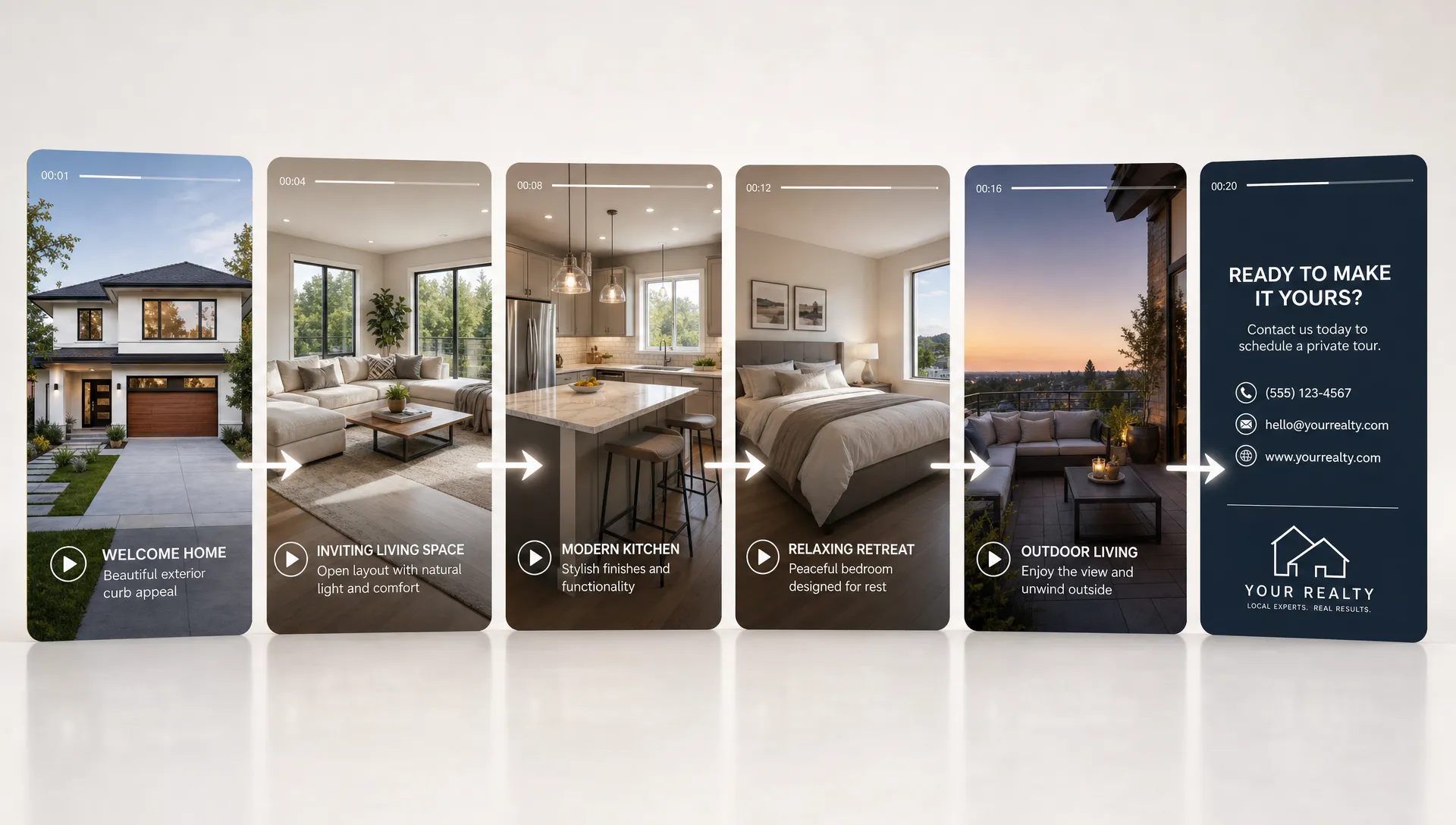
Turn Property Listings Into Videos Buyers Want to Watch
A property listing is usually built for a portal: facts, photos, price, location, energy details, and a description that helps buyers compare options. A video has a different job. It has to create momentum, answer questions quickly, and make the viewer feel oriented before they swipe away.
That is why turning property listings into videos is not just a matter of dropping photos into a slideshow. Buyers want to understand the home, picture the layout, and decide whether it is worth a viewing. Agents want to generate qualified interest without spending hours scripting, recording, editing, and resizing content for every channel.
The opportunity is simple: your listing already contains most of what a strong video needs. The difference is how you translate listing information into a short, buyer-centered story.
Why property listings need a video version
Online buyers make fast visual judgments. The National Association of REALTORS has consistently reported that the internet plays a central role in the home search, with buyers relying heavily on online photos, property information, and digital research before contacting an agent. That means your listing is often competing in a crowded feed long before someone reaches the full description.
Photos still matter, but video helps fill the gaps photos leave behind. A good listing video can show how rooms connect, which features deserve attention, how the property feels in sequence, and why a buyer should keep watching. It can also make a familiar listing feel new again when repurposed for Instagram Reels, TikTok, YouTube Shorts, Facebook, LinkedIn, email, or agency landing pages.
For independent agents and agency owners, video also solves a positioning problem. Sellers increasingly expect modern marketing. A polished property video signals that you do more than upload a listing. It shows that you package the property for how buyers actually discover homes today.
What buyers actually want from a listing video
A buyer does not open a video hoping to hear every feature in the listing description. They want clarity. They want to know, quickly, whether the home fits their needs, whether it feels worth their time, and what makes it different from the next property in the feed.
Strong listing videos usually answer five buyer questions:
- What is the property, and where is it located?
- What is the strongest reason to keep watching?
- How do the main spaces connect?
- Which features affect daily life, comfort, or value?
- What should I do next if I am interested?
Notice what is missing: a long list of adjectives. Words like beautiful, charming, rare, and exceptional can help, but only when they are supported by visual proof. A buyer would rather see natural light across the living room than hear a generic claim that the space is bright.
Start with the hook, not the full description
The first three seconds decide whether your video earns attention. That does not mean every video needs a flashy trick. It means the opening should give the buyer a reason to stay.
The best hook usually comes from the listing’s strongest differentiator. For one property, that might be a panoramic terrace. For another, it might be a renovated kitchen, a quiet street near transit, a flexible home office, or a family-friendly layout. The hook should be specific enough to feel useful and visual enough to be understood without sound.
Instead of opening with “Welcome to this three-bedroom apartment,” try something more concrete: “A south-facing terrace, an open living space, and the metro just minutes away.” That line gives the viewer three reasons to continue, and it sets up the rest of the video around buyer benefits rather than listing inventory.
If you need inspiration beyond a standard walkthrough, this guide to real estate video ideas that help listings get noticed can help you choose a format that fits the property, audience, and channel.
Turn listing fields into a story arc
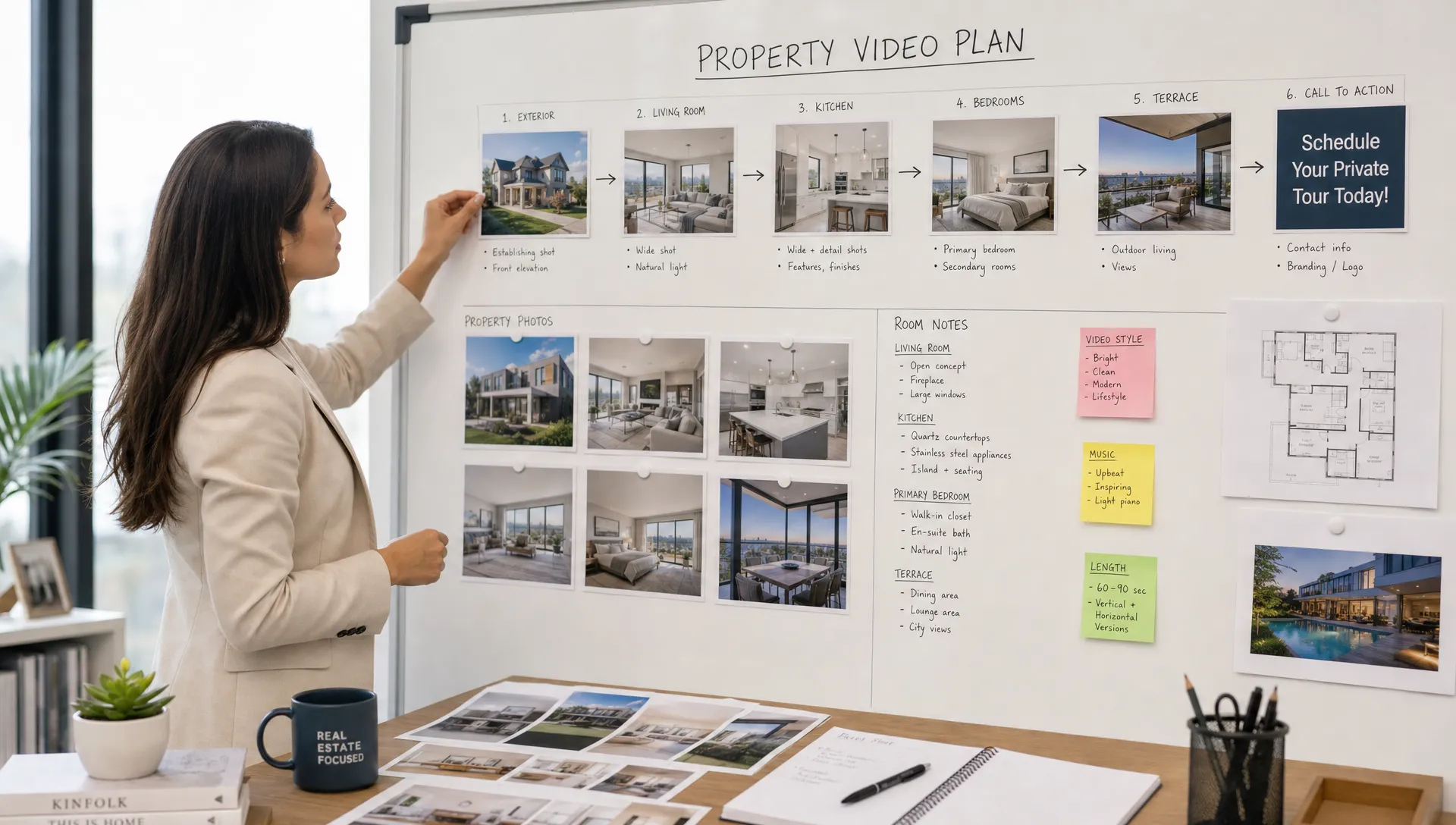
Most property listings are structured like a database. Video needs a sequence. The aim is not to include every detail, but to order the most persuasive details in a way that feels natural.
A simple structure works for most listing videos:
| Video moment | What to show | What to say |
|---|---|---|
| Opening hook | Best exterior, hero room, view, terrace, or lifestyle feature | The top reason this property deserves attention |
| Orientation | Exterior, entry, building, street, or floor plan style shot | Property type, location, and overall positioning |
| Main living areas | Living room, kitchen, dining area, outdoor space | How the home supports daily life |
| Bedrooms and practical spaces | Bedrooms, office, storage, bathrooms, parking | Who the property may suit, without discriminatory language |
| Differentiators | Renovation, energy performance, view, amenities, neighborhood access | Features that separate it from similar listings |
| Call to action | Best closing shot or branded end card | How to book a viewing or request details |
This structure keeps the video moving. It also protects you from a common mistake: treating the narration like a copy-and-paste version of the listing description. The description can be complete. The video should be selective.
Choose visuals that create orientation
A listing video should not feel like a random shuffle of listing photos. Buyers need a sense of progression. Start outside or with the strongest visual, then move through the home in an order that approximates how someone would experience it during a visit.
If you only have photos, sequence them intentionally. Show the exterior or entrance, then the main living space, then the kitchen, bedrooms, bathrooms, outdoor areas, and closing feature. If a photo gallery includes several angles of the same room, avoid using all of them back to back unless they reveal something new.
Cinematic editing can help, but it should serve clarity. Slow zooms, smooth pans, transitions, captions, and light motion effects can make still photos more engaging. The goal is not to disguise the property. The goal is to help buyers understand it without feeling like they are looking through a static gallery.
Write narration that sounds human, not inflated
Narration is where many listing videos lose buyers. The script either repeats the listing too literally or becomes so promotional that it stops feeling trustworthy.
A useful rule is to translate features into buyer meaning. “Large windows” becomes “morning light fills the main living area.” “Open kitchen” becomes “the kitchen connects directly to the dining space, making the room easy to use when hosting.” “Close to shops” becomes “daily errands are within easy reach.”
Keep sentences short. Video narration has to be heard, not studied. If a line looks elegant on a page but feels heavy when spoken aloud, simplify it.
Also, be careful with generic AI phrasing. The wider conversation around AI-written content, including AI detection resources such as Detection Drama, has made people more aware of text that sounds formulaic. For real estate videos, the solution is not to hide that AI helped you. It is to make sure the final script is accurate, specific to the property, and aligned with your professional voice.
Use AI to speed up production without losing your standards
The bottleneck for most agents is not wanting video. It is the time required to create it for every listing. Traditional production means planning, filming, voiceover, editing, captioning, resizing, exporting, and publishing. That workflow can be hard to sustain when you manage multiple properties, seller updates, viewings, and negotiations.
AI changes the economics of listing video. With a platform like Diane, agents can turn listing information, photos, and property details into ready-to-publish real estate marketing reels using AI narration, avatars, voice cloning, multilingual support, cinematic editing, branding, and social formats. The point is not to replace your judgment. It is to remove repetitive production work so you can focus on positioning the property and following up with interested buyers.
For example, if a property is already online, Diane’s one-click real estate listing import can help bring listing details and photos into the video workflow faster. From there, you can review the script, choose the presentation style, adapt branding, and prepare versions suited to the channels where buyers are most likely to engage.
If speed is your main constraint, you can also explore a broader workflow for how to create real estate videos for marketing in minutes, especially when you need a repeatable process for new mandates.
Match the format to the channel
A listing video should not be exported once and posted everywhere without adjustment. Each channel has its own viewing behavior. A portal video may support a more complete walkthrough. A social reel needs a stronger hook and tighter pacing. An email video preview should quickly remind the buyer why the property matches their search.
For most social platforms, vertical video is now the safest default because it fills the mobile screen. Captions matter because many viewers watch without sound. The first frame matters because it often becomes the reason someone pauses. The call to action should be simple, such as booking a visit, requesting the full listing, or sending a direct message.
Think of each video as a version of the same core story. You are not reinventing the listing for every platform. You are adapting the emphasis.
Keep compliance and trust at the center
Real estate marketing has to be persuasive, but it also has to be accurate. A video can move fast, which makes it even more important to review every claim before publishing.
Avoid overstating square footage, renovation status, distances, views, school access, rental potential, or expected returns unless you can verify the information and present it according to local rules. Be mindful of fair housing and anti-discrimination requirements. Instead of describing who a property is “perfect for” in a way that references protected characteristics, describe the property’s features, layout, and practical uses.
If you use virtual staging, make sure buyers are not misled. If local regulations, MLS rules, or agency policy require disclosure, include it clearly. If you use AI avatars, voice cloning, or translated narration, review the final output for accuracy and tone before publishing. AI can accelerate production, but the agent remains responsible for the marketing message.
A practical checklist before you publish
Before posting your next listing video, run through a short quality check. This helps you catch issues that can reduce watch time, confuse buyers, or create avoidable compliance risk.
- The opening shot shows a strong property feature or clear location context.
- The first line gives buyers a specific reason to keep watching.
- The room sequence helps viewers understand the layout.
- The narration is accurate, natural, and free of exaggerated claims.
- Captions are readable on mobile screens.
- The video format matches the target channel.
- Branding is visible but not distracting.
- The call to action is clear and easy to follow.
- Any AI-generated staging, narration, or avatar presentation has been reviewed.
- The final video reflects the actual listing and your agency standards.
This checklist is intentionally simple. The best video process is the one you can repeat for every property, not just your premium listings.
Measure what buyers actually do
Once the video is published, do not judge success by views alone. Views can be useful, but they do not always equal buyer intent. Pay attention to saves, shares, profile visits, direct messages, viewing requests, email replies, and listing page clicks.
If many people watch but few take action, the video may be entertaining but not specific enough. If the video has a low watch time, test a sharper hook or a stronger first visual. If viewers ask questions that the video should have answered, adjust your sequence or captions next time.
Over time, you will learn which property features attract attention in your market. A city-center studio, a family house, a luxury villa, and an investment property may each need a different rhythm. Your best-performing videos become a playbook for future listings.
Frequently Asked Questions
How long should a property listing video be? Most social listing videos work best when they are concise, often around 20 to 60 seconds depending on the property and platform. A portal or website version can be longer if it provides useful layout context and keeps a clear pace.
Do I need professional video footage to create a listing video? Not always. High-quality photos can be turned into an engaging video when they are sequenced well, paired with strong narration, and enhanced with subtle motion, captions, and branding.
What should I include in the first few seconds? Lead with the property’s strongest visual or buyer benefit. This might be a view, terrace, renovated living area, location advantage, architectural detail, or rare feature for the neighborhood.
Can AI-generated real estate videos still feel personal? Yes, if you review the script, use specific property details, keep the tone aligned with your brand, and avoid generic phrasing. AI should speed up production while you guide the message.
Should every property listing have a video? If you can create videos efficiently, most listings can benefit from a video version. Even modest properties can perform better when buyers understand the layout, key features, and next step quickly.
Turn your next listing into a video buyers remember
Your property listings already contain the raw material for better marketing. The opportunity is to transform those details into a video that feels clear, credible, and worth watching.
Diane helps real estate agents and agencies create polished listing videos with AI narration, avatars, voice cloning, multilingual support, cinematic editing, custom branding, and social-ready formats. If you want to publish more video without adding hours to your workflow, start with your next listing and turn it into a buyer-friendly reel with Diane.