
How to Build a Real Estate Lead Follow Up Sequence
A useful real estate lead follow up sequence starts with the question someone actually asked. A buyer requesting a viewing needs an answer about the property. A homeowner asking for a valuation needs to understand the next step, not receive a stream of new listings.
Build your sequence around that difference. Decide who responds, what information they need, which channel they can use and when automated messages must stop. The aim is to move an inquiry toward a useful conversation without making the prospect repeat themselves or dodge reminders.
Start with the outcome, not the message count
Choose one primary outcome for each type of inquiry. For a buyer, it might be a confirmed viewing. For a seller, it could be a valuation appointment. For someone moving next year, success may simply mean agreeing on a future contact date.
Answer the original request before asking qualification questions. If someone asks whether a property has parking, answer that first. Then ask one question that helps you move forward, such as their preferred viewing time.
Set a first-response target your team can actually meet during staffed hours. You could test a 15-minute target, but treat it as an operating choice, not an industry benchmark or a promise you cannot keep. Outside those hours, an acknowledgment should state when a person will respond.
Keep acknowledgments separate from meaningful replies. An automated “we received your inquiry” message does not answer a buyer’s question.
Define your real estate lead follow up branches
Avoid putting every contact into the same sequence. Start with three practical branches: active buyers, prospective sellers and people planning a later move.
Record enough context to make the next message useful:
- Source: Listing portal, website form, social message, referral or event.
- Request: The specific property, valuation question or information requested.
- Timing: Ready now, planning ahead or not yet established.
- Contact permissions: Preferred channel, relevant consent records and any restrictions.
- Ownership: Responsible agent, current status and next action date.
Do not turn the first exchange into an interview. Ask about missing details as they become relevant. A viewing request does not require someone’s entire moving history before you offer an appointment.
Keep source and intent separate. Two people arriving through the same portal may have completely different needs. One wants to visit tomorrow; another is comparing neighborhoods before relocating in six months. Their next steps should differ, even when their acquisition source is identical.
Agree on channels and permission
Your real estate lead follow up process needs channel-specific rules. Responding to a particular inquiry is not automatically permission to add someone to an ongoing promotional campaign.
Check the requirements that apply where you and the recipient operate. Email, SMS, phone calls and messaging apps can have different consent, identification and opt-out requirements. A phone number on a form is not, by itself, permission to send every type of message.
Record where permission came from, what it covered and when it was given. Make marketing opt-outs easy, honor requests promptly and share suppression records across the agency. An agent change must not restart messages someone has already declined.
Make contact choices clear at capture, too. As a service-marketing example, Dr. Monica Filipescu’s consultation page offers a form, telephone and WhatsApp contact options. An agency can apply the same principle: let people choose how to start the conversation, then confirm their preference rather than enrolling them across every channel.
Use one primary channel unless there is a clear reason to switch. If someone requests email, do not chase them through social messages because they have not replied. For campaigns covering several countries, have the workflow checked against local rules before activating it.
Build a 14-day starter sequence
A real estate lead follow up schedule should create opportunities to respond, not an obligation to endure repeated reminders. The example below is a starting workflow for a new inquiry, not a proven optimum. Use only channels permitted for that contact and pause scheduled messages as soon as a conversation begins.
| Timing | Purpose | Example action |
|---|---|---|
| Day 0 | Answer the request | Confirm known property details or explain the valuation process, then offer one next step. |
| Day 1 | Resolve a missing detail | Ask one question needed to arrange the viewing or consultation. |
| Day 4 | Add relevant information | Share an alternative property, an answer about the building or a seller preparation resource. |
| Day 8 | Check whether timing changed | Ask whether they are still looking now or would prefer a later contact date. |
| Day 14 | Close the active sequence | Explain that you will pause reminders and leave a clear way to reconnect. |
Skip any touch that adds nothing. If you have no new information on day four, repeating “just checking in” is not a substitute.
A reply, booked appointment, opt-out or confirmed lack of fit should stop this schedule. From that point, the next action should reflect the conversation. Someone who says “contact me in February” needs a February task, not the remaining messages from this table.
Adapt the message to the lead source
Buyer inquiry from a listing portal
Good real estate lead follow up preserves the context of the original inquiry. Name the property and answer the question before introducing other services.
Example: “Hi [Name], thanks for asking about [property]. The parking space is included in the asking price. We currently have viewing availability on [confirmed day/time] or [confirmed day/time]. Would either suit you?”
Only offer slots you have checked. If availability is uncertain, say when you will confirm it.
If the property is unavailable, explain that directly. Ask whether they want alternatives before sending a large selection. One relevant option with a clear reason for the match is more useful than an unfiltered property feed.
Seller valuation request
A seller may be exploring rather than preparing to appoint an agent. Establish timing without assuming they have decided to sell.
Example: “Hi [Name], thanks for requesting a valuation for [property]. Are you considering a sale soon, or gathering information for later? I can explain what we would review and arrange a suitable time if helpful.”
For seller-focused real estate lead follow up, explain what the appointment involves and what the owner will receive. Avoid promising a precise valuation before reviewing the property and relevant evidence.
Once a seller asks about your service, share a concise marketing package they can review. Keep the next step specific, such as discussing the proposed launch plan.
Social inquiry or longer-term move
A reaction to a property reel is not necessarily a request for a sales call. Match your reply to what the person actually said.
Example: “Hi [Name], you asked about the terrace in our video of [property]. It faces [verified direction]. Would you like the listing details, or are you mainly gathering ideas for a later move?”
For someone planning ahead, agree on a useful trigger. That might be a move date, a defined search brief or a future review of their selling plans. Ask whether they want occasional relevant updates and through which channel.
Avoid treating every social interaction as permission to start an outbound campaign.
Send video only when it removes uncertainty
Video can support real estate lead follow up when it answers something that would otherwise take several messages to explain. It should not become another attachment sent automatically to everyone.
For a buyer, that could be a short explanation of the layout using authorized property images. For a seller, it might illustrate how you would present the property online. State what the recipient should notice and offer one next step.
For example: “This short overview shows how the living area connects to the terrace. Would seeing the property in person help you assess whether the layout works?”
Keep the narration focused. A clear property video script can help you explain one relevant feature instead of repeating the whole listing description.
Be transparent about the material. Label virtual staging and materially retouched images so buyers do not mistake them for the property’s current condition. Do not present generated camera movement as footage from an actual walkthrough. Make AI presenters clear where used, and obtain explicit permission from anyone whose voice you clone.
Automate ownership and stopping rules
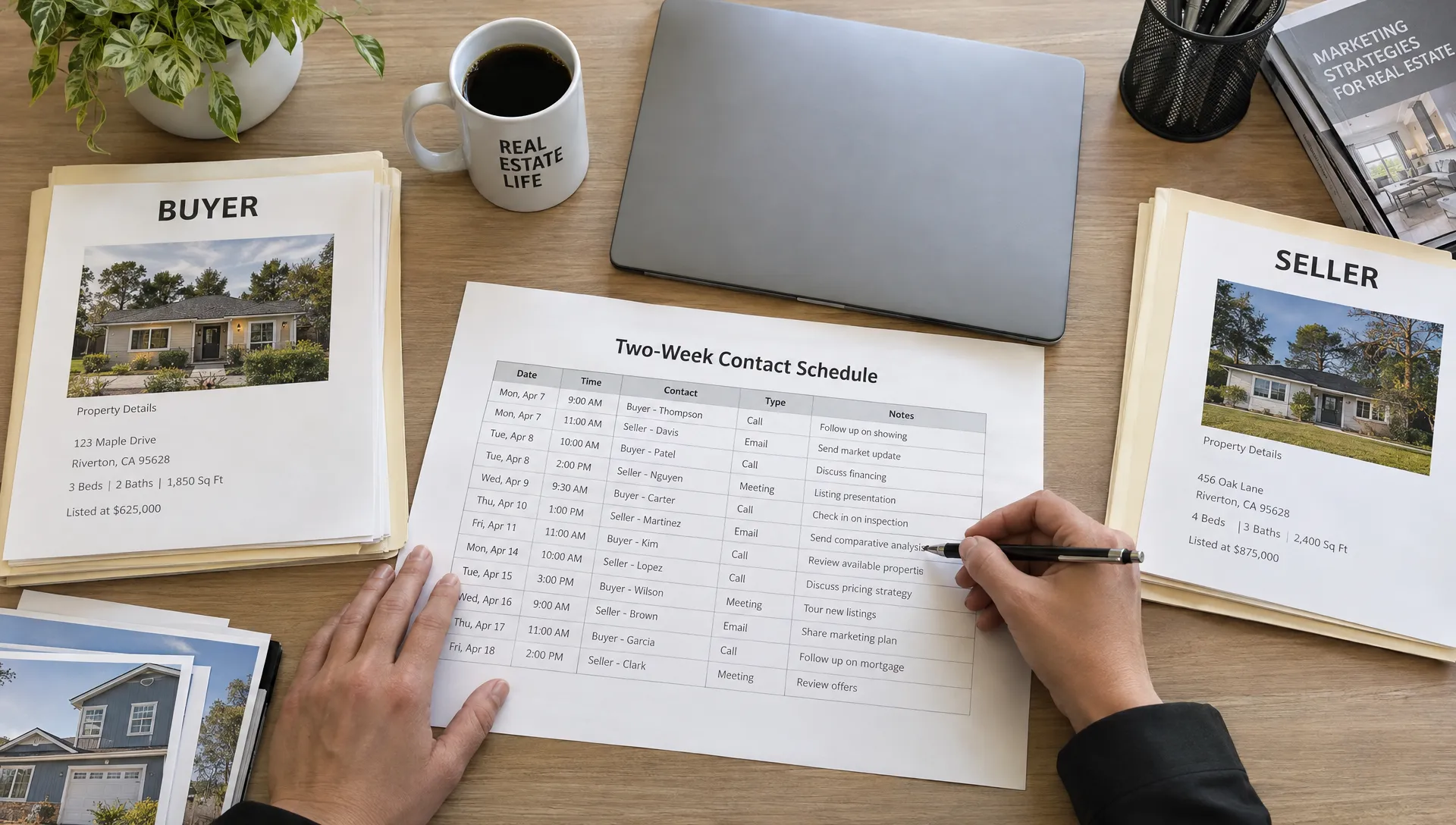
Automation is most useful for routing inquiries, creating tasks and preventing forgotten commitments. It becomes a problem when it ignores replies or lets several agents contact the same person independently.
Give each inquiry one accountable owner. Assign a backup for absences and define when an unanswered task should be escalated. Ownership should remain visible even when a colleague conducts the viewing.
Check for existing records before creating a new contact. Match normalized email addresses and phone numbers, then review uncertain duplicates manually. Do not merge people solely because they share a name. Preserve distinct property inquiries within the contact’s history.
Configure clear stopping conditions. A reply should pause generic reminders for review. A booking should move the contact into appointment preparation. An opt-out should suppress the relevant marketing, including sequences run by other agents.
Your real estate lead follow up system should also preserve conversational context during handoffs. Record the person’s goal, the last useful exchange and the commitment already made. “Call this lead” is not enough; “Confirm whether Saturday’s viewing can include the garage” gives the next agent something concrete to do.
Test these rules with sample records before launch, including a duplicate inquiry, a reply, a booking and an opt-out.
Reactivate inactive contacts with a reason
Silence can mean that timing changed, another property took priority or the person simply did not need help. Do not assume it means you should increase frequency.
At the end of the active sequence, distinguish between a confirmed future plan and an unanswered inquiry. A future plan deserves an agreed reminder. An unanswered inquiry can move to an inactive status without automatic ongoing messages.
Reactivation should have a relevant reason and an appropriate permission basis. Examples include a property that meets a previously agreed search brief or a follow-up date the contact requested. Avoid using unrelated listings as an excuse to reopen every old record.
Example: “Hi [Name], when we last spoke, you were planning to review your sale this autumn. Is that still useful, or would you prefer that I close the reminder?”
A real estate lead follow up reactivation message should make “not now” easy to express. If there is no response, avoid repeatedly restarting the same sequence. Review old records periodically, remove unnecessary personal data under your retention policy and keep the suppression information needed to respect contact preferences.
Measure response quality, not activity alone
A high message count tells you very little about whether people received useful help. Review performance by source and intent so that exploratory social inquiries are not judged against direct viewing requests.
| Metric | Practical definition | What it helps you assess |
|---|---|---|
| Meaningful first-response time | Time from inquiry to the first reply addressing the request, excluding automatic acknowledgments | Whether coverage and routing work |
| Useful reply rate | Contacts providing a relevant answer, preference or next step, divided by contacts reached in the sequence | Whether messages invite a conversation |
| Appointment booking rate | Contacts booking an appointment, divided by contacts entering the relevant sequence | Whether the sequence creates an appropriate next step |
| Appointment attendance rate | Attended appointments divided by appointments due in the reporting period | Whether booking and confirmation are clear |
| Negative feedback rate | Contacts opting out or complaining, divided by contacts reached | Whether targeting or frequency needs attention |
Define each measure consistently and review the reasons behind the numbers. A lower booking rate may reflect a source attracting people who are earlier in their search, rather than poor agent performance.
Improve real estate lead follow up by changing one element at a time, such as the opening question or the timing of the second message. Read a sample of conversations alongside the figures. Small volumes can be misleading, so avoid declaring a winner after only a few inquiries.
Frequently asked questions
How quickly should an agent respond to a new inquiry? Respond as soon as practical during staffed hours. Set a target your team can meet and provide clear expectations outside those hours. Measure the first useful response separately from an automated acknowledgment.
How many follow-up attempts should you make? There is no universal number. The five-touch example above is a starting workflow, not a performance guarantee. Adjust it to the request, timing, permissions and responses. Stop when someone opts out, and pause generic automation when they reply.
Should every lead receive a phone call, email and text? No. Start with the channel used or requested, subject to applicable rules. Additional channels need a practical reason and an appropriate permission basis. More channels do not automatically make the exchange more useful.
How long should real estate lead follow up continue? Continue according to expressed interest and agreed timing, not an indefinite calendar. A person planning next year may welcome a scheduled check-in. Someone who has not replied should not automatically receive permanent promotional messages.
Add a relevant video to your next sequence
If your next message would benefit from a property overview, Diane’s AI real estate video tools can turn listing photos and details into narrated videos, with options including AI avatars, voice cloning and social media formats. Use the video to answer a specific question, then ask for one clear next step. Start with one lead segment, test the workflow and review the conversations before expanding it.