
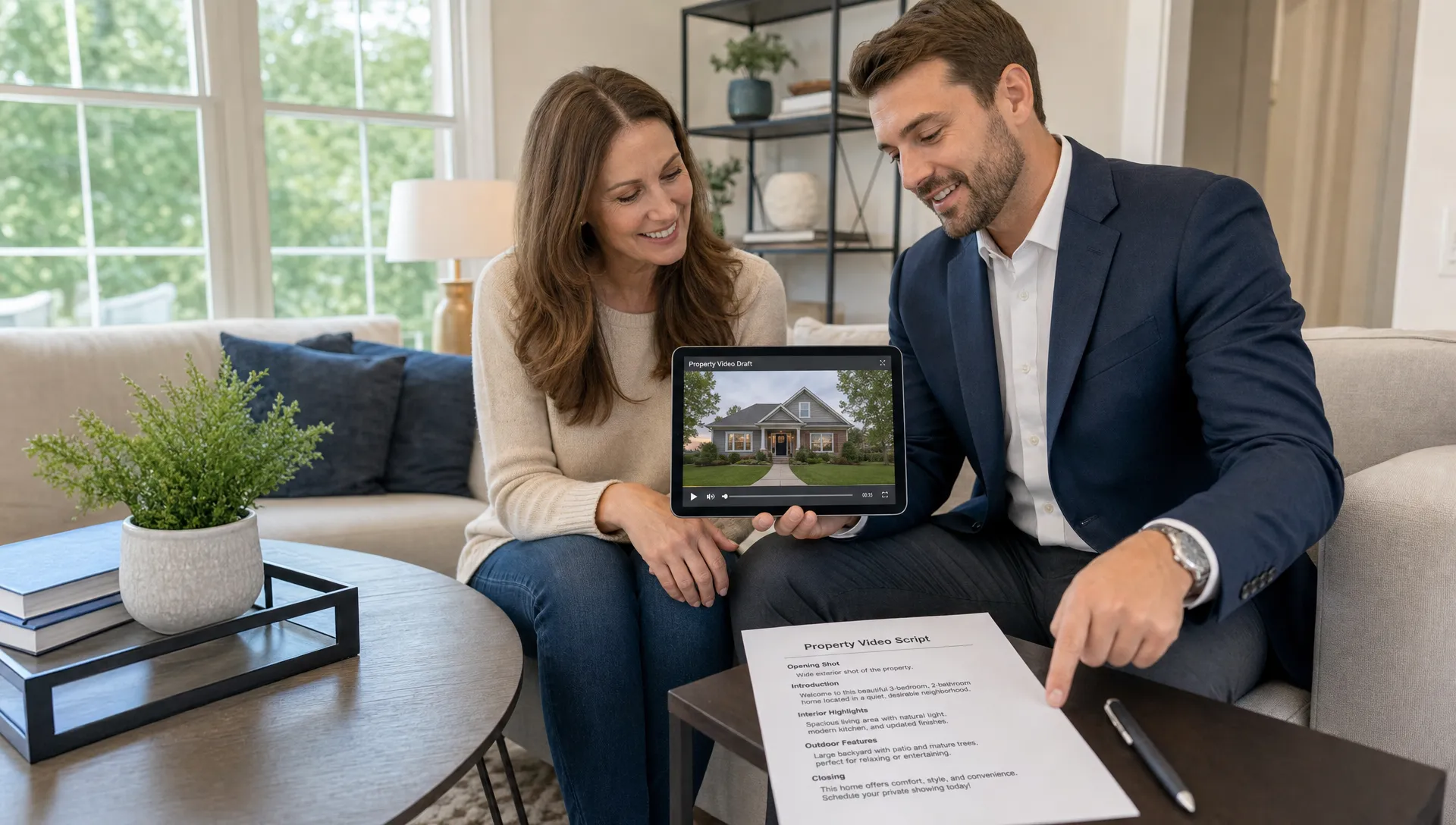
How to Write a Real Estate Script for a Property Video
A real estate script is the difference between a property video that feels like a slideshow with music and one that makes a buyer want to book a viewing. The script decides what the viewer hears first, which details feel important and how the video moves from curiosity to action.
For agents, the goal is not to write something theatrical. The goal is to turn listing facts into a clear, spoken story that sounds natural, respects compliance boundaries and makes the property easier to understand in less than a minute. A good script helps you stay focused whether you are narrating the video yourself, using an AI avatar or creating a multilingual version for different buyer audiences.
Start with the job of the video, not the features
Before writing, decide what the video needs to achieve. A listing launch video has a different job than a price reduction video, a neighborhood teaser or a follow-up video sent to warm leads after an open house.
Most property videos should do one of three things: attract first attention, qualify the right buyers or push interested prospects to schedule a visit. Trying to do all three in one short reel usually leads to a crowded script. You end up naming every feature, rushing the narration and giving the viewer no clear reason to act.
A practical real estate script starts with one sentence that defines the viewer and the desired action. For example: This video should make downsizing buyers book a viewing because the home is low maintenance, bright and close to daily essentials. That one sentence becomes your filter. If a detail does not support it, cut it or save it for the property description.
A real estate script structure that works for property videos
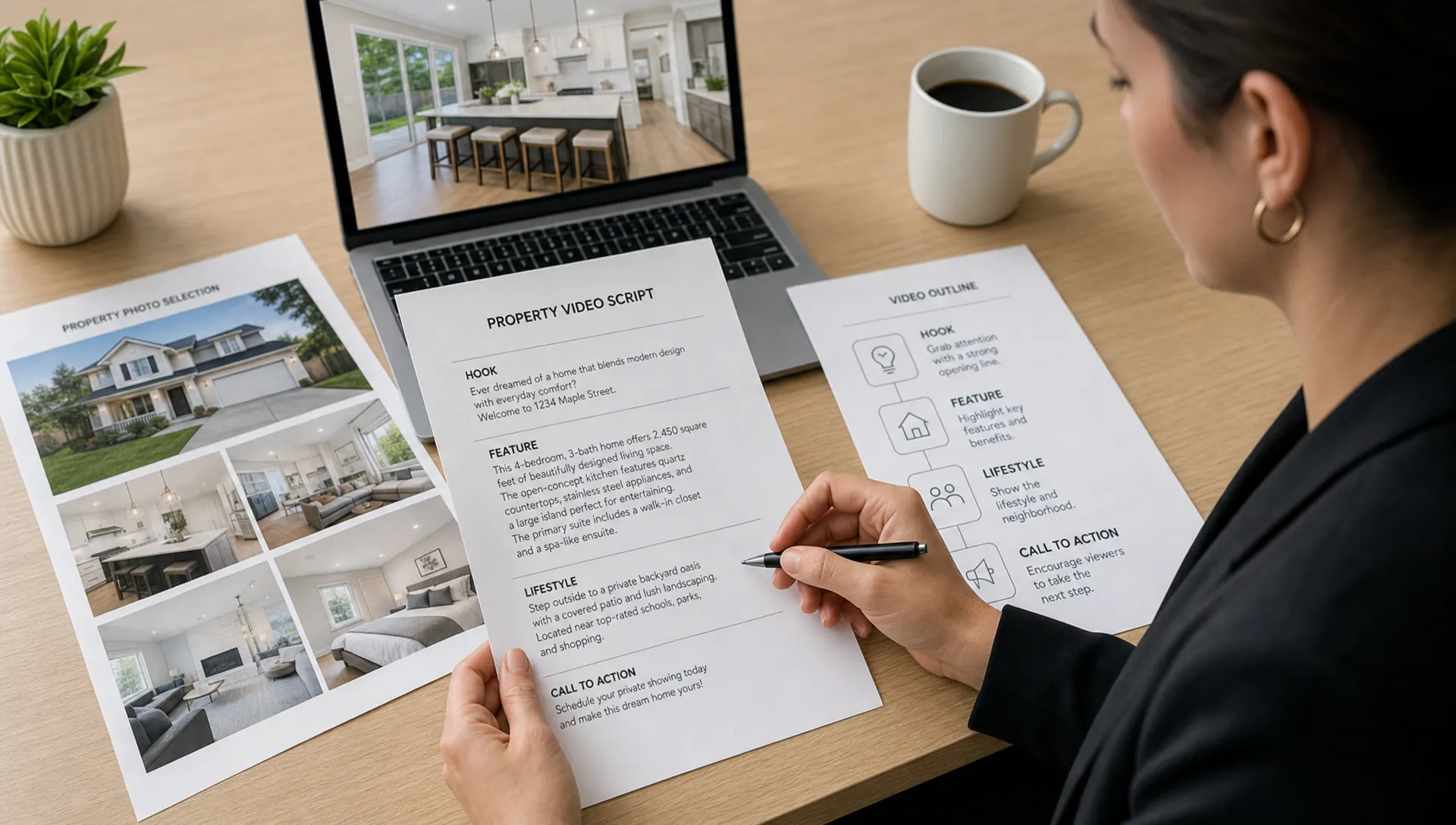
A strong real estate script usually follows a simple sequence: hook, orientation, proof, lifestyle and call to action. The order matters because viewers need context before they can care about the details.
The 5-part flow
Use the first seconds to make the property feel relevant, not to introduce yourself. Your name and agency branding can appear visually or near the end. The voiceover should immediately answer why this listing deserves attention.
| Video moment | Script goal | Example line |
|---|---|---|
| Hook | Give the viewer a reason to keep watching | A quiet corner lot with a renovated kitchen, just minutes from the town center. |
| Orientation | Say what the property is and where it sits | This three-bedroom home is located in Westfield, close to shops and commuter routes. |
| Proof | Highlight the most persuasive facts | The open living area leads to a south-facing patio and a fenced backyard. |
| Lifestyle | Help buyers imagine use, not just features | It is set up for easy weekday mornings and relaxed weekends outdoors. |
| CTA | Tell the viewer what to do next | Message me to schedule a private showing this week. |
This real estate script structure keeps the video moving. It also prevents the common mistake of opening with a long exterior shot while the narration says nothing more useful than welcome to this beautiful home.
Timing by video length
The shorter the video, the more selective the script must be. A 15-second reel can sell one idea. A 60-second video can explain the property more fully, but it still should not read like an MLS description.
| Video length | Best use | Approximate script length |
|---|---|---|
| 15 seconds | Teaser, new listing alert, social ad | 35 to 45 spoken words |
| 30 seconds | Main listing reel, portal video, Instagram or Facebook post | 70 to 90 spoken words |
| 60 seconds | Premium property tour, buyer follow-up, agency website video | 130 to 160 spoken words |
As a rule, read the script out loud before producing the video. If you run out of breath, the narration is too dense. If every sentence begins with this home features, rewrite it in a more conversational rhythm.
Write for the buyer you want to attract
The best script is not the one that lists the most features. It is the one that makes the right buyer feel the listing fits their situation. A first-time buyer, relocating executive, investor, downsizer and commercial tenant all listen for different signals.
A real estate script for a first-time buyer might stress efficient layout, natural light and proximity to daily services. A script for a luxury listing might focus on privacy, design quality and entertaining spaces. For an investor, the narration may need to speak to rentability, maintenance profile and location fundamentals without making promises you cannot support.
Write down the buyer type before writing the hook. Then choose three details that matter most to that buyer. This keeps the script from becoming a feature dump and gives the final video a stronger point of view.
Match the promise to the property type
Residential scripts often work best when they connect rooms to everyday use. Instead of saying spacious living room, explain what the space allows: a full seating area, a dining corner and direct access to the patio. The viewer can picture the room before seeing every angle.
Commercial scripts need a slightly different approach. Office, retail and mixed-use properties often require more emphasis on access, layout flexibility, lease terms, fit-out condition and pricing logic. Commercial agents can also look at market-specific resources, such as this office space pricing workflow for landlords in Malta, to see how rent logic, preparation and negotiation points shape the story behind a listing.
Turn listing facts into spoken language
Listing descriptions are usually written for scanning. Video narration is written for listening. That means shorter sentences, fewer stacked adjectives and smoother transitions between ideas.
A polished real estate script should sound like an agent guiding a buyer through the strongest reasons to care. It should not sound like someone reading the brochure into a microphone.
| Listing-style wording | Better video wording |
|---|---|
| Stunning 4-bedroom, 3-bath residence with premium finishes throughout | This four-bedroom home combines a practical family layout with upgraded finishes in the spaces buyers use every day. |
| Conveniently located near amenities | You are close to grocery stores, cafes and the main commuter route. |
| Chef's kitchen with abundant storage | The kitchen has a large prep island, generous storage and a layout that keeps the cook connected to the living area. |
| Must-see backyard oasis | The backyard is private, fenced and ready for outdoor dining or weekend gatherings. |
Notice that the improved lines are still positive, but they are more specific. Specificity builds trust. If the video says bright, show the windows. If it says move-in ready, show the condition. If it says flexible layout, show the room that could become an office, guest room or playroom.
A real estate script template you can copy
Use this real estate script template when you need a reliable 30-second property video. It is designed for a narrated reel, but it also works for an on-camera agent or an AI avatar.
30-second property video template
Opening hook: If you are looking for [buyer benefit], this [property type] in [location] deserves a closer look.
Orientation: It offers [bedrooms or key size detail], [bathrooms or layout detail] and a setting close to [location advantage].
Main feature 1: Inside, [strongest room or design feature] creates [practical value for the buyer].
Main feature 2: You also have [second persuasive feature], which is ideal for [specific use].
Lifestyle line: The result is a home that feels [emotional benefit] without sacrificing [practical benefit].
Call to action: Send me a message to request the details or schedule a private showing.
The template is intentionally simple. You can make it more elegant with better footage, pacing and delivery, but the core job stays the same: hook the right viewer, prove the value and ask for the next step.
Example property video scripts for common listing situations
Examples are useful because they show how much can be said with restraint. Adapt the wording to your market, listing rules and brand voice.
New listing teaser
For a short teaser, keep the promise narrow. You are not selling the whole property yet. You are giving viewers a reason to pause and ask for more.
A renovated townhouse just hit the market in Brookline. Inside, you will find an open main level, a modern kitchen and a private patio that makes the space feel larger than expected. If you want the full details before showings begin, send me a message today.
This kind of short video works well for Instagram Reels, Facebook, TikTok and Stories because it makes one clean point and ends with a direct action.
Family home walkthrough
A family-focused script should stay factual and avoid assumptions about protected classes. Do not say perfect for families with kids. Instead, describe the rooms, storage, yard and location features accurately.
This four-bedroom home in Maple Ridge gives you space where it matters most. The main level has a bright living area, a connected dining space and a kitchen with room for everyday meals. Upstairs, the bedrooms are grouped together, while the fenced backyard adds usable outdoor space. Contact me to arrange a private tour.
Condo or apartment listing
For condos, the strongest angle is often convenience. Focus on the layout, light, storage, building amenities and connection to the surrounding area.
This one-bedroom condo is designed for easy city living. The open layout keeps the kitchen and living area connected, floor-to-ceiling windows bring in natural light and the building places you close to restaurants, transit and daily essentials. Message me for pricing, fees and available showing times.
Luxury property video
Luxury narration should be calm, specific and confident. Overwriting can make the listing feel less premium.
Set on a private lot with wide interior sightlines, this residence is built around light, proportion and quiet outdoor living. The main suite opens toward the garden, the kitchen anchors the central living space and the covered terrace extends the home for entertaining. Private showings are available by appointment.
Write the way people speak on video
A real estate script is meant to be heard, not admired on a page. Read every line aloud and listen for phrases that sound stiff. If you would not say it to a buyer during a showing, it probably does not belong in the narration.
Good video language is direct. Say the kitchen opens to the living area instead of this culinary space seamlessly integrates with the home's social core. Say the backyard is fenced and private instead of resort-inspired outdoor sanctuary. Buyers can detect inflated language quickly, especially when the footage does not support it.
Pacing also matters. Leave room for the visuals. If the video shows the kitchen, the script does not need to name every appliance. Use the narration to point out the benefit of what viewers are seeing, then let the footage carry the detail.
If you use an avatar or AI narration, the script should be even cleaner. Shorter sentences help the voice sound more natural. For agent-led branding, an avatar can also make listing videos feel more personal when you cannot record yourself for every property, especially if the video still uses your tone and market knowledge. Diane's article on real estate avatars for listing videos explores that balance in more detail.
Compliance and clarity checks before you publish
Real estate video scripts should sell the property without creating avoidable risk. The safest habit is to describe the property, verified facts and observable benefits rather than the type of person you imagine living there.
Before publishing, check the script for three things: unsupported claims, vague superlatives and language that could conflict with fair housing rules. Phrases such as safe neighborhood, ideal for young families or exclusive community can create problems depending on context and jurisdiction. Replace them with factual details: gated entry, nearby park, low-traffic street or homeowner association amenities, if accurate and permitted.
Also make sure the script aligns with the visuals. If the narration mentions a renovated bathroom, show it. If you mention a view, show the view. If you refer to a home office, show the room without implying it is a legal bedroom unless that is verified.
A final review should include price, address, square footage, bedroom count, fees and availability if those details appear in the video. Outdated information can spread quickly when a reel is reposted or shared by a buyer.
How AI can speed up your scripting without making it generic
AI can help agents move faster, but the output still needs your judgment. The listing data provides the raw material. Your market knowledge decides what matters, what to cut and how to phrase the offer for the right buyer.
A useful real estate script prompt includes the target buyer, property type, video length, top three selling points, tone and required call to action. It should also include what to avoid, such as exaggeration, unverified claims or fair housing-sensitive wording.
For example, instead of asking AI to write a property video, ask for a 30-second narrated listing video for a renovated two-bedroom condo aimed at commuters, with a calm professional tone, focusing on light, storage and transit access, ending with a request to book a showing. That level of direction produces a much stronger draft.
Diane is built for this workflow because it turns listings, photos and property details into ready-to-publish real estate videos with AI narration, avatars, multilingual support, branding and social formats. If you want the production side to move as quickly as the writing side, this guide on how to create real estate videos for marketing in minutes shows the broader process from listing input to publishable video.
Frequently Asked Questions
How long should a property video script be? For most social listing videos, 70 to 90 spoken words is enough for a 30-second video. A 15-second teaser usually needs 35 to 45 words, while a 60-second walkthrough can use about 130 to 160 words.
What should every real estate script include? Every real estate script should include a hook, property orientation, two or three meaningful selling points and a clear call to action. The best scripts also connect features to buyer benefits without exaggerating.
Should I write the script before choosing video clips? Usually, yes. The script gives the video a clear story, then the clips prove each point. If you already have footage, write the script while reviewing the clips so the narration matches what viewers see.
Can I reuse the same script on different platforms? You can reuse the message, but adjust the length and opening for each channel. A vertical social reel needs a faster hook than a website video, and a portal video may need more property context.
Is an AI-generated script good enough for a listing video? It can be a strong first draft if you provide clear inputs. Always review it for accuracy, local compliance, natural phrasing and whether it reflects the real buyer appeal of the property.
Turn your listing notes into a publish-ready video
A strong script does not need to be complicated. It needs to be specific, buyer-focused and easy to say out loud. Once you know the viewer, the strongest selling points and the next action, the video becomes much easier to produce.
With Diane, agents and agencies can turn listing details into narrated property videos using AI avatars, voice cloning, multilingual versions, cinematic editing and social-ready formats. Start with the script, let the visuals prove it and give every listing a clearer path from first view to booked showing.