
Build a Real Estate Agent Marketing Package Sellers Can Review
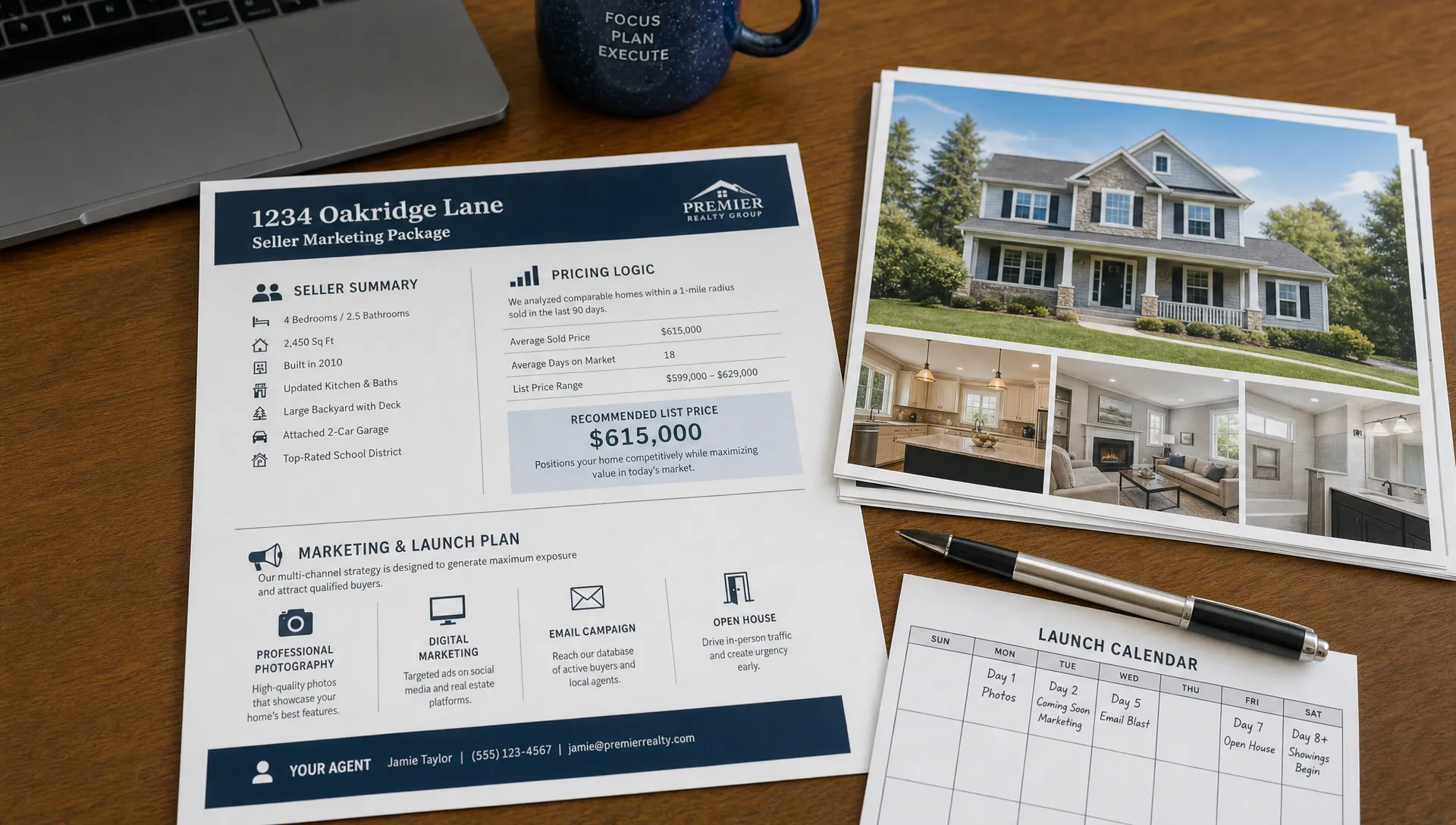
Most sellers do not need a thicker pitch deck. They need a clearer way to compare what you will do, when you will do it and how your plan protects their sale. A real estate agent marketing package gives them that reviewable proof in one place, so your listing appointment does not depend on charm, memory or a quick verbal promise.
The best packages are practical, not decorative. They help a homeowner understand your pricing logic, your launch timeline, your content plan, your communication rhythm and the exact role you will play once the listing goes live. For independent agents and small agency owners, that clarity can make you look more organized than competitors with larger teams.
Treat the package as a seller decision tool. It should be easy to read after the appointment, easy to share with a spouse or co-owner and specific enough to show that you have thought about this property, not just your brand.
What a real estate agent marketing package should prove
A seller is usually trying to answer four questions before they sign: Can you price the home intelligently, can you expose it to the right buyers, can you communicate under pressure and can you make the process feel manageable? Your package should answer those questions with evidence.
| Seller concern | Package section that answers it | What to include |
|---|---|---|
| Will my home be priced correctly? | Market position | Comparable sales, buyer demand signals, pricing scenarios |
| Will enough buyers see it? | Marketing distribution | Listing portals, social channels, email, agent network, video formats |
| Will the home look its best? | Presentation plan | Photography, video, staging notes, copywriting, floor plan or feature highlights |
| Will I know what is happening? | Communication plan | Update cadence, showing feedback process, weekly review points |
| Why should I trust you? | Agent proof | Relevant sales experience, process, testimonials, local knowledge |
A reviewable real estate agent marketing package does not have to overwhelm the seller with every tactic you know. It should make your plan feel concrete enough that the seller can picture the first two weeks of the listing, then understand how you will adapt if buyer response is slower than expected.
Build the package around the seller decision process
Many agents organize their materials around what they want to say. Sellers organize their decision around risk. They are thinking about price, timing, disruption, privacy, negotiation and whether the wrong choice of agent could cost them money.
A strong package meets those concerns in the order a seller naturally considers them. Start with the outcome, then show the plan, then support it with proof.
Start with a one-page seller summary
The first page should act like an executive summary. Include the property address, the seller’s likely goal, your recommended positioning and the key actions you would take before launch. If the homeowner needs speed, say how your plan supports speed. If the seller wants a premium result, show how presentation and exposure support that aim.
This page should not be a generic biography. Your experience matters, but only after the seller sees that you understand their specific situation.
Show your pricing logic without turning it into a CMA dump
Your pricing section should be clear enough for a seller to revisit later. Rather than pasting every comparable sale into the package, summarize what those comps prove. Separate active competition from sold evidence, because sellers often confuse asking prices with market value.
A practical real estate agent marketing package can include three pricing paths: an assertive launch price, a balanced market price and a faster-sale price. You do not need to pressure the seller into one option during the appointment. Instead, show the tradeoffs so the final recommendation feels informed.
Translate the listing timeline into seller actions
A listing timeline is more useful when it shows what you handle and what the seller needs to do. Use simple stages: preparation, media creation, pre-launch, launch week, feedback review and adjustment.
This is where solo agents can win trust. Sellers know you may not have a large operations team, so they want confidence that nothing will be missed. A clean timeline shows you have a repeatable process.
Core sections to include in the package
The strongest real estate agent marketing package feels like a roadmap, not a brochure. It should help the seller understand your plan and also make it easier for you to deliver consistently once you win the listing.
Agent positioning and trust proof
Include a short agent description that connects your experience to seller outcomes. Avoid a long award list unless it is directly relevant. A homeowner wants to know whether you can guide pricing decisions, manage marketing details and communicate clearly when offers arrive.
If you need a sharper way to present yourself, this guide to writing a real estate agent description that builds seller trust can help you turn your bio into seller-facing proof.
Property presentation plan
This section explains how you will make the property look compelling before buyers ever book a showing. Include photography, listing copy, video, floor plans, staging advice and any visual upgrades you recommend.
Do not promise services you cannot deliver. If you offer virtual staging, explain when it makes sense, such as vacant rooms, dated decor or flexible-use spaces. If you use listing videos, describe the story you will tell: arrival, main living areas, lifestyle details, outdoor space and neighborhood context.
Distribution and audience plan
Sellers often hear every agent promise exposure. Your package should make exposure specific. Name the channels you will use and why each one matters. Listing portals capture active buyers, social video reaches passive buyers, email reaches your database and agent-to-agent promotion helps surface qualified interest quickly.
You can also include local context when it helps the property story. For example, a home suited to multigenerational living may benefit from nearby healthcare access, transport options and support services. In some markets, local resources such as home care in Espoo and Turku show how practical community services can support an aging-in-place or family-care lifestyle story without turning the listing into a directory.
Communication and reporting plan
Sellers fear silence. A clear communication plan reduces that anxiety before it starts. State when they will hear from you, what you will report and how you will use feedback.
Keep the promise manageable. A weekly summary with showing activity, buyer comments, ad or social performance and recommended next actions is better than vague daily updates that become impossible to maintain.
| Package element | Seller value | Agent value |
|---|---|---|
| Launch checklist | Shows what happens before the listing goes live | Prevents missed tasks |
| Video plan | Helps sellers see how the home will be presented | Creates reusable marketing content |
| Feedback report | Reduces uncertainty after showings | Supports pricing and strategy conversations |
| Adjustment plan | Shows you are proactive if response is weak | Makes future price or marketing changes easier |
Make video a visible part of the package
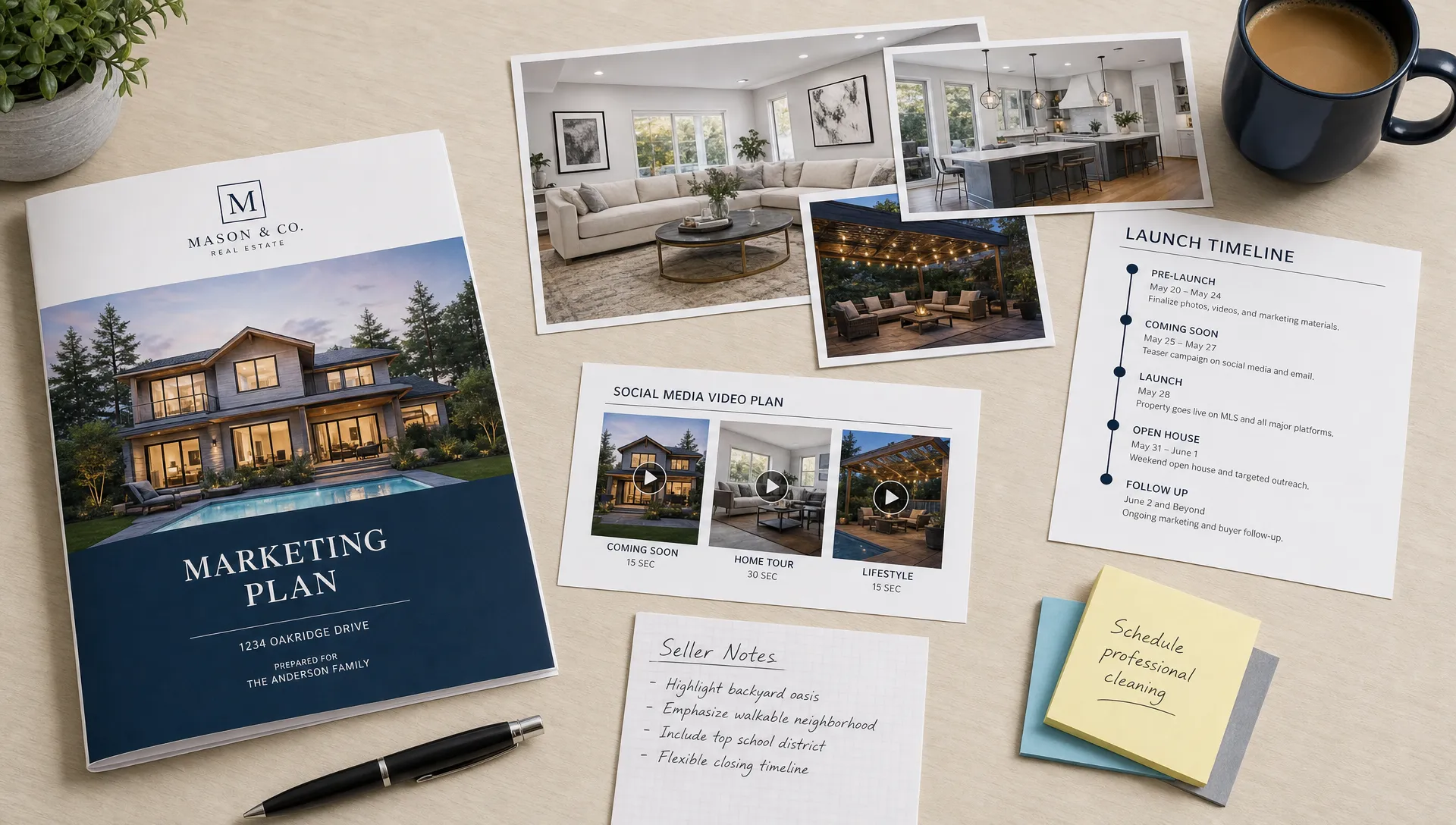
If your real estate agent marketing package still treats video as an optional social media extra, sellers may question whether your plan matches how buyers browse today. Buyers often decide whether a home feels worth viewing before they contact an agent, so motion, narration and room-to-room flow can make the listing easier to understand.
Video does not need to mean a full production crew for every property. For many listings, the goal is a polished marketing reel that turns photos, listing details and a clear script into a shareable asset. That is especially useful when you need content for Instagram Reels, TikTok, Facebook, YouTube Shorts, email and listing pages.
A seller-facing video section can include the formats you plan to create, where each version will be published and what message each format supports. For example, a 30-second reel can drive attention on social media, while a longer narrated version can help serious buyers understand the floor plan and key features.
If you want a deeper practical breakdown, this article on video marketing for real estate agents that drives viewings explains how to connect video assets to buyer action instead of treating them as vanity content.
Package your process in a format sellers will actually review
A real estate agent marketing package works best when it is both polished and easy to skim. Most sellers will not reread a 40-page presentation. They may reread an 8 to 12 page PDF that clearly summarizes your recommendation, your timeline and your marketing deliverables.
Use consistent headings, plain language and property-specific notes. A good rule is that every page should answer one seller question. If a page exists only because it looks impressive, cut it or move it to a supporting appendix.
Recommended page order
Keep the flow simple so the seller can share it with another decision-maker after the appointment.
- Seller goal and property summary
- Market position and pricing logic
- Preparation and launch timeline
- Property presentation plan
- Video and social content plan
- Distribution strategy
- Communication and reporting plan
- Agent proof and next steps
This order keeps the seller’s property at the center. Your brand still appears through design, tone, clarity and proof, but the package does not feel like a self-promotional deck.
Add a short post-appointment version
After the listing meeting, send a shorter version within the same day if possible. This can be a two-page recap that restates the recommended strategy, the launch timeline and any decisions still needed from the seller.
This follow-up is often where agents lose momentum. The seller may be meeting with two or three competitors, so your package should make it easy for them to remember why your plan felt organized.
Use AI to reduce packaging work without losing your voice
Before you bring a real estate agent marketing package into every listing appointment, make sure the system behind it is repeatable. If every package takes hours of manual copywriting, design and video editing, you will stop using it when your week gets busy.
This is where AI can help, especially for listing video creation. Diane turns property listings, photos and details into ready-to-publish marketing reels with AI narration, animated avatars, cinematic editing and social formats. Agents can use their voice, their face or an AI avatar, then adapt content for different listing channels.
The key is to keep strategic control. AI should accelerate the assets, not replace your judgment. You still decide the positioning, the seller message, the pricing story and the local context. The technology helps you turn those decisions into polished content faster.
For a practical workflow, this guide on how to create real estate videos for marketing in minutes shows how agents can move from listing details to usable video without traditional production delays.
Seller review checklist
Use this checklist before sending or presenting your package. It will help you catch the gaps that make sellers hesitate.
- The package names the seller’s goal and property-specific challenge.
- The pricing section explains logic, not just numbers.
- The launch timeline separates agent tasks from seller tasks.
- The marketing plan includes visual presentation, video, copy and distribution.
- The communication plan says when the seller will hear from you.
- The proof section connects your experience to this type of property or seller.
- The next step is obvious, such as signing the listing agreement or approving preparation tasks.
Your real estate agent marketing package should also be easy to update after the appointment. If the seller asks about a different price, a delayed launch date or a staging concern, revise the package and send a clean version. That small act reinforces that you are responsive and detail-oriented.
Frequently Asked Questions
How long should a real estate agent marketing package be? For most sellers, 8 to 12 pages is enough. The goal is to make your strategy easy to review, not to prove how much marketing knowledge you have. Add supporting detail only when it helps the seller make a decision.
Should I bring a printed package or send a PDF? Use both when appropriate. A printed package helps in the appointment, while a PDF is easier for sellers to share with a spouse, co-owner or advisor afterward. Make sure both versions match so there is no confusion.
What should I customize for each seller? Customize the property summary, pricing logic, preparation advice, launch timing, likely buyer profile and video plan. Your core process can stay consistent, but the seller should feel that the strategy was built for their home.
Can a newer agent use this approach? Yes. A newer agent can build trust by showing a disciplined process, clear communication and strong marketing execution. If you have fewer past sales, lean on preparation quality, brokerage support, local research and transparent reporting.
How often should I update the package template? Review it every quarter or whenever your marketing channels, video workflow or seller objections change. A stale template can make your strategy feel generic, even if your actual service is strong.
Turn your package into listing content faster
A reviewable package helps sellers choose you. Polished listing content helps you deliver on the promise once they do.
With Diane, agents and agencies can create AI-powered real estate videos from listing details, photos and property information in minutes. Use your voice, your face or an AI avatar to turn your seller strategy into social-ready videos that support a more professional listing launch.