

Write a Real Estate Agent Description That Builds Seller Trust
A strong real estate agent description does not read like a trophy cabinet. It gives a homeowner reasons to believe you can protect their sale, reduce stress and communicate clearly when money, timing and emotion all collide. If your real estate agent description sounds generic, a seller may assume your service is generic too.
For sellers, choosing an agent is a risk decision. They are asking whether you understand their local market, whether you can create demand for their property and whether you will stay calm when negotiations get uncomfortable. Your description should help them answer those questions before they ever book a valuation call.
Why seller trust starts before the listing appointment
A seller may meet three agents who all say they are experienced, responsive and committed to getting the best price. Those words are easy to say, which makes them weak trust signals. What sellers remember is specificity: the type of property you handle, the area you know well, the process you follow and the way you help them make decisions.
Trust is not built by sounding impressive. It is built by reducing uncertainty. A homeowner wants to know what will happen after they invite you in, how you will position the home, how you will communicate feedback and how you will negotiate without creating unnecessary pressure.
Many agents write profile copy for other agents instead of for sellers. Awards, production volume and years in the industry can matter, but only when they connect to a seller benefit. If a detail does not help a homeowner feel safer choosing you, it probably belongs lower in the description or not at all.
What a real estate agent description must prove to sellers
Sellers read agent profiles through a practical filter: can this person handle my specific move? A real estate agent description should therefore prove three things quickly: local competence, a clear sale process and credible marketing capability.
Local competence
Local competence is more than naming a city. Sellers want to know that you understand buyer demand, pricing behavior, property types and neighborhood nuance. Instead of saying you know the local market, explain the slice of the market you know best.
For example, an agent who works with suburban family homes might mention school catchments, commute patterns and buyer expectations around gardens or parking. An agent who handles city apartments might focus on building amenities, investor demand, rental appeal and presentation in compact spaces.
A clear sale process
A homeowner may not sell often, so your process is part of your value. Your description can briefly explain how you move from valuation to launch, viewing feedback, offer review and closing support. This helps sellers imagine working with you.
Process language is especially useful for independent agents because it shows professionalism without relying on a large agency brand. If you can describe the path clearly, sellers are more likely to believe you can guide them through it.
Marketing capability
Sellers care about marketing because exposure affects demand. Mention the ways you present a listing only if you can connect them to a seller outcome. Professional photos, buyer-focused copy, short-form video, social distribution and portal optimization all become stronger when framed as ways to make the property easier to notice, understand and remember.
| Weak description line | Trust-building alternative | Why it works |
|---|---|---|
| I am passionate about real estate | I help homeowners in North Austin prepare, price and market their homes with a clear weekly communication plan | It names the audience, location and service experience |
| I always go above and beyond | Sellers work with me because I explain tradeoffs clearly before they make pricing, offer and repair decisions | It defines what extra care looks like |
| I use modern marketing | I create listing copy, social video and buyer-focused property tours designed to make the home easy to understand online | It turns marketing into a concrete seller benefit |
| I am a skilled negotiator | I help sellers compare offer strength, contingencies, timing and net proceeds before responding | It shows judgment rather than making a vague claim |
Use this seller-first structure
Your real estate agent description should answer a simple question in the seller's mind: why should I trust you with this sale? A reliable structure keeps the copy focused and prevents it from drifting into a resume.
Open with who you help
The first sentence should make the right seller feel recognized. Include your market, your client type and the main outcome you help with.
A useful formula is: I help homeowners in [area] sell [property type] with [specific advantage].
That might become: I help homeowners in Westchester sell character homes with careful pricing, polished marketing and steady guidance from valuation to closing.
This is stronger than a general introduction because it gives the seller context immediately. They can decide whether you sound relevant within seconds.
Add proof without bragging
Proof can include years of experience, transaction volume, client reviews, neighborhood specialization, repeat clients or a previous career that strengthens your service. Use numbers only if they are accurate and current. If you do not have big production stats, use proof of method instead.
Process proof might sound like: Before launch, I review competing listings, buyer search behavior, photography priorities and likely objections so we can position the home with fewer surprises.
That kind of sentence tells a seller how you think. It can be more persuasive than a broad claim about being a top agent.
Explain the working experience
Sellers want to know how you will communicate with them. Add one or two lines about the service rhythm: preparation advice, launch plan, showing feedback, offer comparison and next-step recommendations.
Keep this practical. A homeowner does not need your entire operating manual, but they do need to feel that you have one.
Close with a low-pressure next step
Your final line should invite action without sounding pushy. A good close might be: If you are considering a sale this year, I can help you understand your likely price range, preparation priorities and best launch timing.
That gives sellers a reason to contact you even if they are not ready to list immediately.
Before and after: from generic to trust-building
Before: Experienced real estate professional dedicated to providing outstanding service, strong negotiation and excellent results for buyers and sellers.
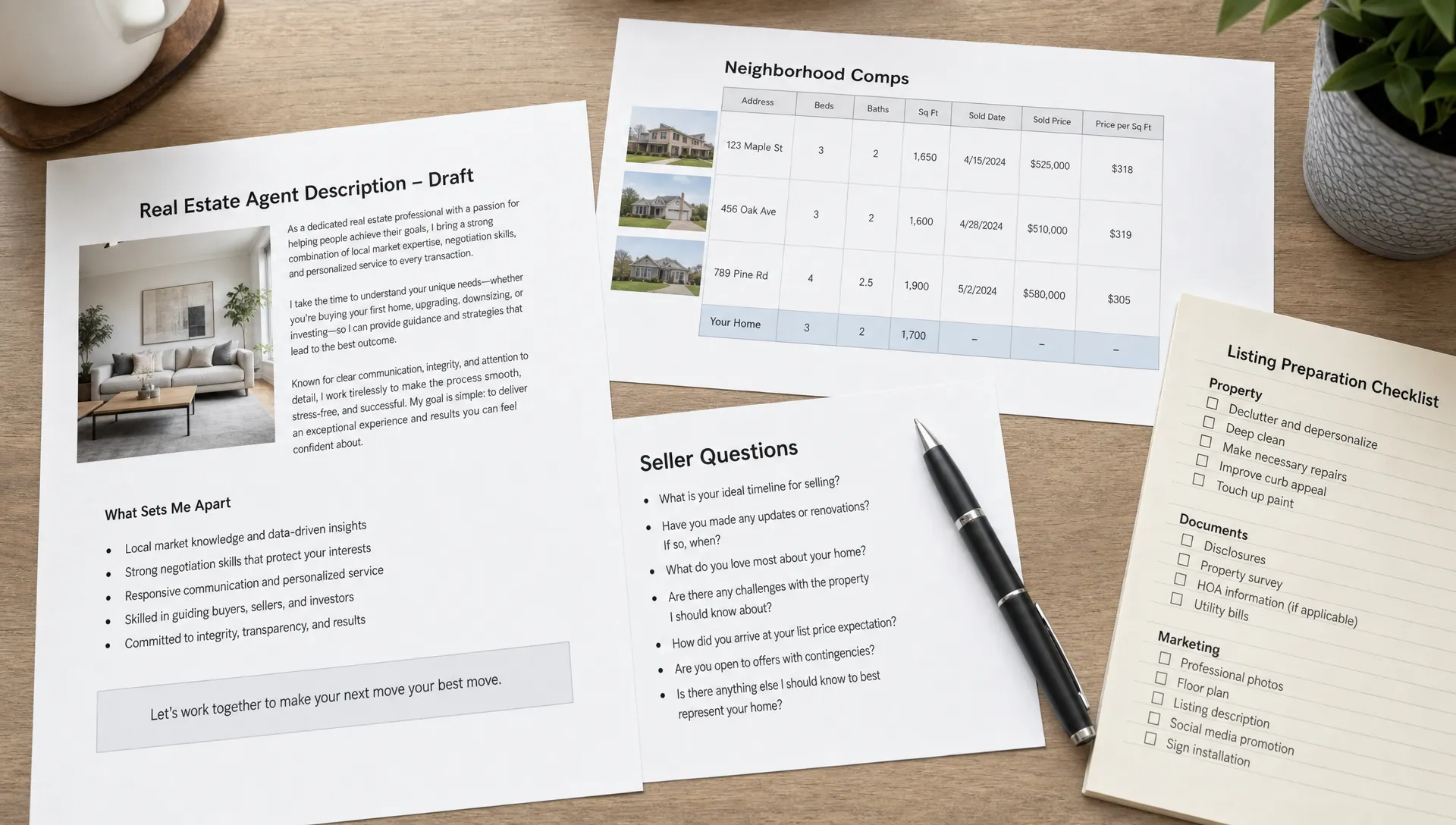
After: I help homeowners in the South Bay prepare, price and market family homes with a calm, step-by-step sale plan. Before listing, I review comparable homes, buyer demand, presentation priorities and likely negotiation points so you can make decisions with clarity. Sellers work with me for practical advice, consistent communication and marketing that helps the right buyers understand the value of the home quickly.
The after version works because it replaces broad claims with observable behavior. It tells the seller where the agent works, what kind of help they provide and how the client experience will feel. It also avoids promising a specific result, which protects credibility.
Adapt the description to each channel
A real estate agent description for your website can be longer than the one on a portal, a social profile or a printed listing presentation. The core message should stay consistent, but the length and emphasis should change by channel.
Website and agency profile
Your website profile can carry the fullest version. Aim for a concise opening, a proof paragraph, a service paragraph and a call to action. If you have testimonials, place them nearby rather than forcing every proof point into the bio itself.
For agency-employed sales agents, this is also where you can balance personal expertise with the support of the wider agency. Sellers want to know who will personally guide them, not only which logo appears on the signboard.
Social media bio
Social bios need compression. Focus on location, seller type and the next step. For example: Helping Brooklyn homeowners sell with clear pricing, polished marketing and calm negotiation. Message me for a pre-sale plan.
This is not the place for every credential. Social platforms work best when the bio makes your positioning easy to grasp and your content proves the rest over time.
Listing presentation and valuation follow-up
Your written profile should support your in-person conversation, not replace it. If you need to sharpen the spoken version, this guide on how to write a real estate agent pitch sellers remember is a useful companion because a pitch and a profile solve different problems.
In a listing presentation, shorten the description and put it near evidence: marketing samples, pricing rationale, recent comparable activity and a clear timeline. Sellers do not need more adjectives at that stage. They need confidence that your plan is organized.
Video intro
Video can make your description feel more personal because sellers hear tone, pace and confidence. A short introduction works well at the start of seller-focused market updates, listing launch videos or follow-up messages after a valuation.
With Diane, agents can turn listing details, photos and property information into ready-to-publish narrated videos using their own voice, their face or an AI avatar. If your written positioning is clear, it becomes much easier to reuse in video without sounding scripted.
Avoid mistakes that weaken seller confidence
A real estate agent description loses trust when it asks the seller to believe too much without evidence. The most common issues are vagueness, unsupported claims and copy that could belong to any agent in any city.
Being vague about risk
Selling a home involves pricing risk, timing risk, negotiation risk and emotional risk. If your copy ignores those concerns, it can feel shallow.
Borrow a useful lesson from other high-trust digital categories. Platforms such as Spinlab's modular iGaming platform have to make trust signals explicit through compliance, payment security and fraud prevention because users need to understand what protects them. Real estate is a different market, but the principle holds: name the safeguards that matter to your client.
For an agent, those safeguards might include pricing analysis, preparation advice, weekly reporting, documented feedback, offer comparison and transparent next steps.
Sounding like every other agent
Phrases like trusted advisor, dream home, full-service professional and exceptional results are so common that sellers barely register them. Replace them with plain language that describes what you actually do.
Instead of saying you provide exceptional service, say when sellers hear from you, what information you share and how you help them decide. Specificity is harder to copy, which makes it more believable.
Making claims you cannot support
Avoid superlatives unless you can prove them. Best, number one, unmatched and guaranteed can create skepticism, especially with sellers who are comparing several agents. Strong copy does not need inflated language. It needs relevant proof.
If you have strong reviews, market share or awards, use them carefully and with context. If you are newer, focus on preparation, responsiveness, mentoring support, local research and the quality of your marketing process.
Quick self-edit checklist
Review your real estate agent description line by line before publishing it. Every sentence should either build relevance, prove competence or make the seller's next step easier.
- Does the opening sentence say who you help and where you work?
- Does the copy mention seller outcomes rather than only your personal qualities?
- Are your claims specific enough to be believable?
- Have you explained how you price, prepare or market a home?
- Does the description show how you communicate during the sale?
- Have you removed generic phrases that any agent could use?
- Is the call to action useful for sellers who are early in the process?
- Can the same core message be adapted for your website, social bio and video intro?
This final edit matters because sellers often compare agents quickly. Clear positioning helps them remember you, and clear proof helps them justify contacting you.
Frequently Asked Questions
How long should a real estate agent description be? A website version can usually be 150 to 300 words, while a portal or social version may need 50 to 100 words. The goal is not length. The goal is to make your market, seller value and working style clear fast.
Should I write in first person or third person? First person often feels warmer for independent agents because it sounds direct and personal. Third person can work well on agency team pages or press-style profiles. Choose the voice that matches the page, then keep the message seller-focused.
What should new agents include if they have limited sales history? New agents should emphasize local knowledge, preparation process, responsiveness, agency support, marketing quality and previous professional experience that helps sellers. Do not pretend to have a track record you have not built yet.
Can I use the same description everywhere? Use the same positioning everywhere, but adjust the format. Your website can explain your process in more detail, your social bio should be short and your video intro should sound conversational.
How often should I update it? Review it at least twice a year, or whenever your market focus, services, achievements or marketing approach changes. Outdated descriptions can quietly weaken trust, especially if your recent work has become more specialized.
Turn seller trust into consistent listing marketing
Once your description is clear, use it as the foundation for the rest of your seller-facing marketing. Your profile, valuation follow-up, listing presentation, property descriptions and videos should all tell the same story about how you help homeowners make better sale decisions.
If you want to connect your agent positioning with stronger property marketing, this guide on how AI for real estate turns listings into scroll-stopping videos shows how listing assets can become more engaging across social and listing channels.
Diane helps agents and agencies create professional real estate videos from listings, photos and property details in minutes, with AI narration, avatars, voice cloning, multilingual support and branded social formats. When sellers see that your own message is clear and your listing marketing is polished, trust becomes easier to build before the first appointment. To bring that consistency into your next listing campaign, explore Diane.