

Write a Real Estate Agent Pitch Sellers Remember
Most sellers do not remember the agent who says, “I’ll get you the best price.” They remember the agent who makes their situation feel clear.
A strong real estate agent pitch is not a speech about your production numbers, brokerage tools or marketing checklist. It is a focused conversation that helps a homeowner believe three things: you understand what matters to them, you have a specific plan for their property and you can explain that plan better than anyone else they meet.
That matters because sellers often interview more than one agent and the pitches blur together quickly. If your presentation sounds like every other listing appointment, you become another option. If your pitch gives them a simple story they can repeat after you leave, you become the obvious choice.
Why most real estate agent pitches sound forgettable
Many listing pitches start in the wrong place. The agent opens with a biography, a sales record or a stack of comparable sales before the seller has emotionally connected with the plan.
None of those things are useless. Sellers do want competence. They want to know you can price the home, market it, negotiate and manage the transaction. The problem is that competence alone is rarely memorable.
Forgettable pitches usually have three problems:
- They rely on generic promises like “maximum exposure” and “top dollar”
- They talk more about the agent than the seller’s goal
- They present marketing as a checklist instead of a strategy
A seller does not wake up thinking, “I need a 17-point marketing plan.” They think about the move, the money, the timing, the stress, the repairs, the neighbor’s opinion, the uncertainty and whether choosing the wrong agent could cost them.
Your pitch should make those concerns feel organized.
Start with the sentence you want sellers to remember
Before you build your full presentation, write the one sentence you want the seller to repeat later.
This sentence is your memory hook. It should connect the property, the likely buyer and your strategy in plain language.
For example:
“Your home is not competing as a standard three-bedroom. It is competing as the easiest move-up option for a young family that wants the school district without renovating.”
That is more memorable than, “We’ll market to qualified buyers across all major channels.” It gives the seller a buyer profile, a positioning angle and a reason your plan exists.
A useful formula is:
“For [specific buyer], this home solves [specific problem] because [specific proof].”
Here are a few examples:
| Property situation | Weak pitch angle | Memorable pitch angle |
|---|---|---|
| Updated condo near transit | “Great location and modern finishes” | “This is a low-friction city base for buyers who want commute convenience without weekend maintenance” |
| Older home with a large lot | “Lots of potential” | “The value story is not just the house. It is the lot, the privacy and the room to create what newer subdivisions cannot offer” |
| Luxury home with strong entertaining space | “Perfect for entertaining” | “This home should be marketed as a private hospitality experience, not just a large floor plan” |
| Starter home in a tight market | “Affordable opportunity” | “This is a realistic first step for buyers priced out of larger homes but unwilling to keep renting” |
This hook can shape the whole listing appointment. It can also carry into your listing description, social captions, short-form videos and follow-up messages. If you want to sharpen that skill, this guide on making home listings more memorable with video expands on how one clear idea can make a property easier to recall.
Build your pitch around diagnosis, strategy and proof
A seller does not need every detail at once. They need a sequence that feels logical.
The strongest listing presentations usually move through three stages: diagnosis, strategy and proof.
| Pitch stage | What the seller needs to hear | What to avoid |
|---|---|---|
| Diagnosis | “I understand your goal, your constraints and how buyers will see this property” | Jumping straight into your resume |
| Strategy | “Here is how we will position, price, launch and adjust if needed” | Listing every marketing channel with no explanation |
| Proof | “Here is evidence that I can execute this plan” | Vague claims about being aggressive or innovative |
This structure keeps your pitch seller-centered. It also helps you sound consultative instead of rehearsed.
Lead with the seller’s goal, not your credentials
Your credentials matter more after the seller believes you understand them.
Start by summarizing what they told you. This creates immediate trust because it proves you listened before prescribing.
A simple opening might sound like this:
“Based on what you shared, the win is not only getting a strong price. It is selling within the right window, avoiding unnecessary prep costs and feeling confident that the home is not being undersold because the marketing was too generic.”
That sentence does several things. It acknowledges price, adds timeline, addresses cost control and introduces your differentiation. It also creates a bridge to the rest of the pitch.
Good discovery questions help you get there:
- “If this sale went perfectly, what would be true 90 days from now?”
- “What are you most worried an agent might get wrong?”
- “Are you optimizing for price, speed, certainty or the smoothest process?”
- “What parts of the home do you think buyers will undervalue if they only see photos?”
- “Have you seen any listings nearby that made you think, ‘I do not want ours presented like that’?”
These questions reveal what the seller will actually use to judge you. One seller may care most about net proceeds. Another may care about discretion. Another may be concerned that an unusual feature will not be explained properly.
Show sellers how buyers will interpret the property
One of the fastest ways to stand out is to explain the home through buyer psychology, not just property facts.
Many sellers know their home too well. They remember the renovation, the family memories, the money spent and the compromises they made. Buyers see something different: a first impression, a lifestyle fit, a price comparison and a set of possible objections.
Your pitch should translate between those two worlds.
For instance, instead of saying, “The backyard is large,” you could say:
“The backyard needs to be shown as usable space, not just square footage. If we lead with the patio, afternoon light and distance from neighbors, buyers understand why this lot is worth more than the one they saw online yesterday.”
If a property has a niche feature, your ability to explain it becomes even more important. A seller with a converted container office, workshop or pool will want to know you can position that asset accurately, which may mean understanding the market for premium shipping containers for sale rather than casually describing it as extra storage.
The point is not to become an expert in every specialty category. The point is to show the seller that you will not flatten their home into a generic list of features.
Turn your marketing plan into a launch sequence
Sellers hear “marketing plan” constantly. To make yours memorable, present it as a sequence of decisions and actions.
A clear launch sequence might include:
| Phase | Purpose | Seller-facing explanation |
|---|---|---|
| Positioning | Decide what the home should be known for | “We choose the buyer story before we choose the caption” |
| Preparation | Remove friction before buyers see the home | “We fix what creates doubt and avoid spending on what will not change value” |
| Media | Capture the home around the strongest buyer story | “Photos, video and copy should all point to the same reason to book a showing” |
| Launch | Create concentrated attention | “The first week should feel intentional, not accidental” |
| Follow-up | Convert attention into offers | “We use showing feedback and buyer questions to adjust quickly if needed” |
This kind of sequence helps sellers see that your plan has judgment behind it. You are not just uploading a listing and hoping the market responds.
It also gives you a natural way to talk about video. Sellers increasingly notice which agents are visible online and which listings feel polished. A short property video, a narrated walkthrough or a seller-focused market update can make your plan feel more tangible. For a deeper strategy on using video before and after the appointment, see this guide on how real estate sales agents can win more appointments with video.
Bring proof the seller can actually feel
Many agents use proof that sellers do not know how to interpret. “I had 120,000 impressions” sounds impressive, but a homeowner may not know whether it led to qualified buyers, showings or offers.
Use proof that connects to the seller’s decision.
Better proof includes:
- A before-and-after example of how you repositioned a listing
- A short video sample that shows how you would present their home
- A pricing explanation from a past sale, with private details removed
- A screenshot of buyer questions you helped answer through better marketing
- A concise case study showing the problem, strategy and result
The best proof does not feel like bragging. It feels like evidence.
For example:
“This home had a similar challenge. Buyers were comparing it to newer homes, so we stopped trying to make it look new and instead positioned it around lot size, privacy and finished lower-level space. That changed the conversation from age to lifestyle.”
That is far more persuasive than, “I’m a top producer.” The seller can imagine you applying the same thinking to their home.
Write the pitch in language a seller would repeat
A memorable real estate agent pitch should sound natural when spoken aloud. If it reads like a brochure, it will feel stiff at the appointment.
Here is a simple script you can adapt:
“From what you have told me, your goal is to sell with confidence, protect your timeline and avoid leaving money on the table because the home was positioned too broadly. My recommendation is to market this property around one clear buyer story: [buyer story]. That means we will price it against the homes buyers are actually comparing, prepare the areas that affect confidence, create media that makes the strongest features obvious and launch with a focused plan for the first seven to ten days. I will show you the feedback we are getting, explain what it means and adjust quickly if the market tells us to. My job is not just to put the home online. It is to make the right buyers understand why this home is the one worth acting on.”
This pitch works because it is specific without being complicated. It gives the seller a reason to believe in your process and a way to explain your value to a spouse, partner or family member after you leave.
Make your leave-behind as strong as the meeting
The pitch does not end when you walk out the door. Sellers often review notes, compare agents and talk privately before deciding.
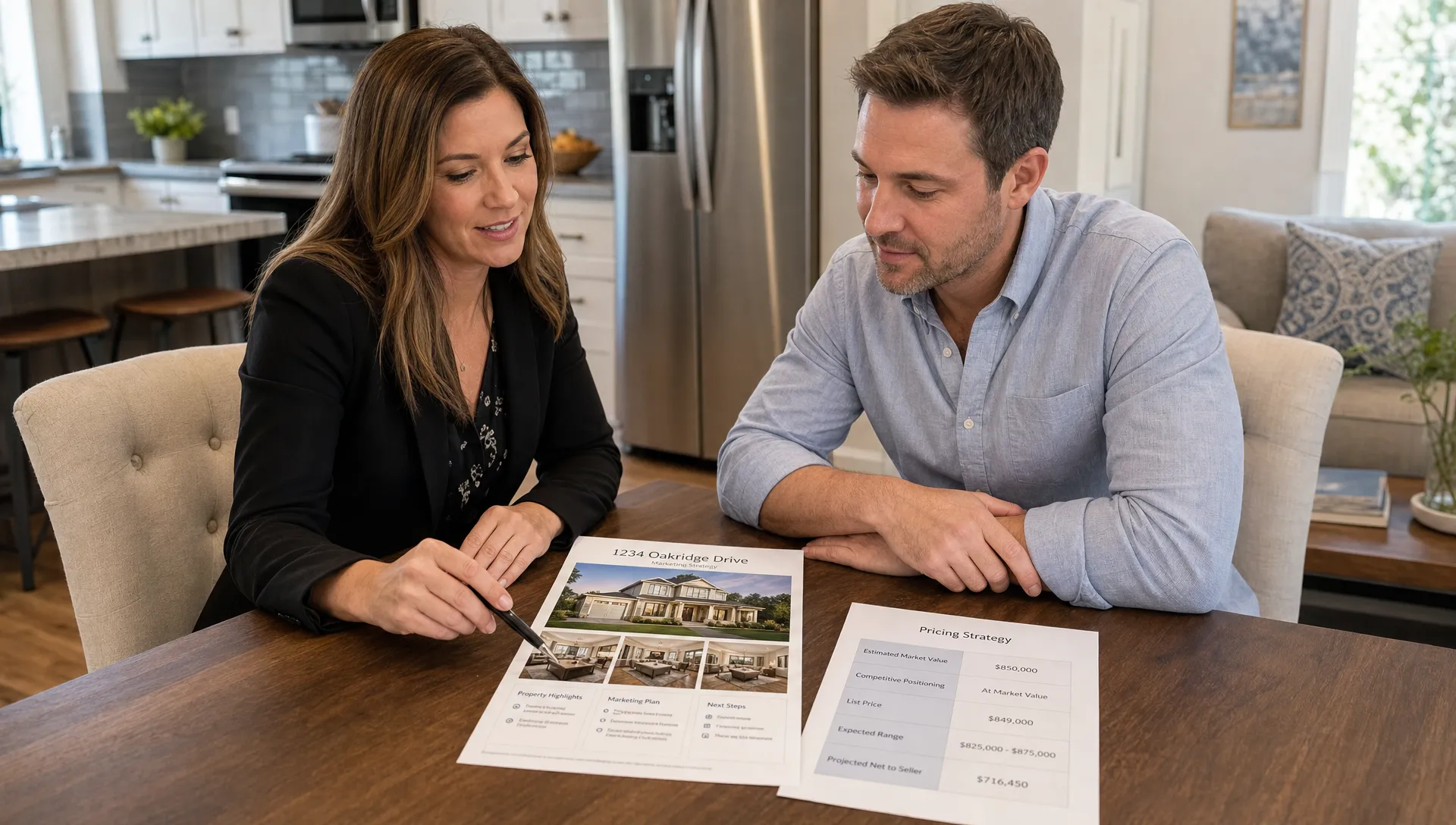
A strong leave-behind should reinforce your memory hook. Keep it short and visual. A one-page summary is usually more useful than a thick packet nobody reads.
Include the seller’s goal, your recommended positioning, the likely buyer profile, the launch sequence and the next decision they need to make. If you use video, send a short recap or sample listing reel that reflects the strategy you discussed. This gives the seller something concrete to remember and forward.
This is where AI video can support the pitch without replacing your judgment. Diane helps agents turn property listings, photos and details into ready-to-publish real estate videos with narration, avatars, branding, multilingual support and social formats. If your pitch promises modern presentation, your follow-up should look modern too. You can also explore how AI can turn listings into scroll-stopping videos when you want your marketing plan to feel more tangible to sellers.
Common mistakes that weaken a seller pitch
Even experienced agents can lose the room by making the pitch too broad or too self-focused.
Watch for these mistakes:
- Opening with your awards before defining the seller’s problem. Your track record supports the pitch, but it should not replace the strategy.
- Using the same presentation for every home. Sellers can tell when a pitch is templated. Personalize the buyer story, the risks and the launch plan.
- Overpromising on price. A memorable pitch should increase confidence, not create unrealistic expectations that damage trust later.
- Talking about marketing channels without explaining why they matter. “Instagram, portals and email” is a list. “We will use short video to make the layout clear before showings” is a reason.
- Leaving without a clear next step. End with the decision, the timeline and what happens if they choose you.
The goal is not to sound clever. The goal is to make the seller feel that choosing you reduces uncertainty.
A quick checklist before your next listing appointment
Before you present, ask yourself five questions:
| Question | Why it matters |
|---|---|
| Can I summarize the seller’s real goal in one sentence? | It proves the pitch is about them, not just the listing |
| Do I have a clear buyer story for the property? | It makes the home easier to remember and market |
| Can I explain my pricing logic simply? | It builds trust without overwhelming the seller |
| Do I have proof that matches this seller’s concern? | It makes your value concrete |
| Is my follow-up easy to review and share? | It keeps your pitch alive after the meeting |
If you cannot answer one of these, refine the pitch before you arrive. Sellers may forgive a missing slide. They are less likely to forgive a presentation that feels interchangeable.
Frequently Asked Questions
What should a real estate agent pitch include? A strong pitch should include the seller’s goal, a clear buyer profile, pricing logic, a property-specific marketing strategy, proof of execution and a simple next step. The best pitches feel tailored rather than scripted.
How long should a listing pitch be? The conversation can take 45 to 90 minutes depending on the property and seller, but the core pitch should be simple enough to summarize in a few minutes. If the seller cannot repeat your strategy afterward, it is probably too complicated.
How do I make my real estate agent pitch stand out? Replace generic claims with a specific point of view. Show how you would position the home, what buyers will notice, what objections may come up and how your marketing will address those issues.
Should I use video in a seller pitch? Yes, when it supports the strategy. A sample listing video, short recap or visual marketing example helps sellers understand how you will present their home online and makes your pitch easier to remember.
Make your next seller pitch easier to remember
A seller will not remember every comparable sale, every slide or every marketing channel you mention. They will remember how clearly you explained their home, their likely buyer and the path from listing to offer.
If your pitch includes video as part of that plan, make sure the execution matches the promise. Diane helps real estate agents create polished listing videos from property details, photos and listings, so your seller presentation can lead naturally into marketing assets that feel ready for today’s market.