
How to Choose a Real Estate Agent Platform for Content
A real estate agent platform can save hours every week, but only if it matches the way you create, approve and publish content. The mistake many agents make is choosing a tool because it has the longest feature list, then discovering that it adds one more login, one more workflow and one more unfinished task.
For content, the right platform should do something simpler and more valuable: help you turn listings, photos, local knowledge and agent expertise into polished marketing assets that buyers and sellers actually see.
That might mean listing videos, short social reels, narrated walkthroughs, neighborhood clips, seller update content, recruiting posts or multilingual versions for international buyers. The best choice depends less on the category label and more on whether the platform can help you publish consistently without watering down your brand.
Start by defining what content means in your business
A real estate agent platform for content is not the same thing as a CRM, transaction system or lead database. Some platforms try to cover everything, but content tools have a specific job: they turn raw property and market information into assets you can publish.
Before comparing products, write down the content you actually need to produce each week. An independent agent might need one listing reel, three social posts and a seller prospecting video. A small agency owner might need every negotiator to publish branded listing videos without each person inventing a different style. A solo listing specialist might need repeatable property launch content that can be created as soon as photography arrives.
The clearer the content job, the easier the buying decision becomes. You are not looking for the most impressive demo. You are looking for the platform that removes the most friction from your real workflow.
Map the workflow from listing intake to published content
Most content problems are workflow problems. A listing exists in one place, photos sit in another, the description needs rewriting, the agent has no time to record voiceover and the final asset never makes it to the channels where buyers spend time.
When evaluating a platform, trace the full path:
- Where does the property information come from?
- How are photos, details and key selling points imported?
- Who writes or edits the script?
- How is the agent, agency or brokerage brand applied?
- Who approves the final version?
- Where is the content published?
- How is performance reviewed after publishing?
If a platform only solves one step, it may still be useful, but you need to understand the hidden work around it. A beautiful video editor that requires manual copy-pasting from every listing can become slow fast. A social scheduler that cannot help create content may not solve your core production issue.
Prioritize listing-to-content speed
For most real estate agents, the listing is the center of the content engine. A signed mandate or new property listing creates a time-sensitive marketing window. The faster you can turn photos and property details into a professional asset, the more useful the platform becomes.
Look for a system that can start from the materials you already have: listing descriptions, property facts, images, amenities, location details and agent notes. Strong platforms reduce blank-page work. They should create a solid first draft, then let you adjust tone, sequence, claims and calls to action.
This matters because content delays compound. If a video takes three days, the agent may skip it. If it takes minutes to reach a ready-to-edit draft, the behavior changes. For a more video-specific buying checklist, Diane’s guide on choosing a real estate platform for listing video covers the production side in more depth.
Choose formats based on buyer behavior, not team preference
Your platform should help you publish where attention already exists. That usually means vertical short-form video for social discovery, polished listing videos for property pages, concise clips for email follow-up and branded assets for seller presentations.
Do not choose a tool just because it creates one impressive format. A cinematic horizontal video can be useful, but it will not replace a vertical reel on Instagram, TikTok, YouTube Shorts or Facebook. Likewise, a short reel may generate attention but cannot carry every detail a motivated buyer needs.
Listing destinations also vary by market. If you work with overseas buyers, investors or relocation clients, study how properties are presented on major portals and marketplaces such as Best Property's Dubai and UAE real estate marketplace, then choose a content platform that complements those listing pages with clearer video, narration and shareable social assets.
The goal is not to copy the listing page. The goal is to make the property easier to understand, remember and share. Diane’s article on using video alongside real estate listing sites is a useful companion if your content strategy depends heavily on portals.
Evaluate brand control before you evaluate templates
Templates are helpful, but only if they protect your brand. Real estate content carries trust signals: your name, voice, face, colors, logo, listing style and local positioning. If every agent in an agency uses a different font, intro style and tone, the brand becomes harder to recognize.
For independent agents, brand control is about personal recognition. Buyers and sellers should connect the property content with you, not with a generic template. For agency owners, brand control is also a quality system. It helps every listing look professional even when different agents have different design instincts.
Ask whether the platform supports consistent branding across formats. Also check how much flexibility agents have. Too much freedom creates inconsistency. Too little freedom makes content feel canned. The best setup gives agents room to personalize the message while keeping the visual identity stable.
Treat AI as an assistant, not an autopilot
AI can dramatically reduce production time, especially for scripts, narration, avatar presentation, editing, translations and staging concepts. Still, real estate content must be accurate. A platform should make human review easy because property marketing is full of details that matter: square footage, legal terms, renovations, views, school zones, amenities and neighborhood claims.
When testing AI features, look beyond the novelty. A voice clone is only useful if pronunciation, pacing and tone sound credible. An avatar is only useful if it supports trust rather than distracting from the property. A translated video is only useful if local terms, currency references and buyer expectations are handled carefully.
Your selection criteria should include editability. If the AI output is hard to change, the platform may create risk. If the AI gives you a strong draft that an agent can review quickly, it can become a practical production advantage.
Use a simple scorecard when comparing platforms
A scorecard keeps the decision grounded. Instead of asking whether a platform is good in general, test whether it supports the work your team repeats every week.
| Capability | What to check | Why it matters |
|---|---|---|
| Listing intake | Can it use existing listing details, photos and property notes? | Reduces manual setup and speeds up launches. |
| Content generation | Can it create scripts, videos or social assets from listing materials? | Removes blank-page work for busy agents. |
| Editing control | Can agents adjust claims, tone, order and calls to action? | Keeps content accurate and locally relevant. |
| Brand consistency | Can logos, colors, intros and style rules stay consistent? | Protects recognition across agents and listings. |
| Channel formats | Can it create assets for social, listing pages and follow-up? | Helps one listing support several marketing moments. |
| Team workflow | Can owners or managers review content before publishing? | Supports quality control as production scales. |
| Language support | Can it support buyers in more than one language when needed? | Helps agents serve cross-border and relocation audiences. |
| Measurement | Can performance be reviewed directly or through channel analytics? | Helps agents repeat what attracts leads. |

Match the platform to your role
The best real estate agent platform for content is not identical for every user. Your business model should shape the decision.
| User type | Main content challenge | Platform priority |
|---|---|---|
| Independent agent | Creating enough content without losing selling time | Fast listing-to-video creation and reusable personal branding |
| Agency-employed sales agent | Standing out while following agency standards | Branded templates, easy approvals and social-ready formats |
| Solo listing specialist | Launching polished assets for every property | Reliable listing intake, editing control and repeatable quality |
| Independent agency owner | Scaling content across agents without brand drift | Shared brand rules, team workflow and consistent output |
If you are a solo agent, you may value speed above everything. If you manage a team, consistency may matter more than creative freedom. If you work luxury, international or investment listings, multilingual support and presentation quality may be more important than volume.
Check publishing fit before you commit
Content creation is only half the job. A platform should help you get assets into the channels that produce visibility, inquiries and listing appointments.
For social media, check whether the platform supports the formats you actually use. Vertical video, captions, thumbnails and shorter edits can make a major difference in whether content gets watched. For email and lead follow-up, you may need assets that explain a property quickly without asking the prospect to read a full listing page. For seller prospecting, you may need examples that prove how you would market their home.
The call to action also matters. A listing reel should not end vaguely. Depending on the goal, it might invite viewers to book a showing, request a floor plan, send a direct message, view the full listing or ask for a valuation. If lead generation is the priority, Diane’s guide to video strategies for lead generation in real estate can help you connect content formats to specific lead outcomes.
Watch for common red flags
A platform may look strong in a demo and still fail in daily use. Pay attention to the issues that tend to appear after the first few weeks.
One red flag is heavy manual setup. If every listing requires re-entering details, resizing assets and rewriting scripts from scratch, the platform may not be built around real estate workflows.
Another red flag is generic output. Buyers can recognize bland marketing language quickly. The platform should help you highlight what is specific about the property: light, layout, renovation quality, location, lifestyle and buyer fit.
A third red flag is weak review control. Real estate content can create trust or damage it. If an agent cannot easily correct an AI-generated statement, change a sequence or remove an unsupported claim, the tool is risky.
Also be careful with platforms that focus only on aesthetics. Visual quality matters, but a content platform must support speed, accuracy, branding and distribution. Otherwise, it becomes a design tool rather than a real estate marketing system.
Where Diane fits in the decision
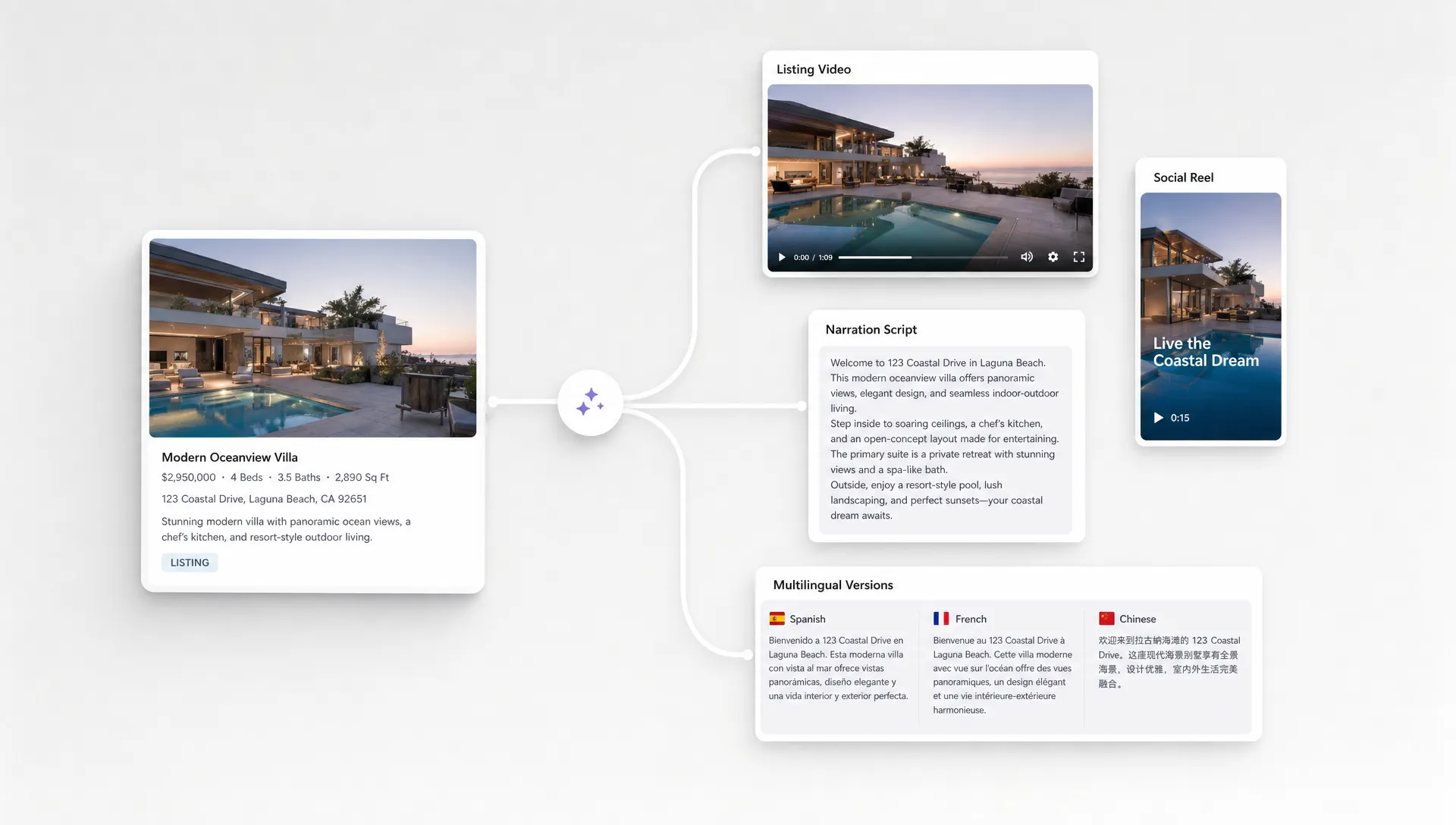
If your priority is turning property listings into publishable videos, Diane is designed for that specific content workflow. It generates real estate videos from listings, photos and property details, with options such as AI avatar presentation, voice cloning narration, multilingual video support, virtual home staging, cinematic AI editing, social media formats, custom real estate branding and direct social publishing.
That makes Diane especially relevant for agents and agencies that want listing content to move faster without building a full studio process around every property. It is not a substitute for agent judgment, compliance review or local market expertise. It is a way to turn the materials you already have into polished marketing videos more consistently.
When evaluating Diane or any other platform, use a real listing as your test. Import or recreate the property details, generate the content, edit it, brand it and prepare it for publication. The right platform should feel like it shortens the distance between listing launch and market visibility.
Frequently Asked Questions
What is a real estate agent platform for content? A real estate agent platform for content helps agents create, adapt and publish marketing assets such as listing videos, social reels, narrated property presentations, email clips and branded seller content. It is different from a CRM or transaction platform because its main job is content production and distribution.
Do I need a content platform if I already use a CRM? You may still need one if your CRM does not help you create publishable assets. A CRM can organize contacts and follow-up, but many agents need a separate tool to turn listings, photos and market knowledge into videos or social posts.
What AI features matter most for real estate content? The most useful AI features are the ones that reduce repetitive work while keeping the agent in control. Look for listing-based content generation, editable scripts, narration options, multilingual support, brand controls and review tools that make accuracy easy to verify.
How should an agency owner evaluate a platform differently from a solo agent? Agency owners should focus on consistency, approvals, brand control and team adoption. A solo agent may choose the fastest tool for personal output, but an agency owner needs a system that works across multiple agents without creating brand drift.
Can one platform handle both listing content and agent branding? It can, but only if it supports both property-specific assets and consistent personal or agency branding. During a trial, test a new listing video, a social version and a seller-facing example to see whether the platform can support more than one use case.
Turn listings into content your market can actually see
Choosing a real estate agent platform for content is ultimately about repeatability. If the tool helps you launch faster, stay on brand, speak to the right buyers and publish in the right formats, it can become part of your listing process rather than another marketing experiment.
If video is the content gap you want to close first, Diane can help you turn listings, photos and property details into ready-to-publish real estate videos with AI narration, avatars, branding and social formats built for agents and agencies.