
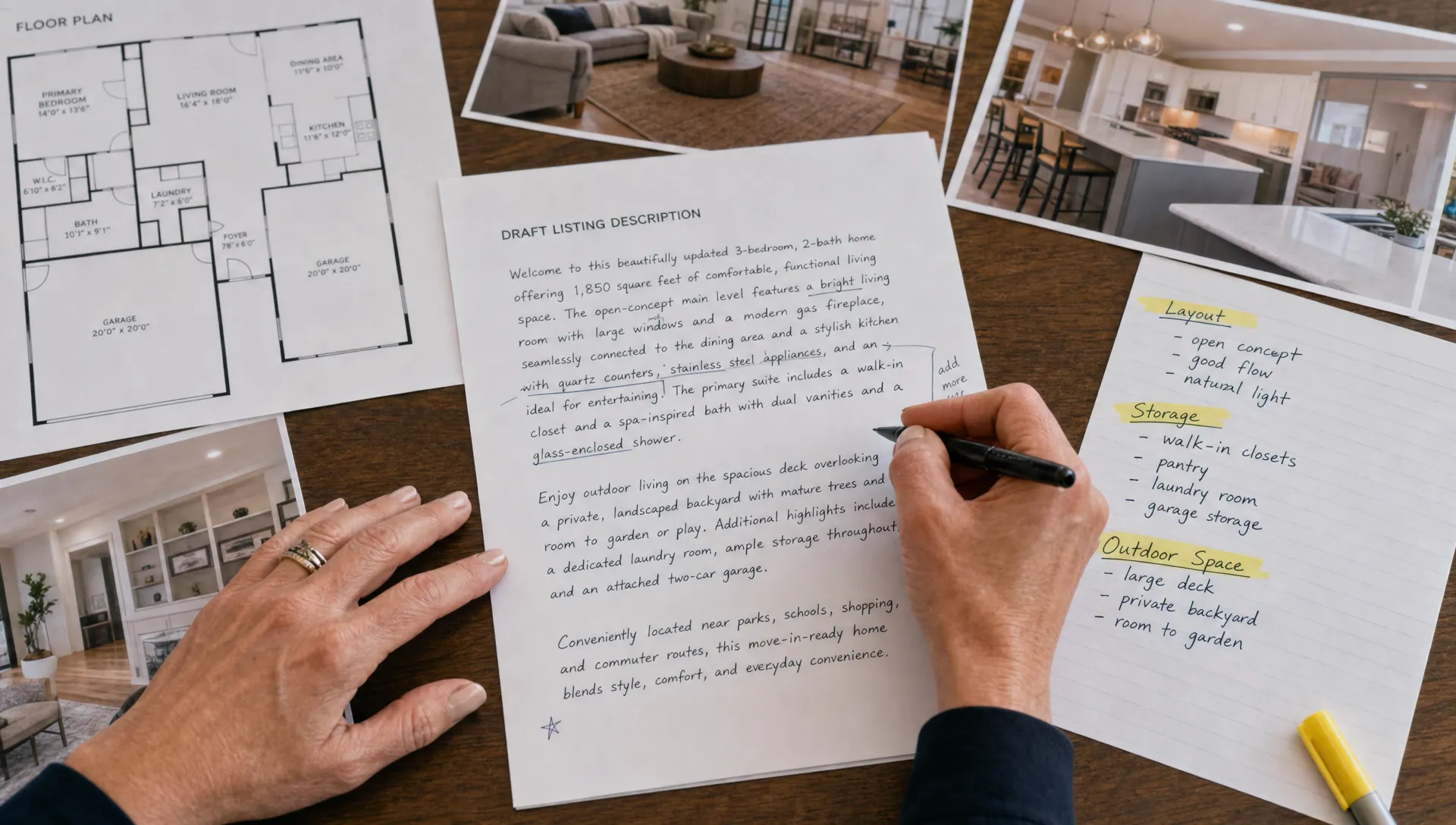
How to Write a Property Listing Description Buyers Want to Read
Most buyers do not read listing copy from top to bottom. They scan the first line, check whether the home fits their life, look back at the photos, then decide whether to save, share or book a viewing. A strong property listing description respects that behavior.
Your job is not to write the longest paragraph on the portal. It is to help a buyer understand the home faster than the competing listings around it. That means clarity before cleverness, specifics before hype and a structure that works on MLS pages, agency websites, social posts and video scripts.
Start With What Buyers Are Trying to Decide
Before you write, ask what the buyer needs to know in the first 20 seconds. Most buyers are sorting listings by a mix of price, location, layout, condition and lifestyle fit. They are not looking for a poetic description of a “must-see gem.” They are trying to answer practical questions.
A buyer usually wants to know:
- Does the layout fit my household or plans?
- Is the home move-in ready or a project?
- What makes this property different from the others at the same price?
- How does the location affect daily life?
- Is there enough reason to request a viewing?
That last question matters most. The purpose of a property listing description is not to explain every inch of the home. It is to create enough confidence and curiosity for the next action.
If you want a broader look at online presentation, Diane’s guide to how to make real estate listings stand out online pairs well with the writing principles below.
Choose One Buyer Promise Before You Write
Many weak listing descriptions fail because they try to sell every feature equally. The result feels generic: spacious, charming, beautiful, well located, perfect for everyone. Buyers do not remember that.
Instead, choose one clear promise. This is the main reason the right buyer should care.
For example:
- “Low-maintenance city living close to transit”
- “A family layout with flexible work-from-home space”
- “A renovated period home with original character preserved”
- “A lock-and-leave apartment with strong rental appeal”
- “A private outdoor setting minutes from everyday amenities”
This promise should come from the property, not from your imagination. Look at the photos, floor plan, seller notes and neighborhood context. Then decide what the home is best at.
A good property listing description keeps returning to that promise without repeating it word for word. The opening line introduces it, the middle proves it and the closing call to action invites buyers to experience it.
Use a Simple Structure Buyers Can Scan
A reliable listing description does not need a complicated formula. It needs an order that matches buyer attention.
Use this structure for most homes:
| Section | What it should do | Example focus |
|---|---|---|
| Opening sentence | State the strongest buyer benefit | Light-filled corner apartment near transit |
| Layout summary | Explain how the home lives | Open kitchen, three bedrooms, separate office |
| Key features | Add proof and useful details | Updated appliances, storage, parking, garden |
| Location context | Connect the address to daily life | Schools, parks, commute routes, shops |
| Call to action | Prompt the next step | Book a private viewing or request the floor plan |
This order prevents the common mistake of opening with a bland property type. “Welcome to this beautiful home” wastes your most valuable line. Buyers already know it is a home. Tell them why this one deserves attention.
Write an Opening Line That Earns the Next Line
The first sentence should combine the home’s best feature with the buyer benefit. It should be specific enough to feel credible and short enough to scan.
Weak opening:
“Don’t miss this stunning 3-bedroom property in a sought-after location.”
Stronger opening:
“Set on a quiet residential street, this three-bedroom home combines a sunny open-plan living area with a private fenced garden and off-street parking.”
The stronger version gives the buyer immediate information. It says something about setting, layout, light, outdoor space and practicality. It does not rely on empty adjectives.
Here are a few opening line patterns you can adapt:
- “Designed for low-maintenance living, this [property type] offers [main feature] with [daily-life benefit].”
- “Just moments from [location advantage], this [bedroom count] home pairs [feature] with [feature].”
- “With [layout feature], [outdoor feature] and [parking or storage feature], this home is well suited to buyers seeking [lifestyle fit].”
A property listing description should sound polished, but it should not sound like it was written for every home in your inventory. If the opening line could apply to 20 listings, sharpen it.
Turn Features Into Benefits Without Overwriting
Buyers need features, but they remember benefits. The trick is to connect the two without making unsupported claims.
“Large windows” becomes more useful when you explain that they bring natural light into the living area. “Separate entrance” becomes more compelling when it supports guest privacy, rental flexibility or a home office, if that use is realistic and compliant with local rules.
| Feature-only copy | Buyer-focused copy | Why it works |
|---|---|---|
| “Updated kitchen.” | “The updated kitchen includes generous counter space and opens directly to the dining area.” | Adds function and flow |
| “Great backyard.” | “A fenced backyard gives you usable outdoor space for dining, pets or play.” | Shows possible everyday uses |
| “Close to transport.” | “The home is within easy reach of commuter routes and daily services.” | Makes location practical |
| “Lots of storage.” | “Built-in wardrobes and a garage storage area help keep living spaces clear.” | Connects storage to comfort |
| “Luxury finishes.” | “Stone counters, wide-plank flooring and recessed lighting create a clean, modern finish.” | Replaces vague luxury with details |
You do not need to turn every feature into a lifestyle sentence. Too much interpretation can feel inflated. Use buyer benefits where they clarify value, then let concrete details do the rest.
Keep the Description Short Enough to Finish
A common mistake is treating the listing description as a full property brochure. On portals and mobile screens, dense blocks of text lose readers quickly.
For most residential listings, aim for three to five short paragraphs. Luxury, rural, investment or architect-designed properties may need more detail, but even then, clarity beats length.
A clean structure might look like this:
- Paragraph one introduces the main promise and strongest features.
- Paragraph two explains the layout and how the spaces connect.
- Paragraph three covers condition, outdoor space, parking, storage or building amenities.
- Paragraph four adds location context and a clear viewing prompt.
If a detail is already obvious in the photos, do not spend too much space describing it. Use the description to explain what photos cannot fully communicate: flow, privacy, orientation, updates, commute convenience, storage and daily usability.
Make It Searchable, But Do Not Write for Robots
Search visibility matters, especially on agency websites and property portals where buyers filter heavily. Still, awkward keyword repetition makes copy harder to read and can weaken trust.
Use natural terms buyers actually search or scan for, such as the property type, bedroom count, neighborhood, outdoor space, parking, school zone, renovation status, views, building amenities or commute access. Mention them where they belong.
A property listing description can support search while still sounding human. For example, “two-bedroom apartment with secure parking in Midtown” reads naturally. Repeating “two-bedroom apartment Midtown secure parking” several times does not.
Think of listing writing as a repeatable professional skill. The same way certification learners improve with structured guides, practice and progress tracking, agents improve listing copy by using a clear rubric, testing openings and reviewing which descriptions generate saves, inquiries and viewings.
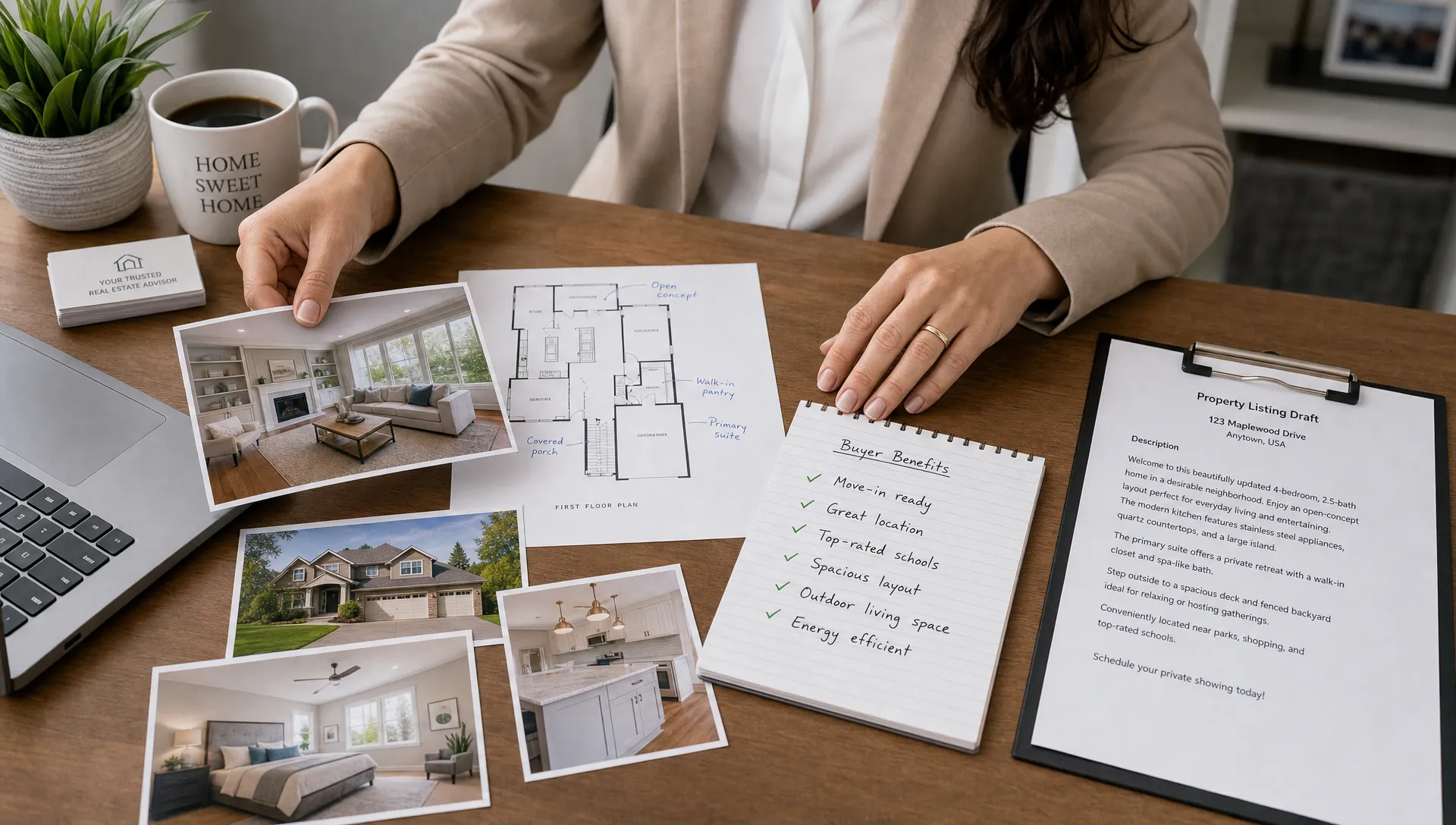
Be Accurate, Compliant and Fair
Good listing copy creates interest, but it should never create risk. Accuracy is part of trust. If you describe a room as a bedroom, confirm it meets local requirements. If you mention square footage, renovations, zoning, rental potential, parking rights or school catchments, make sure the information is verified and up to date.
Fair housing and anti-discrimination rules also affect wording. Avoid language that implies a preferred buyer, tenant or household type. Instead of “perfect for young families,” describe the features: “three bedrooms, a fenced garden and a nearby park.” Instead of “ideal bachelor pad,” describe the layout, finishes and location.
This shift improves compliance and makes the copy more useful. You are selling property characteristics, not selecting who belongs in the home.
Replace Empty Adjectives With Evidence
Real estate copy has a vocabulary problem. Words like stunning, charming, rare, immaculate and desirable can work in moderation, but they lose force when every listing uses them.
Evidence is stronger than praise.
Instead of writing “stunning views,” specify what the buyer sees and from where: “The living room and balcony look across the tree-lined street toward the park.” Instead of “immaculate condition,” mention “fresh interior paint, refinished flooring and updated bathroom fixtures.”
This does not mean your copy should feel flat. It means the emotional pull should come from believable details. A buyer can picture morning light in the kitchen, a quiet office at the back of the home or a balcony that fits a small dining set. They cannot picture “unmissable opportunity” with the same confidence.
Use a Final Call to Action That Matches the Listing
The closing line should tell the buyer what to do next. Many agents end with “book your inspection today,” which is fine, but you can make the prompt more relevant.
Examples:
- “Request the floor plan and arrange a private viewing to see how the layout works in person.”
- “Contact the listing agent for current disclosures, showing availability and offer timing.”
- “Schedule a tour to experience the garden, natural light and quiet street setting firsthand.”
- “Ask for the rental estimate and building information if you are comparing investment options.”
The best call to action removes friction. It tells buyers what they will receive or experience when they contact you.
Edit With a Listing Copy Checklist
Before publishing, read the description as if you were a busy buyer comparing several similar homes. Then run a quick edit.
Check whether the copy:
- Leads with the strongest buyer-relevant benefit
- Includes specific features rather than generic praise
- Explains layout, flow and daily usability
- Mentions verified location advantages
- Avoids discriminatory or unsupported language
- Matches the photos, floor plan and listing data
- Uses short paragraphs for mobile scanning
- Ends with a clear next step
This checklist is especially useful for independent agents and small agency teams because it creates consistency. You can still adjust tone for each property, but the quality standard stays the same.
Turn Your Description Into a Stronger Video Script
Once your written copy is clear, it becomes the foundation for other marketing assets. A concise description can turn into a social caption, email teaser, voiceover script or short listing video.
This is where many agents get extra value from better writing. A weak paragraph produces a weak narration. A buyer-focused structure gives your video a natural sequence: hook, layout, standout features, location and call to action.
If you are planning to use video, Diane’s guide on how to turn property listings into videos buyers want to watch shows how to adapt listing details into a more visual format without simply reading the MLS copy aloud.
Frequently Asked Questions
How long should a property listing description be? Most residential listings work best at three to five short paragraphs. The goal is to give buyers enough useful information to request a viewing, not to include every detail in the first read.
What should the first sentence include? Lead with the strongest buyer benefit, supported by a concrete feature. Mention the property type, location advantage or standout lifestyle detail only if it helps the buyer understand why the home is worth attention.
Should I use emotional language in listing copy? Yes, but keep it grounded. Phrases that help buyers imagine daily life can be effective, but vague hype is less persuasive than specific details about light, layout, storage, outdoor space and location.
Can AI write a property listing description? AI can help draft, restructure and repurpose listing copy, but agents should always verify facts, adjust tone and confirm compliance. The best results come from combining accurate property details with a clear buyer-focused brief.
How do I make a listing description work better for video? Write in a logical viewing order. Start with the hook, move through the main spaces, highlight standout features, add location context and finish with the viewing prompt. That same sequence can become a short narration.
Turn Better Listing Copy Into Better Listing Videos
When your property listing description is clear, specific and buyer-focused, it becomes much easier to market the home across channels. You can use the same core message for your portal listing, website page, social caption and video narration.
Diane helps agents and agencies turn listing details, photos and property information into ready-to-publish real estate videos with AI narration, avatars, cinematic editing, branding and social formats. Start with better words, then let your listing work harder everywhere buyers are watching.